

BANGLADESH
Overview
The first information on SRI was brought to Bangladesh in 1999 by a CARE/Bangladesh employee who circulated a paper by N. Uphoff within NGO and government circles after she attended a conference in Bellagio, Italy. During 1999-2001, CARE/Bangladesh and the Department of Agricultural Extension (DAE) introduced SRI to farmers with whom they were working in Kishorganj District (first boro season average of 6.5-7.5 t/ha), the Bangladesh Rice Research Institute (BRRI) documented a 1 t/ha yield increase and Bangladesh Rural Advancement Committee (BRAC) initiated its own trials. In January 2002, a meeting hosted by BRAC brought together public sector, NGO and private sector institutions and resulted in the formation of a national SRI working group and steering committee which gave rise to national SRI workshops in 2002 and 2003. The steering committee was composed of BRRI, DAE, BRAC, CARE, and Syngenta/Bangladesh, which had also tried SRI methods for two years and found them beneficial, particularly for seed multiplication. Other 2003-2004 evaluations were undertaken by BRAC (2003), SAFE Group (2003), and PETRRA (2004).
During 2006, a meeting of the Bangladesh SRI National Steering Committee hosted in Dhaka by ActionAid resulted in the establishment of a SRI National Network Bangladesh (NBB) which subsequently was funded by the Asian Development Bank to undertake SRI trials in different regions of the country. A national workshop on October 11, 2006, was convened by the SRI NNB with cosponsorship and support from Oxfam GB Bangladesh. ActionAid/Bangladesh 2006 reports from several districts showed positive results with SRI. According to 2006 and 2007 reports, various partner NGOs of Oxfam GB Bangladesh (SSUS, ZIBIKA, SKS, GUK, RSDA, Padakhep and POPI) implemented SRI with resource-poor farmers in the northern Char region and the northeastern Haor region with good results. A national SRI workshop was held in 2008 was chaired by the Secretary of Agriculture. The most recent national SRI workshop, which was jointly organized by SRI National Network Bangladesh (SRI NNB) and BRRI, was held at the Bangladesh Rice Research Institute on April 28, 2010. Future plans included an integrated and coordinated program approach by government (research and extension) and NGOs (national and international) for promotion of SRI in Bangladesh. (Revised proceedings were made available in 2012). For a more details rendition of the history of SRI in Bangladesh, see Muazzam Husain's 2015 update on behalf of the SRI NNB.
A 2015 research project involving 3,000 farmers was undertaken to understand SRI adoption in 180 villages associated with BRAC. The results showed that when provided with the incentives, 50% (one in two) of the referred farmers adopted the SRI techniques. Though SRI techniques involve some additional labor for managing practices, the profit remains significantly higher (33%) than the traditional farming, even with less-than-perfect adoption of SRI. The findings were reported in a January 15, 2017, seminar in Dhaka. In 2016, the Water Management Project of the Department of Agricultural Extension (DAE) began a country-wide SRI program in 90 sub-districts in 45 districts to educate and demonstrate to farmers how rice production can be increased through the SRI approach. A 2020 report by Barrett et al showed that greater intensity of training exposure to SRI has a sizable effect on farmers’ likelihood to adopt (and not to disadopt) SRI. They also found a significant spillover learning from trained to untrained farmers as well as large, positive and significant impacts of SRI training on rice yields, revenues, costs, and profits for both trained and untrained farmers in training villages. During 2021, a report from the SRI National Network Bangladesh (SRINNB) noted that, after a decade of training by the NGO ADRA (in conjunction with the Dept. of Agricultural Extension (DAE)), 2,000 farmers in Mymensingh and Manikganj regions are now using SRI methods.
Progress and Activities (2010-2022)
2022 Updates
-
 SRI Study Shows Positive Outcomes for SRI on Methane Emission and Heavy Metal Reduction
[October 25, 2022] A 2022 article by Borna et al in the European Journal of Agriculture and Food Sciences considers the influence of rice establishment methods (SRI, AWD, *DSWR, and conventional) on water productivity, methane emissions and rice grain heavy metal content from irrigated rice paddies in Bangladesh. A field experiment was conducted at Bangladesh Agricultural University, Mymensingh, during the Boro season in 2018 to examine whether rice establishment methods could maintain grain yield with reduced water use and CH4 emissions. The yield difference was not significant (p>0.05) in CF, AWD, and SRI systems other than DWSR. Planting methods in combination with organic fertilizer amendment had little effect on the grain Fe, Zn, and Cd concentration but significantly affected the As concentration. AWD, SRI, and DWSR significantly reduced the total water use by 17-33% and increased water productivity by 22-35% compared to CF. SRI performed superior (p>0.05) by increasing the water productivity coupled with reducing water consumption compared to CF. The impact of water management on changing climate in rice fields was compared using seasonal CH4 emission and yield-scaled global warming potential (GWP). Total seasonal CH4 memissions were significantly distinct from different rice establishment methods. Seasonal CH4 emissions from CF, AWD, SRI, and DWSR systems were 147.85, 128.11, 110.35, and 91.52kg CH4 ha-1, respectively. Emissions were reduced by about 13-38% in contrast with continuous flooded soil. The emissions of greenhouse gases per unit grain yield (yield-scaled GWP) followed the order; CF>AWD>DWSR>SRI, while reducing yield-scaled emissions from AWD, SRI and DWSR decreased around 15-25% over that of the CF system. In conclusion,the authors suggest that the AWD and SRI treatments can potentially reduce CH4 emissions, water use, grain As content, and increase grain yield. [See full article in the European Journal of Agriculture and Food Sciences for details].
(* DSWR = direct seeded wet rice).
2021
-
Peer-to-Peer Farmer Extension Show Good Results in SRI Study
[October 15, 2021] A recent article by Fafchamps et al in the World Bank Economic Review reports on a randomized controlled experiment in which farmers trained on System of Rice Intensification methods teach two other farmers. The results show that the intervention increases yields and farm profits among treated farmers. Teacher-trainees are effective at spreading knowledge and inducing adoption relative to just training. Incentivizing teacher-trainees improves knowledge transmission but not adoption. Interestingly matching teacher-trainees with farmers who list them as role models does not improve knowledge transmission and may hurt adoption. The study finds that the knowledge of the teacher-trainee is correlated with that of their students, consistent with knowledge transmission. The paper also finds that SRI knowledge predicts adoption of some SRI practices, and that adoption by teacher-trainees predicts adoption by their students, suggesting that students follow the example of their teacher. The authors conclude that, with cost-benefit estimates of social returns in excess of 100 percent, explicitly mobilizing peer-to-peer (P2P) with transmission of knowledge seems a cost-effective way of inducing the adoption of new profitable agricultural practices. [See World Bank Economic Review article.]
-
ADRA’s SRI Progress in Bangladesh
[September 20, 2021] Gopal Chowhan, Member SRI National Network Bangladesh (SRINNB), recently reported on the progress of the NGO ADRA's decade-long promotion of SRI in Mymens
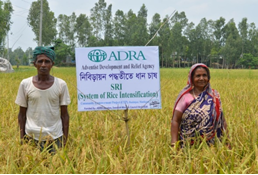 ingh and Manikganj regions of Bangladesh. ADRA's SRI activities, which use Participatory Action Research (PAR) approaches, are carried out in collaboration with the Department of Agricultural Extension (DAE) of Ministry of Agriculture. ADRA’s program staff provided farmer training and SRI demonstrations and subsequently shared results during the crop harvest with community farmers. The higher yield obtained in the SRI fields compared to traditional fields, which surprised farmers, encouraged them to adopt SRI methods. SRI differered by spacing (25cm x 25cm for SRI vs 15cm x 15cm for the traditional method), fewer seedling per hill (1-2 seedlings per hill with SRI vs the traditional 4-5 seedlings per hill), and younger seedlings (20 day-old seedlings for winter SRI rice vs 30+-day-old seedlings for traditional/control). The SRI plots also applied alternate wetting and drying irrigation and used manual rotary weeders. The average yield from the SRI fields was around 25% higher than the control plots, whereas production cost was almost same. However, the farmers opined that SRI production costs might be reduced further by using less irrigation and fewer seedlings in the field.
In Manikganj area, during the 2020 Boro (winter) rice season, a total of 94 farmers were trained in SRI methods; 468 farmers followed SRI methods in their 7,826 decimals area with the two rice varieties released from Bangladesh Rice Research Institute (BRRI) BRRI-Dhan29 and 58. Yields of the SRI fields averaged 35 kilogram per decimal, while the control field was 28 kilogram per decimal. A 2020 ADRA video shows some of the progress in Manikganj.
Over the past 10 years, ADRA Mymensingh has trained several hundred farmers for the both monsoon and winter rice season. A total of 50 farmer SRI trial plots were demonstrated in the Amon (monsoon season) using BRRI Dhan 34, 49, 52, and 75 rice varieties. The SRI farmers achieved 35% higher rice yields compared to the control plots of traditional practice; the biomass production was 26% higher during the last Amon. Presently there are around 2,000 farmers following SRI cultivation methods, many of whom learned of SRI from ADRA-trained farmers. The number of farmers and the rice cultivation area for SRI method will doubtless continue to increase as a result of higher yields without any increase in production costs. [See Chowhan's report for more information. Also see 2020 ADRA SRI video.]
2020
-
Experimental Evidence on Adoption and Impact of the System of Rice Intensification
[October 15, 2020] A report by Barrett et al discusses results of what the authors believe to be the first large-scale, multi-year experimental evaluation of the System of Rice Intensification (SRI). They found that greater cross-sectional or intertemporal intensity of training exposure to SRI has a sizable effect on Bangladeshi farmers’ propensity to adopt (and not to disadopt) SRI, and, there is significant spillover learning from trained to untrained farmers. The researchers found large, positive and significant impacts of SRI training on rice yields, revenues, costs, and profits for both trained and untrained farmers in training villages. They also found strong positive impacts on various household well-being indicators. Despite the significant impacts on rice productivity and labor costs, they found no evidence of significant general equilibrium effects on rice prices or wage rates. The authors also report high rates of disadoption, and clear indications of non-random selection into technology adoption conditional on randomized exposure to training. Independent learning outside of BRAC’s formal SRI extension effort within villages appears somewhat limited except for the spacing of seedlings, which, along with AWD water management, is the most easily visible change of practice from traditional to SRI rice cultivation and thus most likely to be absorbed through passive learning from others. [See full 73 p. report, which is available on both Cornell and Monash University websites.]
-
Study in Gopalganj District Compares SRI and Conventional Rice Production Methods
[November 7, 2020] An article by Akondo et al in the Asian Plant Research Journal presented findings of an experiment conducted at BINA sub-station, Gopalganjto, to compare the performance of modified System of Rice Intensification (SRI) methods and conventional rice cultivation methods. In the SRI plots, 10 day-old seedlings were transplanted with 2 seedlings/hill, and the field condition was moist. (Note: SRI generally recommends transplanting single seedlings). In conventional plots 25 day-old seedlings, 3 per hill, were transplanted in fields that were kept flooded. In terms of plant height, tillers/hill and dry matter partitioning SRI performed better than the conventional method of rice cultivation. SRI showed better performance in terms of yield contributing characters than conventional cultivation method. SRI showed the highest yield (7 t/ha) than conventional (6.67 t/ha) cultivation method. [For details, see the full article.]
2019
-
Technology Adoption Study in Bangladesh Focuses on SRI
[July 28, 2019] A VOX policy brief by Islam et al focused on SRI as a case study for considering how information matters in adopting a new technology in Bangladesh. In collaboration with BRAC, an international development organization based in Bangladesh, a randomized controlled trial (RCT) was conducted over two years – 2014/15 (year 1) and 2015/16 (year 2) – in 120 villages across five districts in rural Bangladesh. A set of 60 villages were randomly allocated to one-year training
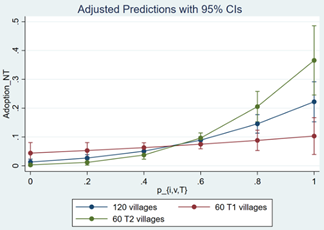 (referred to as T1 villages) and treated farmers only received one-time training in year 1. For the other 60 villages (referred to as T2 villages), treated farmers received the same training twice (i.e. in both the first and second year). Within each village some farmers were treated, and some were not. The model suggests that when untreated farmers receive more accurate and precise information about a new technology from their treated peers, they are more likely to adopt the new technology. In the model, the lower the variance of the noise of the quality of the technology, the more accurate the information transmitted to the untreated farmer, and the more likely the latter is to adopt the SRI. This implies that the T2-treated farmers provide the untreated farmers with a more accurate and precise information on SRI than the T1-treated farmers due to their more advanced training.
 It is well known that risk aversion plays an important role in new technology adoption, especially in poor socioeconomic context such the one in which field experiment was conducted. The experiments indicated that risk-averse untreated farmers are less likely to adopt than risk-loving untreated farmers. In addition, as the fraction of treated farmers increases, more untreated farmers adopt SRI; however, the more risk averse they are, the lower the impact of this is on the adoption rate of untreated farmers. The results suggest that untreated farmers who are more risk averse are less influenced by their treated peers. A trained farmer's impact on his untrained peers increases if he himself adopts SRI. More generally, the results indicate that the crucial determinants of adoption and diffusion of new technology are the accuracy and reliability of information transmission about the quality of technology circulated among farmers and their degree of risk aversion. In terms of policy implications, the authors believe that when a new technology is as complex as the SRI, most farmers will be reluctant to adopt it. The findings suggest that frequent information and training are the easiest ways to help disseminate a new technology and encourage its adoption. [See full policy brief; a more in depth journal article is in progress].
A PowerPoint presentation on the same project given by Chris Barrett on July 21 at the conference on Economics of Agricultural Technology & Innovation in Atlanta concluded that farmers seem to learn to whether to use SRI more than how to use SRI. While exposure had a pure scaling effect on adoption, additional information did not necessarily result in improvement of performance.
-
World Bank Seminar Summarizes Research Results on the Effects of Exposure Intensity on Technology Adoption and Gains from SRI Project in Bangladesh
[May 9, 2019] A World Bank presentation on May 9, 2019, reported on the results of a large-scale, multi-year experimental evaluation of the System of Rice Intensification (SRI). The researchers, which included Christopher Barrett (Cornell University), Asad Islam (Monash University), Abdul Malek (BRAC), Debayan Pakrashi (IIT, Kanpur), and Ummul Ruthbah (Dhaka University), found positive impacts of SRI on rice yields, profits, and various household well-being indicators. Using a randomized controlled trial with an innovative, multi-year, randomized saturation design, the research team found that greater cross-sectional or intertemporal intensity of exposure to the innovation has a sizable effect on Bangladeshi farmers’ propensity to adopt (and not to disadopt) SRI. There is significant spillover social learning by untrained farmers from trained farmers. But the biggest impacts on uptake and compliance with practices reportedly come through direct exposure, consistent with a complex contagion model of learning and technology diffusion. Average impacts of the technology, however, are invariant to exposure intensity, which seems to have mainly a scaling effect on diffusion of SRI, not an impact on performance with the technology. This finding appears most consistent with emerging models of multiple objective learning, as farmers quickly learn whether to adopt SRI but not necessarily how best to practice the method. [See event description]
An SSRN article by Asad Islam and other colleagues at Australian Universities report on the value of information in SRI adoption in Bangladesh. They developed and tested a theoretical model in which farmers' adoption decisions are based on their degree of risk aversion and on the information about the quality of a new technology received from other farmers. Experimental results showed that (treated) farmers who receive more training in terms of the quality of SRI, and thus have more accurate information about this technology, have a higher impact on the adoption rate of the untreated farmers. We also find that more risk-averse untreated farmers tend to adopt less and are less influenced by their treated peers. Finally, a trained farmer's impact on his untrained peers increases if he adopts himself the SRI methods. The results indicate that the crucial determinants of technology adoption for untreated farmers is their degree of risk aversion and the accuracy and reliability of the information transmission about the quality of the technology circulated among farmers. [See article By Islam et al entitled: The Value of Information in Technology adoption: Theory and evidence from Bangladesh.]
2018
- BBC Reports on an Alliance of Researchers Proving SRI's Value
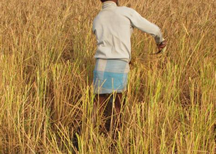 [August 6, 2018] An article on the BBC future website reported on an initiative envisioned by Dr. Asadul Islam, an Associate Professor at the Department of Economics at Monash Business School, who set out to look for a way to produce more rice to feed more people.
Together with a team of collaborators from a non-governmental organization in Bangladesh, BRAC, Cornell University, the Indian Institute of Technology Kanpur, and Monash Business School, Dr Islam has collected the data to show that the System of Rice Intensification (SRI) production method improves rice yields by more than 50 per cent for Bangladesh farmers, without requiring additional investment such as seed, chemical fertilizer or increased irrigation. Dr Islam has long suspected that SRI holds potential for Bangladesh, but lacked the data to prove it. According to the article, more than 70 per cent of the workforce in Bangladesh relies on agriculture for their livelihood and spend more than 60 per cent of their food budget on rice, so he felt that the study made good sense.
Over a two-year period, Dr Islam and his collaborators implemented a large, randomized trial in Bangladesh. To do that, they had to persuade farmers to set aside methods they had followed for generations, which wasn’t without its challenges.
“To begin with, it looks different,” he says. “We went out to show the farmers the SRI techniques, and they sometimes had traditional thinking as to how the rice field should look – it’s not easy to change that norm. So, the study had to change their way of thinking first.”
The team held information sessions, undertook training and showed video demonstrations. They later returned to reinforce the method and to help farmers struggling with the change.
The method demands only small changes to irrigation, planting and fertilizer; yet interestingly uses more organic fertilizer rather than the chemical ones many farmers were using. And as time went on, the farmers began to see the results for themselves.
“When the farmers use chemical fertilisers, this can increase their chance of them getting infected hands. So this method is more environmentally friendly, and better for their personal health,” says Dr Islam, who has since met with Bangladesh’s Minister for Agriculture and the Head of the Department of Agriculture to discuss the study’s outcomes.
“If I can convince the government of the SRI method’s improved yield, better food security, greater life satisfaction and higher living standards through further research and collaboration, then this could be a very good outcome for the farmers and people of Bangladesh. If I can do this, it will be the biggest achievement of my life.” [See full article for details..]
[August 6, 2018] An article on the BBC future website reported on an initiative envisioned by Dr. Asadul Islam, an Associate Professor at the Department of Economics at Monash Business School, who set out to look for a way to produce more rice to feed more people.
Together with a team of collaborators from a non-governmental organization in Bangladesh, BRAC, Cornell University, the Indian Institute of Technology Kanpur, and Monash Business School, Dr Islam has collected the data to show that the System of Rice Intensification (SRI) production method improves rice yields by more than 50 per cent for Bangladesh farmers, without requiring additional investment such as seed, chemical fertilizer or increased irrigation. Dr Islam has long suspected that SRI holds potential for Bangladesh, but lacked the data to prove it. According to the article, more than 70 per cent of the workforce in Bangladesh relies on agriculture for their livelihood and spend more than 60 per cent of their food budget on rice, so he felt that the study made good sense.
Over a two-year period, Dr Islam and his collaborators implemented a large, randomized trial in Bangladesh. To do that, they had to persuade farmers to set aside methods they had followed for generations, which wasn’t without its challenges.
“To begin with, it looks different,” he says. “We went out to show the farmers the SRI techniques, and they sometimes had traditional thinking as to how the rice field should look – it’s not easy to change that norm. So, the study had to change their way of thinking first.”
The team held information sessions, undertook training and showed video demonstrations. They later returned to reinforce the method and to help farmers struggling with the change.
The method demands only small changes to irrigation, planting and fertilizer; yet interestingly uses more organic fertilizer rather than the chemical ones many farmers were using. And as time went on, the farmers began to see the results for themselves.
“When the farmers use chemical fertilisers, this can increase their chance of them getting infected hands. So this method is more environmentally friendly, and better for their personal health,” says Dr Islam, who has since met with Bangladesh’s Minister for Agriculture and the Head of the Department of Agriculture to discuss the study’s outcomes.
“If I can convince the government of the SRI method’s improved yield, better food security, greater life satisfaction and higher living standards through further research and collaboration, then this could be a very good outcome for the farmers and people of Bangladesh. If I can do this, it will be the biggest achievement of my life.” [See full article for details..]
2017
- Seminar to Disseminate IGC-Commissioned Study on SRI Held in Dhaka
[January 12, 2017] IGC Bangladesh, together with the Department of Agricultural Extension (DAE) of the Ministry of Agriculture, hosted a seminar on January 15, 2017, to disseminate the findings of the International Growth Centre (IGC) commissioned study entitled “Social network, referrals and technology adoption: Randomized field experiments using Systems of Rice Intensification (SRI)”. The study, led by Professor Asadul Islam (Monash University), presents interesting results on effective diffusion mechanism of agriculture knowledge and practice and how farmers can be motivated to adopt new technology. The Department of Agricultural Extension (DAE) aims to provide knowledge on eco-friendly, sustainable agricultural practices to marginal farmers as well as commercial agriculture with a view to enhance agriculture productivity. As paddy is the major crop in Bangladesh, DAE is interested in insights on farmer’s behavior on technology adoption and changes in management practices in response to the diffusion mechanisms incentives utilized by the study. Findings such as these related to SRI are particularly useful to DAE to modify or amend in order to improve the efficacy of extension services practices currently delivered. [For additional information see the IGC article; additional background can be found in the item directly below]
2016
- Collaborative Research Project at BRAC Sheds Light on SRI Adoption
[September 2016] A project funded by the International Growth Centre (IGC) was undertaken by researchers from Cornell, Stanford, and Monash Universities, IIT (Kanpur), and BRAC to study Technology Adoption, System of Rice Intensification and Food Security in Rural Bangladesh. The researchers wanted to find out why more farmers in Bangladesh had not adopted SRI methods on their farms. According to a later GDRC article, 300 villages were visited and 180 were randomly selected for training and to receive information about SRI. About 3,000 farmers from these villages were trained. The results showed that when provided with the incentives, 50% (one in two) of the referred farmers adopted the SRI techniques as opposed to 1 in 3 farmers when incentives for referral were not provided. This showed that the incentives matter, but not the conditions (see article for referral incentive details). Though SRI techniques involve some additional labor for managing practices, and hence the cost is higher, the profit remains significantly higher (33%) than the traditional farming. This is true even with less-than-perfect adoption of SRI. The main constraint for adoption appears to be managing irrigation, which made it difficult for some farmers to use SRI methods effectively. The irrigation system, though privately managed, requires collaboration among farmers of nearby plots of land to pump water at the same time.
The team leader, Asad Islam, met with Secretary, Ministry of Agriculture for Bangladesh and is working with the government to explore ways adoption and diffusion of SRI can be enhanced across the country. (See Islam's project description in the video at right.) The department of agricultural extension (DAE) has in principle agreed to recommend practices of SRI through its marketing branch and local agricultural officers. A national level workshop is being planned after the final results are available for which the survey is now ongoing. A follow up study is planned. [See video explaining the project and results, GDRI summary article, and the original working paper from February 2015.]
- DAE Undertakes Country-Wide SRI Demonstration and Education Program
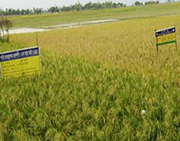 [April 17, 2016] According to Gopal Chowhan, SRI is gaining popularity among the farmers in Bangladesh. The Water Management Project of the Department of Agricultural Extension (DAE), Ministry of Agriculture, has begun a country-wide SRI demonstration program. A total of 90 sub-districts in 45 districts has been included in a program to educate and demonstrate to farmers how rice production can be increased through the SRI approach. SRI methods would also reduce water use in the rice field during the dry (winter) season. The farmers are reportedly happy to see the performance of SRI under limited irrigation conditions. The project is currently sharing the results among the neighboring farmers to encourage wider adoption of SRI. Chowhan, who is a member of SRI NNB (SRI National Network Bangladesh) visited a field at Sreemongal district in northeastern Bangladesh.
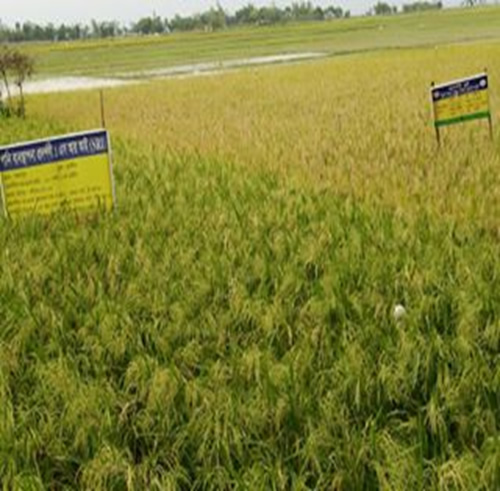
Farmers at Ghandhorbopur village in Sreemongal are expecting a much higher yield from the SRI plot conducted by DAE. The comparison plot is shown at right; the SRI plot will take little more time to mature. Farmers noticed a greater number of tillers, large size panicles and healthier plants in the SRI plot compared to the traditional one. The SRI NNB facilitated training for the DAE Water Management project personnel before the onset of the Boro season 2016.
[April 17, 2016] According to Gopal Chowhan, SRI is gaining popularity among the farmers in Bangladesh. The Water Management Project of the Department of Agricultural Extension (DAE), Ministry of Agriculture, has begun a country-wide SRI demonstration program. A total of 90 sub-districts in 45 districts has been included in a program to educate and demonstrate to farmers how rice production can be increased through the SRI approach. SRI methods would also reduce water use in the rice field during the dry (winter) season. The farmers are reportedly happy to see the performance of SRI under limited irrigation conditions. The project is currently sharing the results among the neighboring farmers to encourage wider adoption of SRI. Chowhan, who is a member of SRI NNB (SRI National Network Bangladesh) visited a field at Sreemongal district in northeastern Bangladesh.
Farmers at Ghandhorbopur village in Sreemongal are expecting a much higher yield from the SRI plot conducted by DAE. The comparison plot is shown at right; the SRI plot will take little more time to mature. Farmers noticed a greater number of tillers, large size panicles and healthier plants in the SRI plot compared to the traditional one. The SRI NNB facilitated training for the DAE Water Management project personnel before the onset of the Boro season 2016.
2015 Updates
-
 SRI Research in Bangladesh Presented at the 17th Annual Australian Agronomy Conference
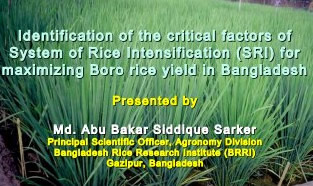
[September 24, 2015] Md. Abu Bakar Siddique Sarker, Principle Scientific Officer in the Agronomy Division of the Bangladesh Rice Research Institute (BRRI), gave a presentation on SRI at the 17th Annual Australian Agronomy Conference. He shared the importance of improving rice production in Bangladesh, and discussed experiments conducted from 2007-2011 to determine the best ways to implement SRI during the Boro rice-growing season. Factors tested included timing of transplanting, water management, fertilizer use, soil stirring, spacing, and nursery bed design. (Click on the image to the right to view the powerpoint).
- 2015 Progress Report Recounts Activities of the SRI National Network Bangladesh Over Past Decade
[April 30, 2015] Muazzam Husain, Coordinator of the SRI National Network Bangladesh (SRI NNB), provided a report chronicling the activities of the SRI NNB, which was formalized in 2006. The document recounts the SRI activities beginning in 1999 that lead up to the formation of the network. (See full report)
- Opportunity for Rural Development Academy (RDA) to Include SRI Methods in Five Year Government Water-Saving Project
[April 30, 2015] Muazzam Hussain reports that the Government has approved a five year project to be implemented by Rural Development Academy (RDA). The title of the project is "Action research project on extension and dissemination of modern water saving technologies and management practices to increase crop production." The objectives of the project include introduction of modern farming technologies in 200 sites in 40 districts for increasing rice and other crops, to increase irrigation water use efficiency, and improve the soil fertility through utilization of trichoderma enhanced composting. This is hoped to be a good opportunity for promoting SRI methods of rice production management by RDA among other methods. There is also a scope for including crops other than rice in the project.
- Bangladesh Rural Advancement Committee (BRAC) SRI Progress for 2012-2015
Under its Agriculture and Food Security Programme, BRAC initiated a validation and dissemination of SRI methods for sustainable rice production through active participation of farmers during the 2012-13 Boro season. A block approach was followed to facilitate irrigation under the AWD system and strengthen participatory group action. The programme has been continuing during the last three years. The following table shows the number of districts covered, Upazilas/blocks, number of participating farmers, and acreage under SRI during the last three Boro seasons.
Table 1: Progress of BRAC SRI programme 2012-13 to 2014-15
Year Districts Upazilas/blocks No. Of farmers SRI acreage2012-13 5 15/15 1105 441.09
2013-14 11 31 2830 1335.21
2014-15 8 27/52 2758 1513.94Of the above information only the first year’s report has been received, which indicates that performance of SRI was much better than that under farmers’ practice. SRI yield was 50% higher and profitability was almost double for both hybrid and inbred rice cultivation.
2014
- Bangladesh Agricultural University Research
Prof. Najrul Islam, professor of Agronomy has now three graduate students doing dissertation on SRI methods in an one acre experimental plot during the last Aman (Kharif 2) season (2014), using a raised bed method of planting and a new variety of rice developed by BAU. Comparative performance between SRI and farmer’s practice showed that yields under SRI and farmer’s method were 6-5 tons/ha and 5.00 tons/ha respectively.
2012-13 (For additional information see SRI NNB update)
- RDA Progress for 2012-2013
At the SRI NNB meeting held on May 11, 2013, the EC expressed its satisfaction at the initiation of a new programme on SRI promotion under its Agriculture and Food Security programme in five northern districts. The RDA reported that it had also started action programme on SRI during the 2012-13 Boro season, and that they would try SRI during all three production seasons, i.e., Boro, Aus (Kharif 1) and Aman (Kharif 2). BAU has also been conducting some action-research on a small-scale. Their activities are briefly reported below.
- RDA programme Progress
Experiments were conducted at RDA demonstration farm and at farmers’ fields of 15 selected farmers during all three rice production seasons during 2012-13. Findings on comparative performance showed that during all seasons, performance of SRI was better than that of farmers’ practice. Both yields and returns of SRI were higher during all three seasons.
- Proshika conducts SRI trials
Proshika, which earned reputation for its initiative in organic farming, conducted demonstration trials on SRI in three districts, Manikgonj, Naogaon, and Rangpur during the 2011-12 Boro season. The results were encouraging except in Rangpur where transplantation was made very late in the season.
2011
- DAE undertakes SRI demonstration during Aus season, 2011 in Kushtia
During a discussion session with the Director General, Department of Agricultural Extension (DAE), the matter of initiating demonstration of SRI method by DAE in different suitable areas was raised by the Coordinator, SRI NNB. The DG proposed to start SRI demonstration immediately during the Aus season in Kushtia and asked the Deputy Director, DAE, Kushtia to arrange the same in consultation with the SRI NNB. The DD was very enthusiastic about the proposal and a training session and field visit was arranged. A two member team went to Kushtia and conducted SRI training to 27 field staff (SAAO) and 13 farmers. Field visits were also made to discuss different aspects of SRI, motivate interested farmers, and advice on the suitability of selected plots. Finally demonstration plots were started in six upazila with five farmers’ plots in each upazila. Progress was monitored. The DD informed that the performance of the trials was good. However, he has been transferred to Ishwardi as Principal of the Agricultural Extension Training Institute (AETI) there. He promised to continue his support to promote SRI.
2010
- National SRI Workshop Held
at BRRI
The Fifth SRI National Workshop was hosted by Bangladesh Rice Research Institute (BRRI) at Gazipur, Bangladesh, on April 28, 2010. The workshop was jointly organized by SRI National Network Bangladesh (SRI NNB) and BRRI, and was cosponsored by Padakhep Manabik Unnayan Kendra (Centre for Sustained Human Development). Policy makers, researchers, practitioners including field workers, and senior scientists from BRRI, BARC, IRRI, and Bangladesh Agricultural University (BAU) participated along with representatives from Padakhep, a partner organization of Oxfam GB, the Department of Agricultural Extension (DAE), Bangladesh Krishibid Samity, Bangladesh Rice Foundation (BRF), and SAFE Development Group, IFDC, FAO, ADRA Bangladesh, CRWRC, and other members of SRI-NNB.
Workshop recommendations stressed an integrated and coordinated program approach by government (research and extension) and NGOs (national and international) for promotion of SRI in a planned manner. The DAE would support extension/promotion of SRI as a regular programme, and BRRI should conduct research on overcoming various constraints that the farmers face in specific areas. Action research by practitioners on identified impediments related to water management, transplantation of young seedlings during winter cold waves, labour and weeding may be given priority. Studies on identifying areas most suitable for SRI should recommended to be one of the research activities, including finding out better combination of SRI practices appropriate for different agroecological zones in Bangladesh. Social, environmental and ecological studies were also recommended to better reflect the benefits of SRI. Additionally, studies were suggested to elucidate how SRI can better address a number of negative ecological impacts that affect the environment, biodiversity and climate change. SRI NNB would play a coordinating role in carrying out the above recommendations. (Full workshop proceedings were revised in 2012 [3.38MB]; a shorter version is also available) .
- BRAC Prepares to Initiate Demonstration Plots for Sharecropper
Development Project
The Bangladesh Rural Advancement Committee (BRAC) has agreed to set up ten SRI demonstration plots in different districts during the upcoming boro season. Muazzam Husain, coordinator of the SRI National Network Bangladesh, conducted a training/orientation session with 25 Agricultural Development Officers employed under BRAC's sharecropper development project to organize and help sharecroppers in 158 Upazila (sub-districts) to improve their production by using better technology. Support and monitoring of the demonstrations will be provided as well as technical and credit support for the farmers.
For 1999-2008 SRI activities, see SRI Bangladesh Archives
Workshops/Seminars
- DIME Event: The Effects of Exposure Intensity On Technology Adoption and Gains: Experimental Evidence from Bangladesh on the System of Rice Intensification
Presentation about positive impacts of SRI on rice yields, profits, and various household well-being indicators resulting from a large-scale, multi-year experimental evaluation in Bangladesh.
MC 7-100, World Bank Main Complex, World Bank, Washington, DC
(organized by World Bank / Development Impact Evaluation [DIME])
May 9, 2019, 1:00-2:30 PM
- National Experience Sharing workshop
Bangladesh Rice Research Institute
April 28, 2010 - National SRI Workshop
Dhaka, Bangladesh
(organized the SRI National Network Bangladesh and Oxfam GB/Bangladesh)
February, 13, 2008 - Farmers' Field Day Session in Gaibandha
District
Village of Dhumaidhari, in Sundergonj Upazila of Gaibandha District
(organized by DAE officials, OXFAM partners NGOs and SRI NNB)
May 12, 2007 - SRI Experience-Sharing National
Workshop
Khamarbari, Dhaka, Bangladesh
October 11, 2006 - National SRI Workshop
IDB Bhaban, Dhaka, Agargaon, Bangladesh
(organized by IRRI/PETRRA sub-projects of Bangladesh)
December 24, 2003 - SRI National Workshop
Mymensingh, Bangladesh
(organized by CARE)
September 27, 2002
Reports and Articles
Newspaper articles
-
নের অধিক ফলন পেতে ব্যবহার করুন এসআরআই পদ্ধতি
[Use SRI method to get higher rice yields]
August 5, 2019, Adhunik Krishi Khamar (Bangladesh) - Islam, Asad. 2017. Food security: Trying new rice cultivation method. The Financial Express, November 15.
- Jahangir, Rahman. 2016. A silver lining amid gloom. The Financial Express. April 1. [Agro-economist suggests that yield gaps of existing varieties could be reduced with the adoption SRI]
- কুষ্টিয়ায় এরাইজ গোল্ড ধানের সফল গবেষণা. [Bengali language: Golden rice research with SRI successful in Kushtia]
February 21, 2013. Bangla Mail and Unmochan (Kushtia, Bangladesh) -
সমন্বিত ধান চাষ পদ্ধতিতে মনোযোগ দেওয়ার আহ্বান. [Bengali language: Call for attention for coordinated paddy cultivation with SRI]
November 05, 2012. Shokaler Khabor (Bangladesh) - জনতা ব্যাংকের সহায়তায় ধান চাষে রেকর্ড. [Bengali language: Janata bank facilitates record production with HYV paddy in Kushtia]
November 05, 2012. Shokaler Khabor, Bangladesh) -
খাদ্য নিরাপত্তা নিশ্চিতে সমন্বিত ধান চাষে মনোযোগ দিতে হবে. [Bengali language: Integrated rice cropping to address food security]
October 18, 2012. BD Today.(Bangladesh) -
খাদ্য নিরাপত্তার চ্যালেঞ্জ মোকাবিলা: এসআরআই পদ্ধতির দিকে মনোযোগ দিতে হবে. [Bengali language: Food security challenges: Attention must be given to SRI methods]
October 15, 2012. Dainik Destiny (Bangladesh) -
বোরোতেই বাড়তি ৫০ লাখ টন চাল উৎপাদন সম্ভব. [Bengali language: Additional 5 million tonnes of rice production possible with SRI]
October 15, 2012. Naya Diganta (Dhaka, Bangladesh) -
কৃষি উৎপাদন বাড়াবে এসআরআই পদ্ধতি. [Bengali language: Agricultural production can increase with SRI]
October 15, 2012. Kaler Kantho (Dhaka, Bangladesh) -
নওগাঁয় এসআরআই মাঠ দিবস পালিত. [Bengali language: March day celebrated for head start in to SRI]
May 06, 2012. NBN24 (Raj Shahi, Bangladesh)
Website articles, blog posts and reports
-
নের অধিক ফলন পেতে ব্যবহার করুন এসআরআই পদ্ধতি
[Use SRI method to get higher rice yields]
August 5, 2019, Adhunik Krishi Khamar (Bangladesh) - Islam, Asad, et al. 2019. How information matters for adopting a new technology in Bangladesh. VOX CEPR Policy Portal. June 6. [Article by Monash University researchers using SRI to study adoption.]
- Holland, Peter. 2018. Unexpected research outcomes. BBC.com website. [Together with NGOs in Bangladesh, BRAC, Cornell University, the Indian Institute of Technology Kanpur, and Monash Business School, Dr. Asadul Islam at Monash University has proven that SRI methods improve rice yields by more than 50 per cent for Bangladesh farmers, without requiring additional investment such as seed, chemical fertiliser or increased irrigation] [accessed Aug. 6, 2018]
- IGC. 2017. Social network, referrals and technology adoption: Randomized field experiments using System of Rice Intensification (SRI). International Growth Centre (IGC) website. January. [IGC Bangladesh will have a meeting Jan. 15 to disseminate study findings.]
- Islam, Asadul, Chris Barret, and Marcel Fafchamps. 2015. Technology adoption and diffusion: The System of rice intensification and food security in Bangladesh. International Growth Center website. September 7. [Update on a project completed in July 2015.]
- Husain, Muazzam. 2015. SRI National Network Bangladesh Update of SRI Progress in Bangladesh (April 2015). SRI-Rice website. April 30. [Report on the past 15 years of progress of SRI in Bangladesh by the Coordinator of the SRI National Network Bangladesh (SRI NBB).
- Desh Premik. 2012. কৃষি উন্নয়নে প্রযুক্তি ব্যবহারে ২০ শতাংশ উৎপাদন বাড়ানো সম্ভব. Somewhere in.. blog. April 30. [Bengali language: Rice production can be increased by 20- 40% by using SRI technologies, Bangladesh]
- 2012.গবেষণা তথ্য : কৃষি প্রযুক্তি ব্যবহারে উত্পাদন বাড়ানো সম্ভব. Aamar Desh website. April 23. [Bengali language: Research Information: Agricultural technology can increase production, Bangladesh]
- SRI National Network Bangladesh. 2010 (revised 2012). System of Rice Intensification (SRI) - Proceedings of the Experience-Sharing National Workshop: Fifth National SRI Workshop. System of Rice Intensification website. (74p., 3.38MB pdf) (see also shorter version: 11p., 68 KB pdf) [Proceedings of the Fifth SRI National Workshop, which was hosted by Bangladesh Rice Research Institute (BRRI) at Gazipur on April 28, 2010, and jointly organized by SRI National Network Bangladesh (SRI NNB) and BRRI, and was cosponsored by Padakhep Manabik Unnayan Kendra (Centre for Sustained Human Development).]
- Chowhan, Gopal. 2007. Farmers' field day session in Gaibandha district, Bangladesh. System of Rice Intensification website. (2p., 98KB pdf) [Report of May 12 event in the Village of Dhumaidhari, in Sundergonj Upazila of Gaibandha District, Bangladesh]
- Chowhan, Gopal. 2006. Proceedings of the SRI Experience-sharing National Workshop, October 11, in Khamarbari, Dhaka, Bangladesh. (12p., 352KB pdf)
- Uphoff, Norman T. 2005. Report on a visit to India and Bangladesh regarding SRI progress. Cornell International Institute for Food, Agriculture and Development. System of Rice Intensification website. (34p., 394KB pdf) [Trip report of February 17-26, 2005 visit to South Asia for CIIFAD].
- Husain, A. M., G. , G., and P. Barua 2004. Completion report on verification and refinement of the System of Rice Intensification (SRI) project in selected areas of Bangladesh (SP 36 02). Research Reports (2004): Social Studies, Vol – XXXV, 171–267.
- 2003. Proceedings of a National SRI Workshop,
December 24, in IDB Bhaban, Dhaka, Agargaon, Bangladesh.
- Uphoff, N.T. 2002. Trip report on SRI activities in Bangladesh. Cornell International Institute for Food, Agriculture and Development. System of Rice Intensification website. [Trip report of September 2002 visit to Bangladesh for CIIFAD].
- Husain, A.A.M. 2002. Experience with SRI methods in Bangladesh. Paper presented at the international conference on Assessments of the System of Rice Intensification (SRI), April 1-4, in Sanya, China. (pdf)
Research and Evaluations (in order of acquisition)
- Islam, M. J., M.S. Islam, M. L. Mia, et al. 2025. Influence of water management and weeding practices on the growth and yield of Boro rice (cv. BRRI dhan29). IKR Journal of Agriculture and Biosciences (IKRJAB), 1(4): 215-228.
- Al Mamun, Abdullah, Md. Ferdous Hossain Khan, and Md. Mojaherul Haque. 2023. Effect of SRI and AWD technology in comparison to traditional methods on yield contributing characters of rice (Oryza sativa). Big Data in Agriculture 5(1): 15-21. doi:10.26480/bda.01.2023.15.21
- Borna, Samina Nasrin, et al. 2022. Influence of rice establishment methods on water productivity, methane emissions and rice grain heavy metals content from irrigated rice paddies in Bangladesh. European Journal of Agriculture and Food Sciences 4(5): 112-119. doi:10.24018/ejfood.2022.4.5.586
- Fafchamps, Marcel, et al. 2021. Mobilizing P2P diffusion for new agricultural practices: Experimental evidence from Bangladesh.The World Bank Economic Review. 35(4): 1076-1101, doi:10.1093/wber/lhab009 [accessed December 4, 2021]
- Alam, Khairul, et al. 2020. Rice (Oryza sativa L.) establishment techniques and their implications for soil properties, global warming potential mitigation and crop yields. Agronomy 10(6): 888. doi: 10.3390/agronomy10060888
- Akondo, Md Robiul Islam, et al. 2020. Comparative performance of System of Rice Intensification (SRI) and conventional methods of rice cultivation in Gopalganj District of Bangladesh. Asian Plant Research Journal 6(4):1-7
- Barrett, Christopher B., et al. 2020. Experimental evidence on adoption and impact of the System of Rice Intensification. Cornell University. (73p) [Also available from Monash University]
- Paul, S., M. Ray, M.A.R. Sarkar, and S. Sarkar. 2010. Effect of water, nutrient and weed management on the yield and quality of aromatic boror rice (CV. BRRI dhan50). Bangladesh Agronomy Journal, 22(1), 57-69. doi:10.3329/baj.v22i1.44937
- Uddin, M. Taj, and Aurup Ratan Khar. 2020. Assessing the impact of water-saving technologies on Boro rice farming in Bangladesh: economic and environmental perspective Irrigation Science. (online first January 14, 2020). doi:10.1007/s00271-019-00662-2
- Islam, Asadul, Philip Ushchev, Yves Zenou, and Xin Zhang. 2018. The value of information in technology adoption: Theory and evidence from Bangladesh. SSRN. 55p.
- Hosain, T., et al. 2018. Response of physiological characteristics and productivity of hybrid rice varieties under System of Rice Intensification (SRI) over the traditional cultivation. International Journal of Plant Biology & Research 6(2): 1085.
- 2016. Technology adoption, System of Rice Intensification and food security in rural Bangladesh. Global Development & Research Initiative (GDRI) website, research section. [accessed September 2016]
- Barrett, Chris, Marcel Fafchamps, Asad Islam, Abdul Malek, and Debayan Pakrashi. 2016. System of rice intensification in rural Bangladesh: Adoption, diffusion and impact. International Growth Center (IGC) Working Paper. February 14. (37 pdf) [A study by researchers from Cornell, Stanford, and Monash Universities, IIT (Kanpur), and BRAC studying SRI in farming communities being served by BRAC. A follow up study is planned.]
- Chakrabortty, Sudip, S. Islam, P. K. Biswas, et al. 2015. Response of seedling age to growth and yield of boro rice (BRRI Dhan 50) under SRI. International Journal of Business, Social, and Scientific Research 3(2): 97-101.
- Haque, Muhammed Maksudul, Ratna Rani Majumder, Tapas Kumer Hore, and Md. Romel Biswash. 2015. Yield contributing characters effect of submerged water levels of boro Rice (Oryza sativa L.). Scientia Agriculturae 9(1): 23-29. doi:110.15192/PSC P.SA.201 5.9.1.2329
- Senanayakea, Nari, and Aditi Mukherjib. 2014. Irrigating with arsenic contaminated groundwater in West Bengal and Bangladesh: A review of interventions for mitigating adverse health and crop outcomes. Agricultural Water Management 135(31): 90-99. doi: 10.1016/j.agwat.2013.12.015
- Mondol, Amit Partha. 2012. Assessment of SRI with conventional method of rice cultivation in Boro season. Master's thesis, Sher-e-Bangla Agricultural University, Dhaka (Bangladesh)
- Rahman, M and I. B. Roy. 2006. Effect of the System of Rice Intensification (SRI) on rice yield in Bangladesh, boro season, 2005-2006. ActionAid Bangladesh. System of Rice Intensification website. (11p., 359KB pdf) [Evaluation of the FoSHoL Project of ActionAid Bangladesh]
- Husain, A.A.M. et al. 2004. Report on System of Rice Intensification (SP 36 02). Presentation at the PETRRA Technology Workshop, May 23-24, at BRRI, Gazipur, Bangladesh.
- Husain, A.A.M. 2004. Final evaluation report on verification and refinement of the System of Rice Intensification (SRI) in selected areas of Bangladesh (SP 36 02). System of Rice Intensification website. (84p. 595KB pdf). [Report submitted to PETRRA, IRRI, Dhaka, Bangladesh.]
- Das, Luthur. 2003. Trial Monitoring Report for SP 36 02. System of Rice Intensification website. September. [Report for the SAFE Development Group, Bangladesh]
- Husain, A.A.M, et al. 2003. SRI Survey Trial Monitoring Report for SP 36 02. BRAC University. System of Rice Intensification website. December. (24p., 211KB pdf)
Presentations
- Barrett, Christopher, et al. 2019. The Effects of Exposure Intensity on Technology Adoption and Gains: Experimental Evidence from Bangladesh on SRI. 30 slides. Presentation at the USDA Multi-state Research Project NC-1034 annual research conference on The Economics of Agricultural Technology & Innovation. Atlanta, Georgia, July 21, 2019.
- Husain, A.M. Muazzam. 2018. 1805 Experience with SRI in Bangladesh through Promotion and Networking. 17 slides. SRI-Rice Slideshare website. Presentation at the Final Workshop: Sustaining and Enhancing the Momentum for Innovation and Learning around the System of Rice Intensification (SRI) in the Lower Mekong River Basin (SRI-LMB), November 2.
- Sarker, Md. Abu Bakar Siddique. 2015. Identification of the critical factors of System of Rice Intensification (SRI) for maximizing Boro rice yield in Bangladesh. Presentation at the 17th Australian Agronomy Conference, Tasmania, Australia, September 24, 2015. 26 slides. [Md. Abu Bakar Siddique Sarker is Principle Scientific Officer, Agronomy Division, Bangladesh Rice Research Institute (BRRI)]
- Husain, A. M. Muazzam. 2007. Some Agro-ecological and Institutional Aspects of the System of Rice Intensification (SRI): The Bangladesh Case. 14 slides. (PowerPoint embedded below requires Flash 9 or higher; or view directly on slideshare.net)
- Husain, A. M. Muazzam. 2004. Evaluation of SRI in Bangladesh. BRAC University, Dhaka, Bangladesh. Presentation given at the WRRC, Tokyo-Tsukuba, Japan November 4-7, 2004. 29 slides.
Videos
- 2025 (June 16). Grow More With Less: The SRI Revolution. "The System of rice Intensification" || Warasha Najmin. 4:32 min. warasha najmin channel, YouTube. [An interview with SRI farmer Ashrah Uddin, from Dinajpur, Bangladesh on why he uses SRI to grow rice.]
- 2022 (June 25). SRI Method at CEP Manikganj. 5:32 min. ADRA Bangladesh channel, YouTube. [Community Empowerment Project (CEP) – Daulatpur, Manikgan, in Bangladeshj set up four SRI demonstration plots in three Unions (Jionpur, Chakmirpur, and Kalia) under Daulatpur; 188 farmers have implemented the SRI on 21.132 ha.]
- 2022 (June 23). Punjab Talks SRI System Episode 5- Dr. Kuldip Singh Herian. 5:57 min. Punjab Talks channel, YouTube. [Punjabi language radio show clip by Dr. Kuldip Singh.]
- 2022 (January 18). Rice Production on SRI System.14:36 min. kutub uddin green agriculture channel, YouTube. [Bengali language training on SRI in Koyra Upazila Khulna, Bangldesh.]
- 2020 (September 28). System of Rice Intensification (SRI) Alternative wetting and Drying (AWD). 7:27 min. education channel, YouTube. [Bangla language academic explanation of SRI from S. M. Shikha Mukhlesur Rahman College Bangladesh.]
- 2020 (July 4). SRI or System of Rice Intensification has increased rice production in developing countries. 1:56 min. Sukanto Roy channel, YouTube [Video about a large SRI adoption study in Bangladesh .]
- 2020 (June 13). System of Rice Intensification (SRI). 2:25 min. ADRA Bangladesh video on Facebook. [In the boro season, there are 300 farmers implementing SRI with the help of the NGO ADRA-Bangladesh's CEP-Dalatpur, Manikgan.]
- 2020 (May 3). SRI Method of Rice. 7:01 min. Dr. Pronay Bala channel, YouTube. [Bengali language SRI intro video made by professor at Hazi Lalmia City College in Bangladesh]
- 2018 (February 6). The new method of rice cultivation - SRI, নতুন পদ্ধতিতে ধান চাষ. Green Bangla AT Entertainment channel, YouTube.
- 2017 (August 12). Farmers view about System of Rice intensification (SRI) in Bangladesh. Tanvir Shatil channel, YouTube. [Farmer interviews from from an RCT-based project on Technology Adoption and Food Security in Rural Bangladesh.]
- 2017 (June 4). SRI, অধিক ধান উৎপাদন করতে কিভাবে বীজ তলা করতে হয়, কিভাবে চারা রোপন করতে হয়, কখন কি সার দিতে হয়? 6:08 min. Md. Bayezid Moral channel, YouTube. [Bengali language instructional discussion from Bangladesh].
- 2017 (February 6).উন্নত পদ্ধতিতে ধান চাষাবাদ, অধিক ধান উৎপাদনে SRI, Improved methods of rice cultivation. Part 1, 6:19 min., Part 2, 4:13 min.; Part 3, 9:51 min. AT channel, YouTube. [Bangali language SRI information, Bangladesh]
- 2016 (September 26) Can SRI techniques help Bangladeshi farmers increase their yields? 1:56 min. Monash Business School channel, YouTube. [Associate Professor Asad Islam, Monash University, explores the implications of SRI techniques in rural Bangladesh.]