

THE GAMBIA
Summary
SRI was first introduced into The Gambia in 2000 in conjunction with thesis research undertaken by a Cornell University PhD student, Mustapha Ceesay, who was formerly director of the National Agricultural Research Institute station at Sapu, The Gambia. SRI results reported in his 2004 dissertation ranged from 5.4 to 8.3 t/ha depending on variety and spacing. Ceesay, who is currently Assistant Director General in charge of Research and Development at the National Agricultural Research Institute, Gambia, continues to promote SRI in his own country as well as other African countries, including Egypt and Ghana. As one of 13 participating countries in the World Bank-financed regional project "Improving and Scaling up the System of Rice Intensification in West Africa" (SRI-WAAPP) that formally began in January 2014, The Gambia participates in the project in regional workshops, trainings and meetings is undertaking nationally funded SRI activities through the WAAPP (See SRI-WAAPP website and Gambia page on the SRI-WAAPP website). The map on the right shows 23 SRI-WAAPP sites currently in The Gambia. After the end of the SRI-WAAPP project in 2015, organized SRI events ceased for a time. However, SRI activities resumed in 2019 with SRI trainings in the Central River Region (CRR) which were sponsored by the Gambia Commercial Agriculture and Value Chain Management Project (GCAV), in partnership with Department of Agriculture (DoA). In October 2021, the Adaptation Fund approved the “Scaling up Climate Resilient Rice Production in West Africa” (RICOWAS) project which includes Ghana and 12 other countries in the region. The Gambia and 12 other countries in the region.
Progress and Activities
 Rice Farmers from the Central River and Upper River regions of The Gambia Trained in SRI Methods
[July 23, 2024] According to an article in Agridigitale, 150 rice farmers from the Central River and Upper River regions of The Gambia are being trained in System of Rice Intensification (SRI) methods through the World Bank-funded Gambia Inclusive and Resilient Agricultural Value Chain Development Project (GIRAV) Project. Ramatoulie Hydra Sanyang, GIRAV Project Operations Manager, relayed to participants that the Government of The Gambia is committed to reversing the trend of depending on rice imports. The GIRAV Project, through a practical training for rice farmers, aims to help Gambia become self-sufficient in rice while creating a surplus to sell to generate income. It is also about obtaining significantly higher agricultural yields while reducing inputs and greenhouse gas emissions. [See Agridigtale article for more info (in French).]
2021
- The Gambia Included in Four-Year Regional SRI-Based RICOWAS Project
[October 21, 2021] The Adaptation Fund (AF) has approved the “Scaling up Climate Resilient Rice Production in West Africa” (RICOWAS) project in October 2021. The four-year, $14 million effort, which emphasizes the System of Rice Intensification (SRI), is the largest regional project funded by the AF in Africa, covering thirteen ECOWAS countries. In The Gambia, the Ministry of Agriculture will be in charge of executing the project. The overall purpose of the initiative is to improve climate resilience and increase the productivity of the rice system of smallholder rice farmers in West Africa. Regionally, the Sahara and Sahel Observatory (OSS), will oversee the project overall implementation. The Rice Regional Center of Specialization, hosted by the Institute of Rural Economy (IRE) of Mali, will be in charge of the regional level execution and will work in partnership with the Climate Resilient Farming Systems program at Cornell University. [See OSS article for more information.]
2019
- SRI Trainings Gambian Farmers Held in Central River Region (CRR)
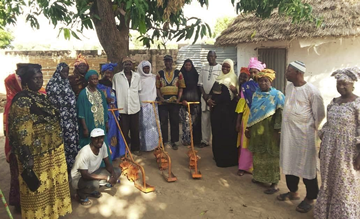 [July 26, 2019] According to an article in Mansa Banko Online, Gambia Commercial Agriculture and Value Chain Management Project (GCAV), in partnership with Department of Agriculture (DoA), conducted a ‘System of Rice Intensification’ (SRI) training in Central River Region (CRR) July 20-23, 2019. The training targeted the communities of Tuba Demba Sama, Wellingara, Kerewan in CRR South and Kuntaur in CRR North; and a total of 60 farmers, mostly women, benefited from the training. The main objectives of the SRI trainings were to create awareness about SRI amongst rice farmers, improve rice production and productivity and encourage communities and individuals in the targeted areas to adopt the SRI system.
Delivering the opening remarks in the said communities, the Station Manager of Sapu Agric Station who doubles as SRI facilitator, Mr. Momodou Sambou, said the SRI trainings were first conducted by the West Africa Agricultural Productivity Program (WAAPP) project few years ago, and by the time farmers started understanding the SRI technique, the project phased out. He explained that since it’s proved to be a very productive planting system in terms of yield, GCAV project and DoA deemed it necessary to commence SRI training in CRR.
[July 26, 2019] According to an article in Mansa Banko Online, Gambia Commercial Agriculture and Value Chain Management Project (GCAV), in partnership with Department of Agriculture (DoA), conducted a ‘System of Rice Intensification’ (SRI) training in Central River Region (CRR) July 20-23, 2019. The training targeted the communities of Tuba Demba Sama, Wellingara, Kerewan in CRR South and Kuntaur in CRR North; and a total of 60 farmers, mostly women, benefited from the training. The main objectives of the SRI trainings were to create awareness about SRI amongst rice farmers, improve rice production and productivity and encourage communities and individuals in the targeted areas to adopt the SRI system.
Delivering the opening remarks in the said communities, the Station Manager of Sapu Agric Station who doubles as SRI facilitator, Mr. Momodou Sambou, said the SRI trainings were first conducted by the West Africa Agricultural Productivity Program (WAAPP) project few years ago, and by the time farmers started understanding the SRI technique, the project phased out. He explained that since it’s proved to be a very productive planting system in terms of yield, GCAV project and DoA deemed it necessary to commence SRI training in CRR.Station Manager Sambou pointed out that the training would be reminder to some participants as they were introduced to SRI planting technique during the time of WAAPP project and some participants are new to the technique. He, therefore, challenged the participants to take up the technique and also train other farmers who are not opportune to be part of the training program. Speaking to participants in the target communities, SRI lead trainer from the Department of Agriculture, Mrs. Ramu Hydara, recalled that SRI planting technique was first implemented by a Gambian researcher, two decades ago, but it had been introduced to farmers by WAAPP project some years ago. She further explained that researches on SRI planting conducted in 13 West African Countries under the WAAPP project all showed that SRI is more productive in terms of yield than the convention planting technique. The Agriculture official in comparing the yield of conventional planting to SRI planting, indicated to the audience that, a hectare of conventional planting of rice usually doesn’t produce more than 3 tons, while SRI planting generally produces 4 to 8 tons per hectare. Hydara went on to note that SRI planting is a climate smart agriculture technique that could help farmers to maneuver the negative effects of climate change and realize good yield in their farming. [See full article in Mansa Banko Online.]

2012-2016
 SRI-WAAPP and CNS-Riz Conducts Support Visits and National Training-of-Trainers
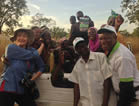
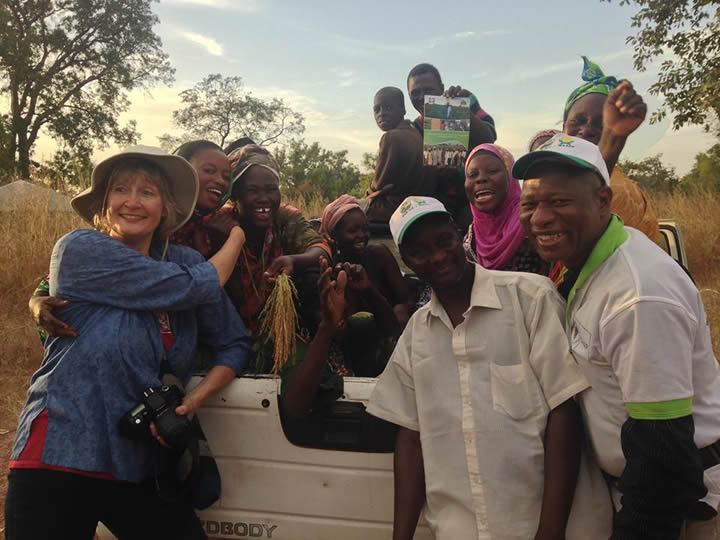
[December 2015] SRI-WAAPP and CNS-Riz (the organization that oversees the SRI-WAAPP project, and is based in Mali) conducted a support visit to the Gambia, with meetings with the Ministry of Agriculture and Peace Corps, visits to farmers fields in the Central River Region, and a national SRI training of trainers held at the Sapu Agricultural Research Center in Central River Region. Participants included farmers, researchers, extension / advisory agents, Peace Corps, and managers of several of the President of Gambia's own farms (he has a network of large farms around the country). A feature article on one of the participants, Kinsa Sidibeh, has been published on the SRI-Rice website. An article on the SRI-Rice visit to Sambel Kunda (see photo at right) appears in the PeriodiCALS magazine.
2012-2014
- Regional Project to Scale Up SRI Formally Launched
[January 1, 2014] As one of 13 participating countries in the World Bank-financed regional project "Improving and Scaling up the System of Rice Intensification in West Africa" (SRI-WAAPP) that formally began in January 2014, The Gambia participates in the project in regional workshops, trainings and meetings is undertaking nationally funded SRI activities through the WAAPP. Part of the larger and on-going West Africa Agricultural Productivity Program (WAAPP), SRI-WAAPP grew out of demands for technical and training assistance in SRI from most of the 13 countries, which resulted in a commissioned project development with an initial regional workshop to design the project in Ouagadougou, Burkina Faso in
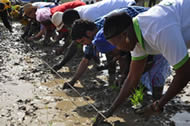 July 2012. The first phase of the project is running from January 2014 – June 2016. For more information about the SRI-WAAPP project view the project website and the project brochure. The project's Regional Coordination Unit is a partnership between Mali's National Center of Specialization in Rice (CNS-Riz) who houses the regional coordinator and SRI-Rice as the technical and strategic partner for this project, The SRI-WAAPP National Facilitator for The Gambia is Mamodou Sambou, who works at the National Agricultural Research Institute (NARI) at Sapu. For more about SRI activities in The Gambia through the SRI-WAAPP project, visit the project's page on The Gambia. Since the project's initial planning workshop in 2012, Liberia has participated in the numerous regional workshop (see reports for the various national and regional SRI-WAAPP activities).

2002-2006
- National Agricultural Research Institute Trials Continue at
Sapu
Mustapha Ceesay, who is currently Assistant Director General in charge of Research and Development at the National Agricultural Research Institute, Gambia, received a Cornell Ph.D. degree in crop and soil sciences, undertaking demonstration trials on SRI at Sapu in The Gambia. SRI results ranged from 5.4 to 8.3 t/ha, depending on variety and spacing. This compares with usual rice yields of 2 t/ha (see Ceesay's 2004 PhD dissertation and related 2003 paper presented at the Northeastern Branch of the American Society of Agronomy meeting, Burlington, VT.)
- Gambian Farmers Undertake SRI Trials in 2002
In 2002, ten Gambian farmers who had observed the Sapu trials tried SRI methods on their own farms, dividing a field in two portions, to practice SRI on one half and conventional rice growing on the other. The average SRI yield was 7.4 t/ha (see paper presented at the Sanya conference) compared with 2.5 t/ha on the other half, where the only difference was crop management, not farms or farmers.
Reports and Articles
- CORAF. 2024. En quoi consiste le Système de Riziculture Intensive? Agri Digitale, July 23. [150 rice farmers from the Central River and Upper River regions (Gambia) are using SRI]
- Segnon, A.C., R. B. Zougmoré, and P. Houessionon. 2021. Technologies and practices for agriculture and food system adaptation to climate change in The Gambia. CCAFS Working Paper no. 344. Wageningen, the Netherlands: CGIAR Research Program on Climate Change, Agriculture and Food Security (CCAFS). [accessed March 20, 2022]
- Drammeh, Seikhna. 2019. Gambian farmers schooled on SRI techniques. Mansa Banko Online. July 26. [Gambia Commercial Agriculture and Value Chain Management Project (GCAV), in partnership with Department of Agriculture (DoA), conducted SRI training with 60 farmers in Central River Region (CRR) from July 20-23, 2019.]
- Jenkins, Devon. 2016. Meet Kinsa Sidibeh, an SRI farmer in Central River Region South, The Gambia. SRI-Rice website. April 27. [uploaded April 26, 2016]
- Garris, Amanda. 2016. International call: Sambel Kunda, The Gambia. periodiCALS magazine 6(1) April. [Story about the SRI-Rice work with the SRI-WAAPP project in The Gambia]
- WAAPP-Gambia. 2016. National SRI Training of Trainers Report. SRI West Africa website. March. [A report covering the first national SRI training as part of the SRI-WAAPP project.]
- Styger, Erika and Devon Jenkins. 2016. Senegal and The Gambia - December 2015 SRI-Rice Trip Report. SRI West Africa website. (11p., pdf) [The trip report from a support trip to Senegal and The Gambia conducted by SRI-Rice’s Director of Programs, Erika Styger, and Technical Specialist, Devon Jenkins, to Dakar, Senegal, and Banjul and Central River Region, The Gambia in December, 2015. This trip included meetings in Dakar and Banjul, field and farmer visits in Central River Region, and a Gambian national SRI training of trainers in Central River Region.]
Research and Evaluations
- Ceesay, Mustapha. 2011. An opportunity for increasing factor productivity for rice cultivation in The Gambia through SRI. Paddy and Water Environment 9:129-135. DOI: 10.1007/s10333-010-0235-1
- Ceesay, Mustapha C., William S. Reid, Erick C. M. Fernandes and Norman T. Uphoff. 2006. The effects of repeated soil wetting and drying on lowland rice yield with System of Rice Intensification (SRI) methods. International Journal. of Agricultural Sustainability 4(1):5–14.
- Ceesay, Mustapha C. 2004. Management of rice production systems to increase productivity in The Gambia, West Africa. PhD diss., Cornell University. (178p., 744KB pdf)
Web Modules and Presentations
- Ceesay, Mustapha C., William S. Reid, Erick C. M. Fernandes and Norman T. Uphoff. 2006. Opportunities for increasing land, labour and water productivity in Africa with the System of Rice Intensification (SRI). Slide presentation. African Rice Center website. 45 slides.
- Ceesay, Mustapha C. and Norman T. Uphoff. 2003. The
effects of repeated soil wetting and drying on lowland rice yield
with System of Rice Intensification (SRI) methods. Paper presented at the Northeastern Branch of the American Society of Agronomy meeting, Burlington, VT. (11p., 185KB pdf) - Ceesay, Mustapha C. 2002. Experiments with the System of Rice Intensification in The Gambia. Paper presented at the International Conference on Assessments of the System of Rice Intensification (SRI), April 1-4, in Sanya, China. (2p. pdf)
- Ceesay, Mustapha. System of Rice Intensification in The Gambia. System of Rice Intensification website. [Web module by Mustapha Ceesay, National Agricultural Research Institute and Cornell University]
- Ceesay, Mustapha. 2000. System
of Rice Intensification. PowerPoint presentation. NARI Sapu Research Station,
The Gambia. 13 slides.