

IRAN
Summary
Encouraged by Dr. M. H. Emadi, Deputy Minister for Extension in the Ministry of Agriculture, the Agronomy Group of Haraz Extension and Technology Development Center started SRI trials in 2004 with guidance from CIIFAD's SRI website. During 2005-2008, various experiments with traditional, improved and hybrid varieties were undertaken at the experiment station and in farmers' fields with positive results (see 2006, 2007 and 2008 reports). After the first year, a training program on SRI was established for farmers and governmental rice staff. The 2008 report notes that, in addition to reducing water use by 2/3, SRI practices "increase rice yield about 60% due to higher tiller number and panicle number, increasing numbers of grains per panicle, percentage of ripened grains, root and plant health, resistance to lodging, and tolerance to pest damage." H. Aghagolzadeh also designed the first rotary weeders in Iran for use with SRI in 2008. A 2012 research article by Amiri Larijani and Hoseini indicated that, while combined chemical and organic fertilizers gave the best growth and yields under SRI management, organic inputs can replace chemical fertilizer for local varieties without reducing yield. A 2013 report on SRI trials in a World Bank-funded Participatory Technology Development (PTD) project in Mazandaran province confirmed best results were achieved with fewer seedlings, shallow planting and intermittent irrigation. In a presentation at Cornell University during June 2016, Dr. M. H. Emadi summarized some of the major results of SRI research in Iran as: yield increases of about 60%; decrease in cost of production up to 40%; and decrease in water consumption up to 30%. In 2019, Haraz Extension and Technology Development Center experts have collaborated in SRI adaptation near of Mahmoudabad City in Mazandaran province. During 2020, an article in the Iranian Journal of Field Crops suggests using SRI intergrated with ducks has a positive outcome: An initial hand weeding to control dominant weeds and stocking 750 ducks per ha has been shown to improve rice production and increase water productivity in rice fields of Guilan province.
Progress and Activities
-
 Effect of Cultivation Systems on Water Productivity, Yield and Yield Components of Two Rice Cultivars
[May 10, 2022] A study in the Iranian Journal of Irrigation and Drainage was conducted to investigate the effect of three rice cultivation systems including traditional flooded cultivation, improved cultivation, and SRI with different irrigation regimes on water productivity, yield and yield components of Hashemi and Kuhsar cultivars in the first and second crops during 2016-2017 and 2017-2018 of Mazandaran province in Iran. The results showed that the effect of these three cropping systems on the number of seeds per panicle, number of full and empty seeds, grain yield, plant height, cluster length, water requirement and plant evapotranspiration. The highest amount of irrigation-based productivity for Kuhsar cultivar occurred in the second crop (SRI) and the lowest amount for Kuhsar cultivar in the first crop (traditional flooding system). The results showed that the use of improved and SRI management systems increases water productivity and therefore can be one of the recommended solutions to officials and farmers in rice fields. SRI was not recommended for use in a second summer crop where farmers try to get a second harvest before cold temperatures set in because of its longer crop cycle started with young seedlings. [See abstract in abstract in English or full text in Farsi.]
- Effect of Rice-Duck Co-Cultivation on Rice Yield, Water Productivity and Weed Control in Different Cultivation Systems
[March 10, 2021] An article by Ghanaei-Pashaki et al in Iranian Journal of Field Crops Research investigates the effect of duck use and weed control in different planting systems on yield and abundance of dominant weeds under field conditions. Rice-duck cultivation is an integrated farming technology which could increase rice production, grain quality, and ecological sustainability in paddy fields. Rice-duck cultivation could be effective for weed control as well as reducing environmental pollution which is caused by herbicides and providing the development of environmentally-friendly agriculture. Studies have showed that the application of effective methods in water productivity, including SRI methods, improved irrigation management in the field and decreased drainage water, soil permeability, and the consequences of conventional cultivation, while increasing soil fertility (with ducks) can significantly increase water productivity.
The experiment, which was conducted during the two years 2017-2018 and 2018-2019 at Guilan University, included three different cultivation systems (conventional, improved, and SRI) as the main factor, and factorial combinations of two duck densities (no use and 750 ducks ha-1) and three treatments for weed control (no weed control, and one and two weedings) as the sub-factors. In general, duck use increased plant growth, improved performance of rice, and finally increased rice yield by proper weed control in the field with muddy water and beaks, as well as adding manure to the paddy field. According to the results of this study, the authors feel it is probably appropriate to use the SRI rice cultivation system, doing an initial hand weeding to control dominant weeds and stocking 750 ducks per ha to improve rice production and to increase water productivity in rice fields of Guilan province. [See Farsi article for details or English translation.]
- Haraz Center Experts Encourage SRI Methods at Vazik
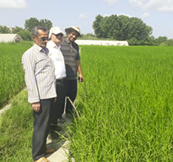 Village Pilot Rice Production Site
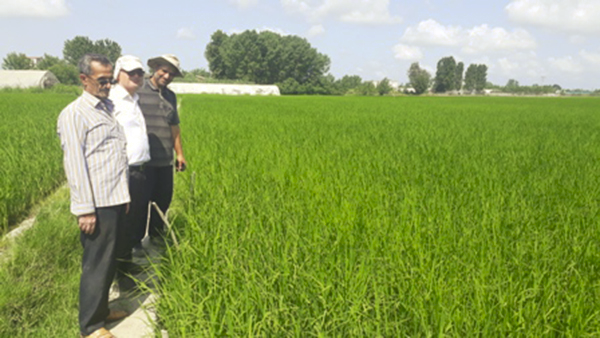
[August 25, 2019] According to Bahman Amiri Larijani, Head Manager of Haraz Extension and Technology Development Center (HETDC), a pilot demonstration in Vazik Village, Mahmoudabad City, in Mazandaran province, was established by the HETDC in
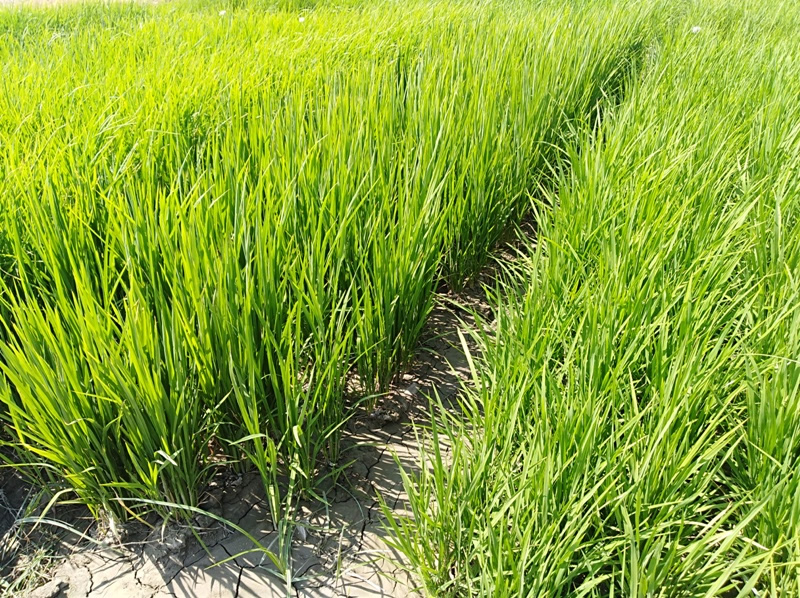
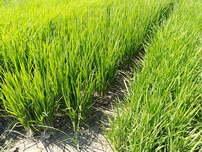 order to investigate the role of plant density on tiller number and tillering pattern of rice plants. The 5,000 sq.mt. site was planted with a local variety known as Tarom. Avoidance of permanent flooding through intermittent irrigation was also used to encourage farmers to begin adopting the SRI. As one of the project goals is to slowly change the attitude of farmers from traditional practices to SRI methods, not all SRI principals were not implemented to in the pilot.
A news item on the HETDC website, which is associated with the Ministry of Agriculture's Agricultural Research, Education and Extension Organization (AREEO), further explained that SRI methods were adapted for plots in Vazik village by Mahmoudabad City's Agricultural Jihad Management in collaboration with HETDC. Majid Niknejad, Senior Expert in Organic Rice at the Center and contributing researcher on this project, provided technical advice during the site visits on how best to manage the plots. In a recent visit to Engineer Ranjbar's farm, vegetative stage spraying, summer drainage, and the impact of plant density on the number of effective tillers were discussed. The merits of SRI rice cultivation methods were covered along with the importance of achieving the proper number of plants per unit area so that, in addition to maximum tillering per plant, productive tillers per unit area can also be obtained. [See HETDC news item for more information on this project.] The HETDC is also carrying out dry-bed rice cultivation without puddling and flooding in the form of direct seeding, dry-bed transplanting, and varying irrigation methods including tape type, sprinkler and drip irrigation methods.
-
Former Vice-Minister of Agriculture from Iran Gives SRI Presentation at Cornell University
[June 15, 2016] M. H. Emadi, who is responsible for initiating SRI trials in Iran in 2004, visited SRI-Rice in Ithaca, NY, during mid-June for discussions on the progress of SRI in Iran during the past twelve years. While at Cornell, he gave a presentation on June 15, 2016, about Iran's experiences with SRI.
 Emadi, who is a former Vice-Minister of Agriculture in Iran, noted that while the rice research efforts in Iran are currently aimed at plant breeding and fine-tuning the use of agrochemical inputs, small farmers, who could benefit greatly from SRI methods, have been largely left out of the agricultural research agenda. SRI is becoming more attractive to researchers and farmers alike as agricultural water availability decreases.
The photo at right includes (from left to right), Emadi, Robert Bimba, who was visiting from Liberia, and Marguerite and Norman Uphoff. -
SRI Demonstrations on Farmer's Fields under PTD Project Successful
[September 27, 2013] Bahman Amiri Larijani, Head of Crop Production Technology Group at Haraz Extension and Technology
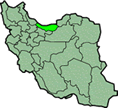 Development Center in Amol, provided a report on the SRI component of a project carried out from May to September 2013
in Gol Mahaleh village, Joybar City, Mazandaran province (see location at left). The project, which was intended to to evaluate, demonstrate and improve paddy field management through extension and application of the SRI method of rice production, included a number of field experiments carried out under the World Bank-funded Participatory Technology Development (PTD) project.
Development Center in Amol, provided a report on the SRI component of a project carried out from May to September 2013
in Gol Mahaleh village, Joybar City, Mazandaran province (see location at left). The project, which was intended to to evaluate, demonstrate and improve paddy field management through extension and application of the SRI method of rice production, included a number of field experiments carried out under the World Bank-funded Participatory Technology Development (PTD) project. The participants and trainees were key PDT farmers and extension staff in Joybar city, who cultivated a local rice
 variety (Tarom) by transplanting methods under three different trials with farmers' participation. Trials were as follows: #1)
effect of number of seedlings per hill at transplanting time on the rice growth and yield, by planting 1, 3, 5, 7 and 11 seedlings per hill; #2)
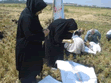
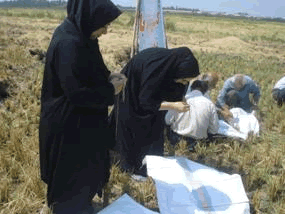
effect of transplanting depth on rice growth and yield, comparing shallow and deep treatments; and #3) effect of irrigation management and intermittent irrigation on rice root system and yield. The photo at right shows Amiri Larijani demonstrating the effects of irrigation on root growth. In the photo at right, women are sampling the harvest for yield component analysis.
The results showed that best results were achieved with fewer seedlings, shallow planting and intermittent irrigation. (For details, see report.)
variety (Tarom) by transplanting methods under three different trials with farmers' participation. Trials were as follows: #1)
effect of number of seedlings per hill at transplanting time on the rice growth and yield, by planting 1, 3, 5, 7 and 11 seedlings per hill; #2)
effect of transplanting depth on rice growth and yield, comparing shallow and deep treatments; and #3) effect of irrigation management and intermittent irrigation on rice root system and yield. The photo at right shows Amiri Larijani demonstrating the effects of irrigation on root growth. In the photo at right, women are sampling the harvest for yield component analysis.
The results showed that best results were achieved with fewer seedlings, shallow planting and intermittent irrigation. (For details, see report.) -
2012 Journal Article Reports on Effects of Integrated Fertilizer Use with SRI in Iran
[December 2012] B. Amiri Larijani and S.J. Hoseini presented results of trials on the effects of integrating chemical and organic fertilizer management on rice growth and yield under SRI management in a 2012 article published in the International Journal of Agronomy and Plant Production. Field experiments were conducted during the 2011 growing season at a Caspian sea coastal area using local high quality variety (Tarom) with 9 treatments consisting of different combinations of organic fertilizer and azola-compost with urea fertilizer using SRI. The results indicated more tillers (28%), higher chlorophyll content at panicle initiation stage (28%) and flowering time (13.5%), more panicles/m2 (60%), a higher number of filled grains/m2 (20.6%), more spikelets per panicle (19.6%) and increased grain yield (30.6%) with combined use of organic and chemical fertilizer compared with chemical fertilizer alone. Interestingly, grain yield of azola compost alone was slightly higher than with chemical fertilizer alone and there was no significant difference between chemical fertilizer and organic fertilizer alone. However, highest yield (4772.4 kg ha) resulted from a combination of organic fertilizer BIOL555 (1 ton/ha) + urea application 50 kg/ha (25% as basal and 25% at PI).
The authors also concluded that rice nutrition under SRI management is especially important under poor soil fertility conditions and that organic inputs can replace chemical fertilizer for local varieties without reducing yield, and, in some cases yields may even improve with SRI methods. However, the kind of compost or organic material and rate of application is very important for increasing soil productivity. (See article for more details.)
-
2008 SRI Report for Iran
 Bahman Amiri Larijani, head of the agronomy department at the Haraz
Extension and Technology Development Center in
Bahman Amiri Larijani, head of the agronomy department at the Haraz
Extension and Technology Development Center in 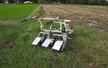 Amol, near the Caspian Sea, has sent in a report (with photos) from the 2008 trials both on-station and
in farmers' fields. Average SRI yield advantage has been 60% thus far. The three
years of on-farm trials have shown a 64% advantage for SRI methods, 6 tons/ha
vs. 3.65 tons, using less than 2/3 as much water as usual. Of the various
on-station SRI experiments with organic and chemical fertilizers, trials using
chicken manure plus NPK fertilizer gave an average yield of 7 tons/ha.
Larijani's colleague, Mr. H. Aghagolzadeh, has designed the first rotary
weeders in Iran that can be used with SRI (see photos at left and right; click
on the photos to enlarge).
Amol, near the Caspian Sea, has sent in a report (with photos) from the 2008 trials both on-station and
in farmers' fields. Average SRI yield advantage has been 60% thus far. The three
years of on-farm trials have shown a 64% advantage for SRI methods, 6 tons/ha
vs. 3.65 tons, using less than 2/3 as much water as usual. Of the various
on-station SRI experiments with organic and chemical fertilizers, trials using
chicken manure plus NPK fertilizer gave an average yield of 7 tons/ha.
Larijani's colleague, Mr. H. Aghagolzadeh, has designed the first rotary
weeders in Iran that can be used with SRI (see photos at left and right; click
on the photos to enlarge).
-
2007 Trials Confirm Yield Benefits of SRI
B. Amiri Larijani sent in a report (436kb) on the trials conducted during 2007 on-station and on nearby farmers' fields, evaluating the impact of SRI practices on a favored local variety (Tarom), an improved variety, and a hybrid. The comparisons with conventional methods are reported as follows: Local variety yield was increased from 3.6 to 5.8 t/ha; the improved variety yield was increased from 6.1 to 9.8 t/ha; and the hybrid rice yield was increased from 7.2 to 10.8 t/ha. The average increase was 56.2%, with reduction in inputs of water and chemical fertilizer.
-
2005-2006 SRI Trials in the Province of Mazandaran
Bahman Amiri Larijani, head of the agronomy group at the Haraz Extension and Technology Development Center in Amol, evaluated SRI trials in the rice-growing province of Mazandaran near the Caspian Sea (see report, 430 KB PDF). The main reasons for interest in SRI practice in Iran are:
- The prevalence of small-scale farms with average rice field ownership about 0.7 ha.
- High costs of production and resulting low income from rice cultivation based on the labor of family members.
- Frequent water shortages during the rice cropping season.
- Local varieties with high consumer demand give low yield with present practices and are susceptible to blast disease and lodging.
- Heavy application of agrochemical inputs that contributes to contamination of water and soil resources.
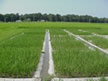
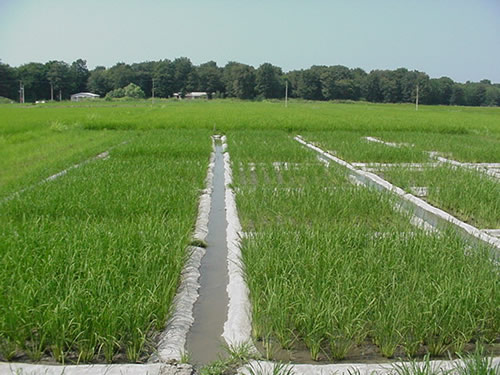
SRI research which started in 2005 on a 2 ha paddy field near the Caspian Sea continued this year with field experimental plots and demonstration fields (click on photo of the experiments at right to enlarge). Evaluation was done with a traditional variety (Tarom) that has high-quality grain and a good market price but which is generally low-yielding. The yield on farmers' fields with conventional methods was 3.65 t/ha vs. 6.0.
At the Amol research station, 12 different treatments were evaluated with different combinations of plant spacing and fertilizer treatment, together with other SRI methods. Highest yield, 7.03 t/ha, was with spacing of 25x25 cm and a combination of chemical fertilizer and chicken manure. The average yield for three spacings (25x25, 30x30 and 40x40 cm) was 5.18 t/ha with chemical fertilizer, 6.12 t/ha with chicken manure, and 6.07 t/ha with a combination of both.

Reports and Articles
- Koutenaei, Norrolah Jalali. 2022. Evaluation of the effect of different cultivation systems on water productivity, yield and yield components of two improved and native rice cultivars. Iranian Journal of Irrigation and Drainage 16(1):135-147.
- Hosseinpour, S., H. Moghadam, and H. Pirdashti. 2021. Evaluation of yield and yield components of rice cv. ‘Tarom Hashemi’ in System of Rice Intensification (SRI) and conventional systems. Journal of Agricultural Science and Sustainable Production (in press). doi:10.22034/saps.2021.36888.2376
- Ghanaei-Pashaki, K. Mansour. 2020. Effect of rice-duck co-cultivation on rice yield, water productivity and weed control in different cultivation systems. Iranian Journal of Field Crops Research 18(3): 341-355. doi: 10.22067/gsc.v18i3.86497 [see English translation]
- 2019. بازدید میدانی سایت الگویی کشت برنج به روش در روستای وازیک محمودآباد با حضور کارشناسان مرکز هراز انجام شد. SRI rice field site visit Vazik village of Mahmoudabad was attended by experts of Haraz Center. Ministry of Agriculture - Jahad - AREEO website.
- Vidal, John. 2019. Miracle method for sustainable rice that scientists dismissed. Iran Daily, January 30. [Article on SRI in Thailand and Afrika published in Iranian newspaper.]
- Dastan, Salman, et al. 2016. CO2 emission and global warming potential (GWP) of energy consumption in paddy field production systems. Būm/shināsī-i kishāvarzī 6(4): 823-835.
- Amiri Larijani, Bahman. 2013. Report of SRI method demonstration at farmer’s field under PTD project in Iran (2013) . System of Rice Intensification website. (6p., 222KB pdf)
- Dastan, S., Gh. Noormohamadi, H. Madani, H. R. Mobasser, and M. S. Daliri. 2013. Evaluation of related to lodging characteristics and grain yield in Iranian rice genotypes under modified agronomical systems. Annals of Biological Research 4(2): 267-275.
- Dastan, S., Gh. Noormohamadi, H. Madani, H. R. Mobasser, and M. Sam Daliri. 2013. Agroecological parameters of Iranian rice genotypes in modified systems. Life Science Journal 10(1s): 219-224.
- Amiri Larijani, B., and Sayed Jalal Hoseini. 2012. Comparison of integrated chemical and organic fertilizer management on rice growth and yield under system of rice intensification (SRI). International Journal of Agronomy and Plant Production 3(S): 726-731.
- Dastan, Salman. 2012. Evaluation on agronomic and eco-physiological indices of lowland rice genotypes under modified agronomical systems. PhD dissertation, Islamic Azad University, Iran.
- Alizadeh, M. R. 2011. Field performance evaluation of mechanical weeders in the paddy field. Scientific Research and Essays 6(25): 5427-5434.
- Amiri Larijani, B. 2009. The System of Rice Intensification (SRI) in Islamic Republic of Iran in 2008. Ministry of Jihad-e-Agriculture, Haraz Extension and Technology Development Center, Amol, Mazandaran, Iran. System of Rice Intensification website. (7p., 308KB pdf)
- Amiri Larijani, B. 2008. Report on System of Rice Intensification in Iran, 2007. Ministry of Jihad-e-Agriculture, Haraz Extension and Technology Development Center, Amol, Mazandaran, Iran. System of Rice Intensification website. (4p., 435KB pdf)
- Amiri Larijani, B. 2006. System of Rice Intensification (SRI) in Islamic Republic of Iran. Ministry of Jihad-e-Agriculture, Haraz Extension and Technology Development Center, Amol, Mazandaran, Iran. System of Rice Intensification website. (6p.,430KB pdf)
Presentations
- Emadi, M. H. 2016. The System of Rice Intensification (SRI) in Iran. 23 slides. Presentation at the SRI-Rice seminar series. Cornell University, Ithaca, NY, June 15. SRI-Rice channel, Slideshare.net.
- Amiri Larijani. 2012. Rice planting under dry bed transplanting. Presentation by B. Amiri Larijani about non-irrigated rice experiments (dry bed transplanting) undertaken at the Haraz Extension and Technology Development Center (HETDC) at Amol City, Mazandaran province, Iran. 6 slides.