

PERÚ
Overview
The first SRI results in Perú were reported by Pablo Lutz, who learned of SRI from a 2001 article in ECHO Development Notes. Working with farmers near Pucallpa in the Amazonian region of Perú, rice yields increased from 2 to 8 t/ha with SRI methods. Ir. Ángel Fernández García, a private agricultural consultant, became interested in SRI and attended the Sanya conference in China in 2002. His first two seasons were unsuccessful, but third-season yields in 2003 resulted in field-scale yields of 9-11 t/ha using IR-42. (Rice production in Perú averages 6 t/ha). By 2007, Fernández' evaluations extended to 500 ha with yields of 8-12 tons. In a review of SRI/SICA in Perú for the 4th International Rice Meeting held in Havana, Cuba (June 2-6, 2008), Fernandez showed that if SRI increased yields from 5-7 tons/ha to 8-10 tons/ha accompanied by a 20% reduction in costs/ha (from $1,000 to $800), this would make rice production in Perú much more profitable than at present.
During 2008, Divar Moya Zavaleta began SRI cultivation in the Lambayeque-Chancay valley and as of 2013, he is averaging 15 tons/hectare. He is a founding member of Agro-Corporación COMFIA, which provides inputs and seedlings to SRI farmers in the area. During December 2014, Molino El Cholo, a company located in the northwestern Perú's rice-growing areas of Chepén district in the La Libertad region, has been conducting trials to show that SICA/SRI can work well in Peru and to convince others in the rice value chain of its importance.
Progress and Activities
2015 Update
 Molino El Cholo Conductis SICA/SRI Trials with Hopes of Scaling Up in Northwestern Perú
[February 27, 2015]
 Molino El Cholo, a company located in the northwestern Perú's rice-growing areas of Chepén district in the La Libertad region, has been conducting trials to show that SICA/SRI can work well in Peru, and has set about on a campaign to reach farmers and to convince officials and others in the value chain of SICA's relevance.
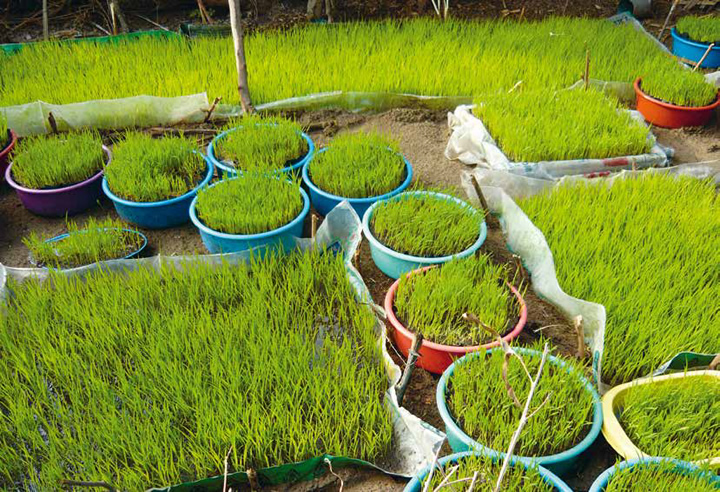
At the fields known as "Campo Molino El Cholo," three hectares were hand-transplanted during December 2014 with seven-day old single seedlings (at the two-leaf stage) at distances of 30x30, 40x40 and other third 50x50 cm.
At 79 days after planting, some of the plants had as many as 101 tillers, with the variety Tinajones has reportedly shown the most promise.
Molino El Cholo, a company located in the northwestern Perú's rice-growing areas of Chepén district in the La Libertad region, has been conducting trials to show that SICA/SRI can work well in Peru, and has set about on a campaign to reach farmers and to convince officials and others in the value chain of SICA's relevance.
At the fields known as "Campo Molino El Cholo," three hectares were hand-transplanted during December 2014 with seven-day old single seedlings (at the two-leaf stage) at distances of 30x30, 40x40 and other third 50x50 cm.
At 79 days after planting, some of the plants had as many as 101 tillers, with the variety Tinajones has reportedly shown the most promise.Though the fields have not been harvested as of this report, the positive features of the SICA plots so far include: Substantial seed savings (five kilos of seeds per hectare were used), no presence of pests and diseases, good seedling vigor and tillering, and 40% water savings, which is excellent for times of drought. After reading reports in the literature about the record-breaking yield with SRI elsewhere, Molino El Cholo expects that, with good cultural management, they can get at least two tons more than they are already getting (about 14 tons/ha) and possibly much more. They hope that this will not only benefit farmers, but consumers, who can get rice at competitive prices, and put more rice millers to work. For photos and more information on the activities described here, visit the El Cholo rice processing plant facebook page.
2013
- Article in Agriculture Matters Magazine Documents SRI Success in Perú
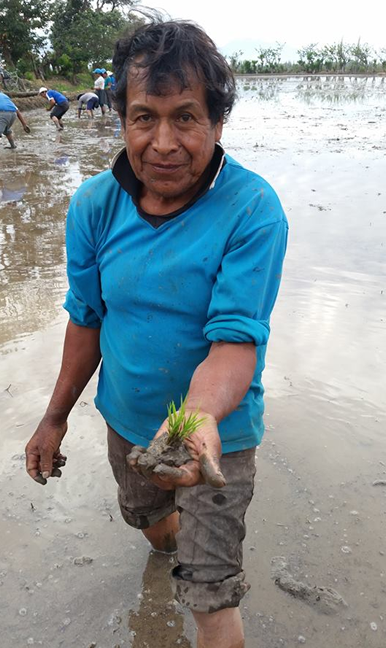
[March 23, 2013] Divar Moya Zavaleta has been growing rice since 1998 at his farm at Fundo Santo Tomas in the Lambayeque-Chancay valley, where average yields are around eight tons/ha. In 2004, he found an article about Angel Fernandez, whose 2002-2008 SRI experience is documented below, and his interest was piqued. According to a recent article in Farming Matters and a Spanish language article in the LEISA revista de agroecología, extension agents advised Divar that small widely-spaced seedlings much less water could not possibly be successful. However, in 2008, he finally met Ing. Fernandez in 2008, organized a seminar for 75 neighbors, and tried SRI himself during the 2008-2009 season. Skeptical neighbors were surprised to find using less water (6,500 m3 of water per hectare as opposed the the recommended 10,000 m3), less seed (6 rather than the usual 80 kg), and small seedlings (right) actually
 resulted in higher yields. While more labor was needed for transplanting and weeding, the extra costs were offset by the additional income. Since 2009,
Divar's yields have averaged 15 tons/ha.
resulted in higher yields. While more labor was needed for transplanting and weeding, the extra costs were offset by the additional income. Since 2009,
Divar's yields have averaged 15 tons/ha. However, even though he saved on inputs and increased yields, most of Divar's neighbors have not adopted SRI. He believes this could be because most are older or resistant to new ideas, but more likely it is because most farmers depend upon others in the value chain who influence their decisions: Those who sell inputs, provide credit, or buy the harvested crop).
Despite resistance from those who "own production process" and little interest from the local authorities, Divar and a few of his neighbors are moving forward with SRI. They began adding compost to their fields (which reduced fertilizer purchases), trying out hand weeders, improving the efficiency of the irrigation system, and, ultimately they formed Agro-Corporación COMFIA to provide the seed and other inputs they needed, and to produce enough rice seedlings for up to 20 hectares. Divar is also considering selling organic rice soon. Meanwhile, they are not waiting for government support for small farmers: They have set a course and believe others will follow. (See Farming Matters article, the LEISA revista de agroecología article, or, for more information, contact the author [dd.moya At hotmail.com].)
An article by Ángel Fernández García also appeared the April edition of LEISA revista de agroecología. "El Sistema Intensivo del Cultivo de Arroz (SICA). Testimonio de 10 años de experiencia en el Perú" outlines Fernández' experiences with SRI beginning in 2002 and the potential to extend SRI/SICA in Perú in subsequent years.
2008 Update
- SRI Progress in Perú Presented at the 4th International Rice Meeting in
Havana
Ir. Angel Fernández prepared a review of progress with demonstrating SRI/SICA under Perúvian conditions in advance of his participation in the 4th International Rice Meeting held in Havana, June 2-6, 2008. Trials plots have shown that yields can be boosted from 5-7 tons/ha to 8-10 tons/ha, with a 20% reduction in costs/ha (from $1,000 to $800), making rice much more profitable than at present.
Despite evident economic advantages of SRI, Ir. Fernández says that he has encountered problems in getting it introduced. There are very high costs of irrigation in the coastal region of Perú, and the costs of agrochemical inputs are mounting, so SRI should be attractive. With the introduction of new varieties, rice yields increased during the 1990s, up to 8 tons in 2000. But since then, there has been no further gain in yield. SRI thus comes along at an opportune time.
With some financial support, the first 500 hectares of SICA have been planted, and Fernández expected that SICA would expand to several thousand hectares in two areas. His goal is to reach 20,000 hectares within 5 years, and rising input costs and tighter water constraints were expected to ensue if the yield gains hold up. However, we have not heard the final outcome of the efforts.
2007 Activities
- SRI Evaluations Expand to 500 Hectares After Four Seasons
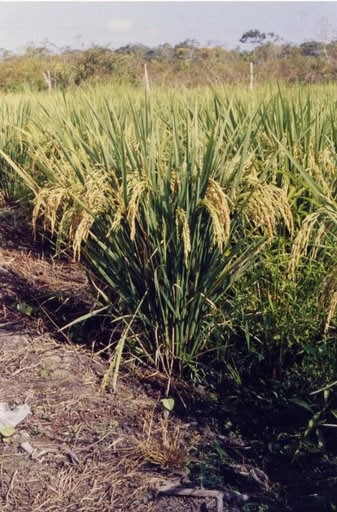
During 2007, Ir. Fernández reported on results of carefully planned trials over the last four seasons of six months each. The evaluations started with 19 farmers on 100 hectares, but the
 number grew to 169 farmers
on 400 hectares by the third season, and then to 500 hectares in the fourth,
indicating farmer satisfaction with the methods. Whereas yields over the past
10 years with standard methods in that area have been 5-7 tons/ha, with SRI
methods the yields have been at least 8 tons/ha and more usually 9-10 tons/ha,
with some yields of 10-11 and 11-12 tons/ha achieved by farmers who adapted
appropriately all the SRI practices -- sowing density, water applications,
fertilization, and timing of irrigation.
number grew to 169 farmers
on 400 hectares by the third season, and then to 500 hectares in the fourth,
indicating farmer satisfaction with the methods. Whereas yields over the past
10 years with standard methods in that area have been 5-7 tons/ha, with SRI
methods the yields have been at least 8 tons/ha and more usually 9-10 tons/ha,
with some yields of 10-11 and 11-12 tons/ha achieved by farmers who adapted
appropriately all the SRI practices -- sowing density, water applications,
fertilization, and timing of irrigation.Costs of production were reduced by $200 per hectare, adding to the profitability of SRI methods. A mechanical weeder is being used that makes the use of herbicides unnecessary, and fertilizer applications are reduced by 50-60%, with higher yield. Fernández reports that the profitability of SRI has become very convincing to farmers, and he hopes to expand this transformation of rice production in Perú.
2001-2005
- 9-11 t/ha Yields Obtained During Third Year of SRI Trials
Ir. Fernández García at the National Institute of Engineering became interested in SRI since attending the Sanya conference in 2002. The first two seasons, his trials were not successful due to drought or cold, which also negated other rice production. In 2003, however, he obtained field-scale yields of 9-11 t/ha, and trial plot results as high as 23 t/ha with IR-42. Rice production in Perú averages 6 t/ha, which is not profitable given the cost or production and prevailing market price for rice. The profitability of rice production with SRI methods, on the other hand, is very attractive, and Dr. Fernandez continued to be optimistic about their spread. (See Spanish language report.)
- 2005 Trials with Pro-A NGO Inconclusive
The NGO Asociación Promoción y Desarrollo Agario (Pro-A), undertook farmer trials in La Ramada, Cajamarca, with inconclusive results. Pro-A produced a 6-page Spanish-language manual, El Sistema de Intensificación del Cultivo Arrocero (SICA), together with and the Asociación Productores de Arroz Ramadino.
- 2002 SRI Trials in Amazonia Region Result in 8 t/ha Yield with SRI and
5.5 t/ha Ratoon Crop
The first SRI results in Perú were reported by Pablo Lutz, based on what he read about the methods in a 2001 article in ECHO Development Notes. Farmers near Pucallpa in the Amazonian region got a yield of 8 t/ha with SRI methods where before they got only 2 t/ha, with a lot of time devoted to bird-scaring. With SRI, this was not necessary because the heavier panicles hung down so that birds could not feed on them. In addition, they got a ratoon (regrowth) harvest of 5.5 t/ha.
Reports and Presentations
- Pinazo Caldas, M. V. 2017. Comparación de tres sistemas de transplante manual en arroz (Oryza sativa L.) en el valle Jequetepequ. Universidad Nacional Agraria La Molina Lima Peru Facultad De Agronomia repository. 88p pdf.
- Moya Zavaleta, Divar. 2013. ¿Loco? ¡De ninguna manera! LEISA revista de agroecología 29 (1): 12-13. April.
- Moya Zavaleta, Divar. 2013. Crazy? Not at all. Farming Matters 29(1):14-15. March.
- Fernández García, Ángel . 2013. El Sistema Intensivo del Cultivo de Arroz (SICA). Testimonio de 10 años de experiencia en el Perú. LEISA revista de agroecología 29 (1): 14.
- Fernández García, Á. 2008. Sistema tradicional vs “SICA” castellano ó “SRI” ingles. System of Rice Intensification website. September 10. [Document prepared for a visit to farmers in Jaén, Perú] (6p. pdf)
- Fernández García, Á. 2008. Avances y perspectivas del SRI/SICA en Perú. Paper prepared for the 4th International Rice Meeting, June 2-6, 2008, in Havana. (3p. pdf)
- Fernández García, Á. 2005. Informe de experimentation - SICA. Asociación Promoción y Desarrollo Agrario (Pro-A). System of Rice Intensification website. June. (4p., 265KB pdf)
- Fernández García, Á. Ensayo de adaptabiliidad del "SRI" y 5 variedades en Rioja. Colegio de Ingenieros del Perú. Lima, Peru. (8p., 207KB). System of Rice Intensification website. November. [Informe final del ensayo "SRI" en Rioja-San Martin]
Practical Information
- PRO-A. El Sistema de Intensificación del Cultivo Arrocera (SICA). Asociación Promoción y Desarrollo Agrario (Pro-A). System of Rice Intensification website. (6p., 864KB pdf).[Instructional material developed by the NGO Asociación Promoción y Desarrollo Agrario (Pro-A) in Chiclayo, Peru, together with the Asociación Productores de Arroz Ramadino in La Victoria, Chiclayo, Perú]