

SENEGAL
Summary
The first SRI trials in Senegal were done in 2003 at the initiative of Dr. William Settle (FAO) who reported control plots yields of 4 and 5 t/ha vs. SRI plot yields of 9 and 11 t/ha, respectively. In 2006, Peace Corps Volunteer Carrie Miner had some initial success introducing SRI to women farmers in the Kolda region (see New Farm article).
During 2007-2009, Tim Krupnik and colleagues at FAO and the Africa Rice Center did a series of evaluations that included adapted SRI practices in the Senegal River Valley and in the Podor region. Their research during 2008-2009 showed that adapted SRI practices resulted in significantly higher yields than traditional farmer practices and were as good or better than current recommended management practices. However, while farmers appreciated the yield and water saving benefits of the adapted SRI approach, they were concerned by the increased labor requirements, especially for weeding activities that coincided with labor needs for the horticultural crop. These findings resulted in further experimentation with a hybrid system that incorporated elements of the recommended practice and the adapted SRI practices (maintaining intermittent irrigation, increasing crop density and following a single round of mechanical weeding with localized herbicide applications). The hybrid system was able to reduce weed biomass, labor, and input requirements (including herbicides) and gave the highest net profits in nearly all sites for the 2009 wet and dry seasons.
During 2012, a delegation from Senegal at the Regional Workshop on the System of Rice Intensification (SRI) in Burkina Faso reported that trials evaluating SRI methods (comparing them with farmer practice under rainfed conditions) in the northeastern part of the country began in 2008 at four sites, and increased to six in 2011. The trials, which were conducted under the Agricultural Development Project in Matam (PRODAM), reported that SRI yields averaged 53% higher than farmer-practice results. During June 2012, USAID's Expanded Agribusiness and Trade Promotion (E-ATP) sponsored a ToT on SRI in Kaolack, with 33 participants from seven partner organizations. In July, 2013, four Peace Corps-sponsored SRI trainings were provided in Senegal's Kaffrine and Fatick Regions. A study on SRI adaptations in these four sites was completed in 2014 by Lorraine Perricone-Dazzo as part of her Cornell University MPS degree (see update below).
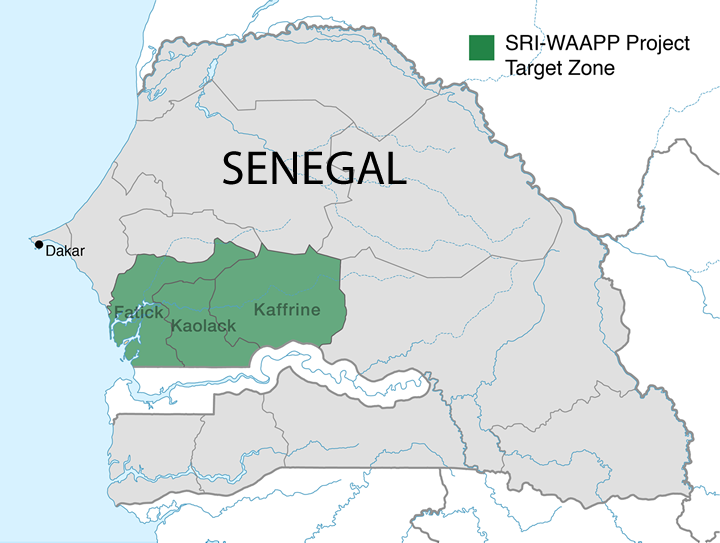
A regional workshop for finalizing the project "Improving and Scaling Up of the SRI in West Africa" was held in Saly, Senegal, from July 30 to August 2, 2013. The SRI-WAAPP project, a 13-country initiative, began during January 2014. The SRI-WAAPP project in Senegal, with Abdoulaye Sy as the Project National Facilitator, began during August 2014. The map at left (click to enlarge) shows the project target zone. As of 2016, there is an updated map of SRI-WAAPP sites in Senegal, which is located below. During 2014, SRI expanded in Senegal through of the efforts of the World bank-funded West Africa Agriculture Productivity Program (WAAPP) program, Peace Corps Senegal, and other smaller initiatives in the country. In December of that year, the National Agency for Agricultural and Rural Extension (ANCAR), in conjunction with SRI-WAAPP made plans to mobilize 5,000 rice producers in Senegal's Fatick and Kaolack regions to try out SRI methods in order to improve rice productivity and farmer income. A four-day technical training was held in Dakar from August 3-6, 2015, with participants from 11 ECOWAS countries, who learned from SRI-Rice how to use ESRI's data collection, visualization and reporting platform to manage information on SRI progress for the SRI-WAAPP Project. While the SRI-WAAPP project ended at the end of 2016 (see map for field sites), subsequent visits from World Bank and WAAPP officials in October 2017 confirmed continued appreciation of SRI by farmers, who were spending less on seeds and inputs, while helping to mitigate climate change by lowering greenhouse gas emissions, and reaping bigger harvests. Two 2019 Université Assane Seck de Ziguinchor theses by Dione and Diédhiou found SRI to be profitable in Ziguinchor district. A 2021 journal article in Ziguinchor district by Diedhiou et al detailed how SRI was more productive and economically more profitable than the traditional system. In October 2021, the Adaptation Fund approved the SRI-based “Scaling up Climate Resilient Rice Production in West Africa” (RICOWAS) project which includes Senegal and 12 other countries in the region. During July 2025, the Senegalese Institute for Agricultural Research (ISRA) began experimenting with SRI in Fanaye, Savoigne, and several other areas of the Senegal River valley.
Progress and Activities
2025 Updates
 L’Institut Sénégalais de Recherches Agricoles (ISRA) Experiments with SRI in the Senegal RIver Valley
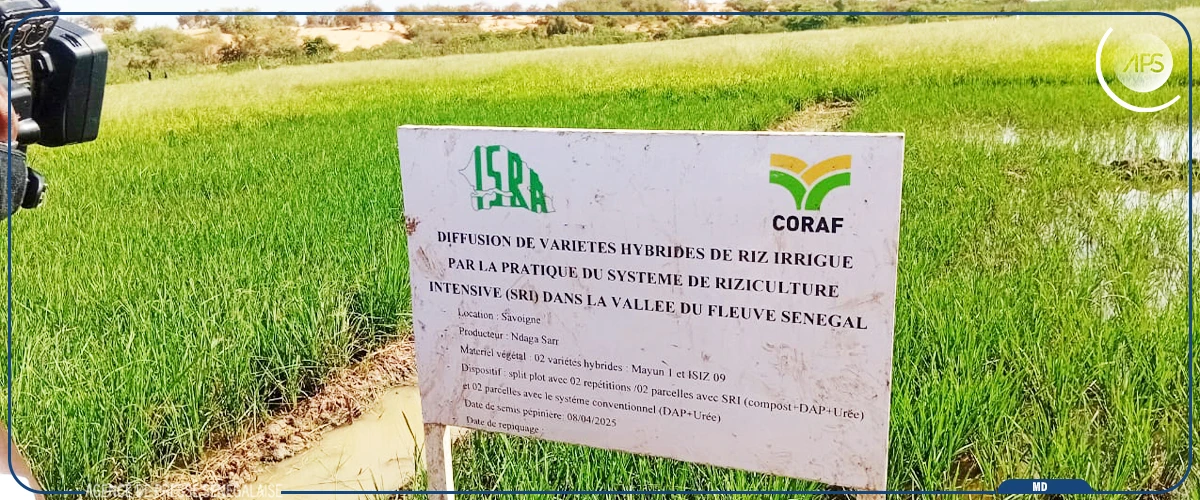
 [July 16, 2025] According to an APS article, the Senegalese Institute for Agricultural Research (ISRA) is experimenting with the System of Rice Intensification (SRI) with the aim of increasing yields in the Senegal River valley. At the end of a two-day tour of the two project sites, Omar Ndao Faye, director of the Agricultural Research Center (CRA) of Saint-Louis said, "We are currently experimenting with SRI in the valley, particularly in Fanaye and Savoigne, in collaboration with the West and Central African Council for Agricultural Research and Development (CORAF)."
The project also encourages the use of hybrid seeds. [See APS article for details.]
[July 16, 2025] According to an APS article, the Senegalese Institute for Agricultural Research (ISRA) is experimenting with the System of Rice Intensification (SRI) with the aim of increasing yields in the Senegal River valley. At the end of a two-day tour of the two project sites, Omar Ndao Faye, director of the Agricultural Research Center (CRA) of Saint-Louis said, "We are currently experimenting with SRI in the valley, particularly in Fanaye and Savoigne, in collaboration with the West and Central African Council for Agricultural Research and Development (CORAF)."
The project also encourages the use of hybrid seeds. [See APS article for details.]
2021
- Senegal Included in Four-Year Regional SRI-Based RICOWAS Project
[October 21, 2021] The Adaptation Fund (AF) has approved the “Scaling up Climate Resilient Rice Production in West Africa” (RICOWAS) project in October 2021. The four-year, $14 million effort, which emphasizes the System of Rice Intensification (SRI), is the largest regional project funded by the AF in Africa, covering thirteen ECOWAS countries. In Senegal, the National Agency for Agricultural and Rural Advice (NAARA) will be in charge of executing the project. The overall purpose of the initiative is to improve climate resilience and increase the productivity of the rice system of smallholder rice farmers in West Africa. Regionally, the Sahara and Sahel Observatory (OSS), will oversee the project overall implementation. The Rice Regional Center of Specialization, hosted by the Institute of Rural Economy (IRE) of Mali, will be in charge of the regional level execution and will work in partnership with the Climate Resilient Farming Systems program at Cornell University. [See OSS article for more information.]
- Studies in Ziguinchor District Shows SRI Improves Yields and Incomes
[January 31, 2021] An article by Diédhiou et al published in Forestry & Agriculture evaluated the yields and profitability of SRI vs the traditional practices (TP) in Ziguinchor district, Senegal. Eighteen producers in the Badiate, Essyl, and Fanda sites had plots planted for comparative yield parameters; questionnaires were randomly administered to 55 producers to collect data on rice production and costs. The yield parameters, including the number of fertile tillers per m2, the number of spikes, and the weight of the 1000 grains, were found to be significantly higher (p<0.05) for SRI including yield compared to the traditional system. The lower the transplanting density, the higher the yield parameters and the yield. The economic profitability, determined based on the benefit/cost ratio, is higher in SRI (1.5) than in TP (1.2). While the authors noted that SRI required a lot of technicality in its implementation and generated more cost of production, SRI was more productive and economically more profitable than the traditional system. [See the journal article for details. This work is also included in his 2019 thesis from Université Assane Seck de Ziguinchor (UASZ) .] A second 2019 thesis from UASZ by Modou Dione also supports the findings that SRI methods result in higher productivity than traditional rice production practices.
2019
-
SRI Project Helps Senegal Move Towared Rice Self-Sufficency
[October 8, 2019] According to an article in Lequotidien, a monitoring mission was conducted by the Directorate of Agriculture and the national research institute to review the a 30-hectare SRI trial in the southern Casamance region implemented by National Agricultural and Rural Advisory Agency (ANCAR). This was the first part of a monitoring mission to review mid-season progress. There will be another mission just before the harvest and then a final mission to review commercialization. The president of the regional farmers group said that the objective of this project is rice self-sufficiency. Farmers who previously individually cultivated small plots now utilize this associated land in order to accommodate mechanization. The president of the group explained how they are now using nurseries and transplanting with 25 cm spacing, which results in significantly less seeds used. (For a .25 hectare parcel, farmers previously used 12-15 kilos of seeds, whereas now they use 3 kilos). He also noted that with SRI farmers require much less space and time to establish nurseries. [See French language article in Lequotidien]
2017
-
SRI Project Helps Senegal Move Towared Rice Self-Sufficency
 [December 22, 2017] An SRI initiative undertaken during the past two years has begun to show results in promoting rice self-sufficiency along with a reduction in Senegal's annual import bill for rice. The project leaders believe that during this next year SRI will gain yet more ground and will be rolled out throughout the country by the majority of Senegalese producers. On December 21, a workshop to review SRI dissemination was held by the National Agricultural and Rural Advisory Agency (ANCAR) and the Agricultural Productivity Program in West Africa (WAAPP), who are partners in the SRI project. SRI has led to marked improvement in rice production in the communes, lowlands and valleys where the Agricultural and Rural Council (CAR) programs are carried out. Yields, which have risen 50% to 100%, vary between 3 to 5 t / ha throughout the 10,000 ha planted. Nevertheless, much remains to be done to achieve the objectives for rice production set by the National Rice Self-Sufficiency Program (PNAR). In addition to reporting on SRI diffusion, the workshop participants discussed SRI's role in resisting the threat of the climatic changes.
-
West Africa Agricultural Productivity Program (WAAPP) Visits in Senegal Highlights SRI Successes in Senegal
[October 29, 2017] At the 10th joint World Bank / State of Senegal support mission to the implementation of the West Africa Agricultural Productivity Program (WAAPP), Ayfa Fatimata Ndoye Niane, senior economist at the World Bank office in Dakar, noted the integrating dimension of the West Africa Agricultural Productivity Program (WAAPP), particularly through technology transfer from Mali, Niger, Burkina Faso and Ghana to Senegal. Participants of a delegation tour to Dialacounda (Kaolack), Coular Socé and Niombato (Fatick) learned that women SRI-adopters supervised by the National Agency for Agricultural and Rural Council have experienced yields up to four times higher. "SRI has been tested at the National Specialized Rice Center in Mali, which has collaborated with WAAPP to introduce this innovation; SRI has been much appreciated by the producers who have adopted it," said Ms Niane, who welcomed the regional dimension of the project. [See French language APS article for details.] An article on the WAAPP website adds that, in the fertile Senegal River valley, farmers who have been in SRI techniques, are using compost, applying organic instead of mineral fertilizer, and planting 20 instead of 60 kilograms of rice seed per hectare. While spending less on seeds and inputs, they are helping to mitigate climate change by lowering greenhouse gas emissions, and reaping bigger harvests.
2016
- SRI-WAAPP Regional Workshop and Expansion of SRI Sites in Senegal
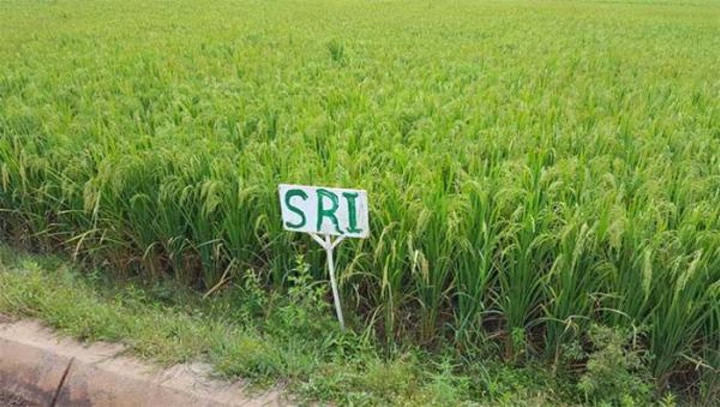
[May 2016] The project on Improving and Scaling up the System of Rice Intensification (SRI) in West Africa (SRI-WAAPP) has had continued success promoting the introduction, adaptation and scaling up of SRI in Senegal since January 2014. SRI continues to expand in the areas of Senegal where rice is cultivated, as can be seen in the SRI-WAAPP Senegal site map to the right. The map, which is current as of 2016, shows 90 sites where farmers have received training in SRI since the project formally began in 2014. A December 2015 trip report discusses the regional workshop and visits with CORAF in Dakar. All 13 countries attended the regional workshop and provided deadlines for finishing their baseline surveys.
-
2015
- Economic Benefits to adopting SRI According to TEEB for Agriculture and Food interim Report
[December 10, 2015] The TEEB for Agriculture and Food interim report described a rice study comparing SRI with conventional production methods. In Senegal, the impacts of water consumption under conventional systems was valued at US$801/ha as compared with US$626/ha under SRI. The study further found that revenues per hectare were estimated to be higher under SRI (US$2422/ha) versus conventional (US$2302/ha). Switching to SRI, society could save around $11 million/annum in water consumption related health and environmental costs in Senegal, and at the same time the rice producing community would gain around US$17 million through yield increases. (Summarized in points #37 and #38 in the executive summary of the full report.)

- Regional SRI Training for Mobile Data Collection, Data Visualization and Stakeholder Communication
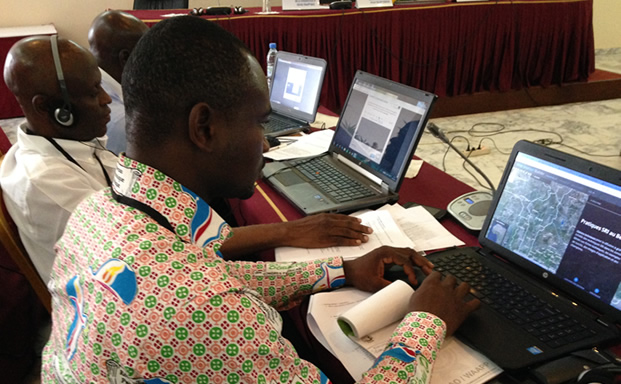
[August 10, 2015] As part of the SRI-WAAPP project, a four-day technical training was held in Dakar from August 3-6, 2015, at the Hôtel Ndiambour. Participants came from 11 countries (Senegal, Mali, Burkina Faso, Nigeria, Benin, Togo, Côte d'Ivoire, Liberia, Sierra Leone and Guinea) and included extension agents, farmers, directors of national agricultural research institutes, and national monitoring and evaluation officers for the West Africa Agricultural Productivity Program (WAAPP). SRI-Rice's Devon Jenkins was the lead trainer for the event, and during the four days of the training introduced participants to ESRI's data collection, visualization and reporting platform, which consists of Survey 123, ArcGIS Online, and Story Maps. (See report for details.)
 SRI-Rice Conducts Support Visit to Senegal for the SRI-WAAPP Project
[February 2015] Following a regional planning workshop and national training in Côte d'Ivoire in mid-February, SRI-Rice Technical Specialist Devon Jenkins spent late February and early March conducting a support trip in Senegal for the SRI-WAAPP project. During the trip he and the project's National Facilitator, Abdoulaye Sy, and WAAPP Senegal's Agricultural Specialist, Mour Guèye, conducted SRI trainings in Ziguinchor and Toubacouta. They also visited organizations including PRODAM, Peace Corps, and IED Afrique, which are also active in promoting SRI in Dakar, Matam and Ziguinchor.
- Senegal TV Program Highlights WAAPP-Senegal SRI Activities in Central Senegal
[January 8, 2015] Senegal’s national television reported on a workshop and training in Kaolack in central Senegal. The SRI segment of the news program, which airs at 20:57 to 23:45, also includes information on the SRI-WAAPP project's activities in Kaolack, Fatick and Kaffrine.
Abdoulaye Sy, the National Facilitator for the project, relayed that since SRI has been proven effective in the region, and, with 150 million CFA of financing approved for three years from le Fonds National de Recherches Agricoles et Agroalimentaires (FNRAA), Senegal is ready to take SRI to scale in the country’s Peanut Basin. Dr. Waly Diouf, the coordinator for the national program for rice self-sufficiency (Program National de l’Autosuffisance en Riz), also noted that SRI is very relevant and these methods should be taken to scale throughout Senegal. (See minutes 20:57 to 23:45 of the TV clip to view the SRI segment.).

2014
- WAAPP-Senegal Announces Plans for SRI Activities in the Fatick, Kaolack and Kaffrine Regions
[December 1, 2014] According to an article on the Senegal News website, the National Agency for Agricultural and Rural Extension (ANCAR) plans to mobilize 5,000 rice producers in Senegal's Fatick and Kaolack regions to try out SRI methods in order to improve rice productivity and farmer income. According to Abdoulaye Sy, ANCAR's director responsible for the Peanut Basin area and the WAAPP National Facilitator for Senegal, the spread of SRI will be accomplished by training technicians and NGOs, who will then train farmers in the regions. During a recent workshop to launch the SRI activities, Sy noted that producers who are trained in SRI will pass on their knowledge to other producers the following year. He said the "cascade training" should reach about 5,000 rice producers in the Fatick and Kaolack within two or three years. A second article on Kaolackois.com notes that the WAAPP project will also promote SRI in the Kaffrine region.
- Study on SRI Adaptations in Kaffrine Shows Yields Can Be Raised Without Increasing Labor Requirements
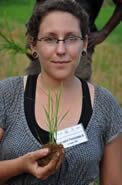
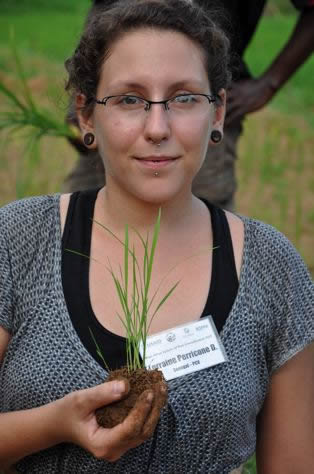
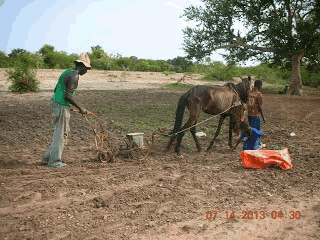
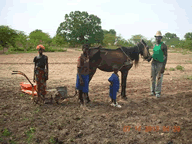 [July 2014] Lorraine Perricone-Dazzo (right) has completed a project for her MPS degree in which the potential of locally adapted methods of SRI to raise yields was assessed in four target villages in Kaffrine, Senegal. This study, which she carried out as a Peace Corps volunteer in conjunction with her graduate work at Cornell University, shows that a combination of local practices and best management practices (BMPs) inspired by SRI can raise yields to above household consumption needs without increasing labor requirements. Surveys, trainings, and experimentation during 2012-2013 showed that the most successful combination of practices for both yield and labor savings in the area were in-line direct seeding using local animal traction machinery shown at left (achieving 35cm between-row spacing) and hand-thinning the result at 8 days to 25cm spacing with one plant per hill. According to Lorraine, this work has given farmers in the four target villages the tools to sustainably increase their yields so that they can reduce dependence on imported rice. The successful adaptations also have the potential to progress the livelihoods of rice growers living in similar ecological environments throughout West Africa. (See Lorraine's International Agriculture and Rural Development MPS project document for details. You can also follow her progress over the duration of the project on her blog).
 - SRI Training at Thilambol in Northern Senegal
[June 20, 2014] Peace Corps Senegal Volunteer Dana Roth organized a System of Rice Intensification (SRI) training at the Thilambol Master Farm in northern Senegal on June 16, 2014. Twenty four rice farmers from the region attended. The Senegalese government is providing seed, fertilizer, and tractors to prepare the new fields and irrigation trenches along with water pumps. Peace Corps will assist with the SRI training. For more info, see the Peace Corps Senegal article, which also links to some of the training documents.
- Peace Corps Senegal
to Undertake SRI Training Circuit in the North and South
[May 2014] Peace Corps Senegal, funded by the Feed the Future Initiative, will be undertaking a System of Rice Intensification (SRI) Training Circuit May 7-15 in nine different sites in Northern and Southern Senegal. The goal is to train nearly 200 farmers in the SRI method, to have these farmers implement SRI this year, and further extend the method in subsequent years. The project will also include collection of data and subsequent reporting on different rice production methods, adoption of SRI, and yield comparison data of SRI versus traditional methods. Peace Corps Senegal volunteers and their counterparts hope to better understand rice production and to further extend SRI in Senegal in order to improve rice yields, thereby helping Senegal reach its goal of self-sufficiency in rice production.
- Regional Project to Scale Up SRI Formally launched
[January 1, 2014] The project Improving and Scaling up the System of Rice Intensification in West Africa (SRI-WAAPP) formally begun during January 2014. This is the first phase of a regional World Bank-financed project to increase rice productivity throughout a 13-country Economic Community of West African States (ECOWAS) area. The three year project, which includes Senegal, is part of the larger West Africa Agricultural Productivity Program (WAAPP), which is funded by the World Bank. SRI-Rice is the technical lead partner on the project, working in close collaboration with the coordinating institution, CNS-Riz, in Mali. Check the project's Senegal page in the coming months for updates.
2003-2013
-
FOR 2003-2013 SRI ACTIVITES, see SRI SENEGAL ARCHIVES
General Reports and Articles
(See also research reports.)
- 2025. Vallée du fleuve : l’ISRA expérimente le système de riziculture intensive. APS website. July 16.
- Tobias, Noah. 2023. In Senegal, rice intensification helps farmers grow more with less. Mongabay website. May 20.
- 2019. Campagne agricole 2019-2020 à Ziguinchor : Le niveau de développement des cultures jugé satisfaisant. Lequotidien. October 8.
- Gueye, Mamadou. 2018. Rétrospective 2017 - Riziculture : Des pas géants. le soleil, January 3. [ANCAR and SAED helped improve rice production through promotion of SRI]
- 2017. Le SRI (Système de riziculture intensive) améliore les rendements en riz du village de Coular Socé. La Vie Senegalais. November 17.
- Ka, Mangoné. 2017. Les inquiétantes contrevérités de Abdoul Mbaye, Par Dr Waly DIOUF. Senego, December 7, 2017, [Contrary to govt. claims, rice production has made progress in Senegal thanks to SRI, mechanization, etc.]
- 2017. Une nouvelle technique de riziculture double les rendements à Nioro (ANCAR). Agence de Presse Sénégalasie, November 18.
- 2017. Le SRI (Système de riziculture intensive) améliore les rendements en riz du village de Coular Socé. La Vie Senegalaise website. November 17.
- Sy, Souleymane Diam. 2017. Riziculture pluviale : La méthode Sri donne des résultats satisfaisants dans le bassin arachidier. West Africa Agricultural Productivity Program (WAAPP) website November.
- 2017. Toubacouta: Le SRI améliore les rendements en riz à Coular Socé. Agence de Presse Sénégalasie, November 17.
- 2017. Senegal adopts Climate Smart Agriculture to mitigate effects of climate change. West Africa Agricultural Productivity Program (WAAPP) website. November 9.
- Ka, Seynabou. 2017. Une agro-économiste salue la dimension régionale de la mise en œuvre du WAAPP, Agnece de Presses senegalaise (APS), October 29.
- 2017. La 10ème mission du WAAPP et de la BM visite des rizières de Fatick et Kaolack. Sinesaloum website.
- Dial, Saër 2017. Autosuffisance en riz en 2017 : La campagne de contre saison démarre plus tôt que prévu à Matam pour atteindre l’objectif fixé. Lactuacho.com website. February 20. [Article from the Matam region of Senegal. President of one of the producers' unions in Kanel department pledges to get 12 tons/ha with SRI.]
- WAAPP. 2016. Senegal adopts Climate Smart Agriculture to mitigate effects of climate change. West Africa Agricultural Productivity Program website. [SRI one of the options noted along with improved seed for other crops in CSA measures promoted by WAAPP.]
- 2016. Mise à l’échelle du Sri – Le Prodam en visite dans les périmètres agricoles de Diowol. La Vie Senegalaise, August 17.
- Styger, Erika and Jenkins, Devon. 2016. Senegal and The Gambia Trip Report 07-17 December, 2015. SRI-WAAP Senegal website. January.
- Muller, Alexander. 2015. TEEB for Agriculture & Food Interim Report. The Economics of Ecosystems & Biodiversity. Geneva, Switzerland. [This report from the United Nations Environment Program (UNEP) features SRI in Senegal, highlighting water savings and increased farmer revenue, among other projects.]
- 2015. Rapport Annuel D'Avancement Du Projet N°26/DGE - SRI WAAPP 3 - FNRAA. SRI-WAAPP Senegal page. December. [The annual report for the SRI-WAAPP project activities in Senegal, covering the Kaffrine, Kaolack, and Fatick target zones].
- 2015. Senegal launches major SRI initiative to train up to 5,000 farmers in the western Peanut Basin. SRI-WAAPP Senegal website. December 12.
- 2015. World Bank: 'Times are hard and uncertain' - Senegal adopts climate smart agriculture to mitigate effects of climate change. PreventionWeb website. December 3.
- Maurice. 2015. Terroirs villageois à matam : 18 unités pastorales se renforcent en infrastructures. Le Soleil, September 5.
- SRI-WAAPP. 2015. Summary Report: Regional training workshop on ARC/GIS and mobile data collection using 'Survey 123' for the SRI-WAAPP project - Dakar, 3-6 August, 2015. SRI West Africa website.
- 2015. L'ANCAR mise sur la riziculture intensive dans le Sine Saloum. Kaolackois.com [article discusses ANCAR's support for SRI training in West Africa].
- Jenkins, Devon. 2015. Senegal Trip Report 26 February - 09 March 2015. SRI-WAAPP Senegal page.
- 2014. Senegal Agriculture - Riziculture: l'ANCAR lance le SRI pour améliorer la productivité. Senegal News. December 1. (Kaolack, Senegal)
- 2014. Senegal Agriculture - Riziculture: L'ANCAR mise sur la riziculture intensive dans le Sine Saloum. Kaolackois.com. December 1. (Kaolack, Senegal)
- 2014. Senegal. SRI West Africa website. [This page has info about the project on Improving and Scaling Up of the SRI in West Africa.]
- Nitzkorski, Dylan. 2014. SRI training reaches 24 farmers in Thilambol. Peace Corps Senegal website. June 20.
- 2014. Adventures of MaryCad. MaryCad blog. Postings from 201-2013 about her SRI (and other) activities in Senegal as a Peace Corps Volunteer.
- Gaoussou Traoré. 2013. Regional workshop for finalizing/launching the project "Improving and Scaling Up of the SRI in West Africa". SRI-Rice website. August. [2013 document uploaded April 8, 2014]
- Perricone-Dazzo, Lorraine, Famara Massaly, Youssoupha Boye, and Arfang Sadio. 2013. System of Rice Intensification training series report - July 2013: Peace Corps Senegal, Fatick and Kaffrine Regions - Senegal, West Africa. System of Rice Intensification website. July.
- 2013. Le système de riziculture intensive. IED Afrique website. AGRIDAPE April newsletter. [pg 13 of the newsletter has an article about Senegal].
- Zotoglo, K. 2012. Rapport de formation des formateurs en SRI au Sénégal. Bethesda, MD: projet ATP, Abt Associates Inc. Juin. (online: SRI West Africa website)
- Perricone-Dazzo, Lorraine. 2012. Rice cropping systems: My M.P.S project paper. Lorraine's Peace Corps Blog (Senegal). November 21.
- Timothy J. Krupnik, Carol Shennan, William Settle, Matty Demont, Alassane B. Ndiaye, Jonne Rodenburg. 2012. Améliorer la production du riz irrigué dans la Vallée du Fleuve Sénégal à travers l’innovation et l’apprentissage par l’expérience. FAO research report.
- Krupnik, Tim, and Makfousse Sarr. 2008. Current research and evaluation efforts of the System of Rice Intensification in the Senegal River Valley. System of Rice Intensification website. (10p.,1.22MB pdf) [August/September 2008 report by student researcher with WARDA/ ADRAO and Ph.D. Candidate, Environmental Studies, UC Santa Cruz; and the National Coordinator of the Programme GIPD (FAO) for Senegal]
- McClintock, Nathan C. 2006. Sustainable in Senegal: Profiles in Senegalese regenerative agriculture - Diabou Balde, rice farmer, Manthiankaning, Kolda region. 2006. The New Farm ( Rodale Institute), March 9. http://www.newfarm.org/international/senegal/0306/index.shtml.
Research and Evaluations
- Ndah, Hycenth Tim, Johannes Schuler, Tchapmi Nghotchouang, et al. 2025. Unlocking Sustainable Intensification: Farmer insights from Senegal River Valley. Tropentag 2025 conference, Sept. 10-12, 2025, Bonn, Germany.
- Diedhiou, Pierre C.C. 2021. Intensification (SRI) and traditional practices (TP) in Ziguinchor District, Senegal. Forestry & Agriculture Review 2(1): 22-36. doi:10.47285/far.v2i1.64
- Diédhiou, Pierre Claver César. 2019. Etude comparative des rendements et de la rentabilité du Système de Riziculture Intensif (SRI) et du Système Traditionnel dans le département de Ziguinchor. Université Assane Seck de Ziguinchor (UASZ)(Senegal). [accessed January 23, 2022]
- Diedhiou, Pierre C.C.2019. Etude comparative des rendements et de la rentabilité du Système de Riziculture Intensif (SRI) et du Système Traditionnel dans le département de Ziguinchor. Master's thesis. Université Assane Seck de Ziguinchor (UASZ) (Senegal). 43p.
- Dione, Moudo. 2019. L’impact du système de riziculture intensive (SRI) sur le rendement des riziculteurs de Matam. Master's thesis. Université Assane Seck de Ziguinchor (UASZ) (Senegal). 45p.
- Perricone-Dazzo, Lorraine. 2014. Farmer centered research on improved rice cropping systems in the Peanut Basin of Senegal: Peace Corps System of Rice Intensification extension campaign. Master of Professional Studies project paper, Cornell University. (128p., 2.26MB pdf) [Accessed July 2014]
- Stoermer, Danielle. 2013. Improving Food Security and Facilitating Farmer Adoption of Improved Technologies: An Evaluation of Peace Corps Senegal's Master Farmer Program. Master of Professional Studies project paper, Cornell University. [189p.].
- Krupnik, Timothy J., Jonne Rodenburg, Van Ryan Haden, Doudou Mbaye, and Carol Shennan. 2012. Genotypic trade-offs between water productivity and weed competition under the System of Rice Intensification in the Sahel. Agricultural Water Management 115: 156-166. doi:10.1016/j.agwat.2012.08.016
- Krupnik, Timothy J., Carol Shennan and Jonne Rodenburg. 2012. Yield, water productivity and nutrient balances under the System of Rice Intensification and recommended management practices in the Sahel. Field Crops Research 130: 155-167. doi:10.1016/j.fcr.2012.02.003
- Krupnik, Timothy J., Carol Shennan, William H. Settle, Matty Demont, Alassane B. Ndiaye and Jonne Rodenburg. 2012. Improving irrigated rice production in the Senegal River Valley through experiential learning and innovation. Agricultural Systems 109: 101-112. doi:10.1016/j.agsy.2012.01.008
- Krupnik, Timothy. 2011. Integrated agronomic and socioeconomic assessment of a water-saving rice crop management system in the Sahel. Doctor of Philosophy, University of California Santa Cruz.
- Krupnik, Timothy J., Carol Shennan, William H. Settle, Alassane Bouna Ndiaye, Makhfousse Sarr, Matty Demont and Jonne Rodenburg. 2010. Adaptive On-farm Evaluation of Resource Conserving Rice Cultivation Practices in the Middle Senegal River Valley. Paper presented at the Tropentag conference, World Food System - A Contribution from Europe, September 14 - 16, 2010 in Zurich, Switzerland.
- Krupnik, Tim, and Makfousse Sarr. 2008. Current research and evaluation efforts of the System of Rice Intensification in the Senegal River Valley. System of Rice Intensification website. (10p.,1.22MB pdf) [August/September 2008 report by student researcher with WARDA/ ADRAO and Ph.D. Candidate, Environmental Studies, UC Santa Cruz; and the National Coordinator of the Programme GIPD (FAO) for Senegal]
- Krupnik, Tim, and Makfousse Sarr. 2008. Recherche en cours et efforts d’évaluation du Système d’intensification du Riz dans la vallée du fleuve Sénégal. System of Rice Intensification website. (10p.,1.30MB pdf) [French language report by student researcher with WARDA/ ADRAO and Ph.D. Candidate, Environmental Studies, UC Santa Cruz; and the National Coordinator of the Programme GIPD (FAO) for Senegal]
Videos
- 2016. ANCAR : introduction du système de riziculture intensive SRI dans le Bassin Arachidier Sud Sénégal. 16:52 min. ANCAR channel, YouTube. [French language ANCAR video on SRI in Bassin Arachidier Sud Senegal]
- 2016 (August 16). Visite du PRODAM dans les périmètres agricoles de Diowol. 12:19 min. La Vie Senegalaise channel. [French language video about SRI in the PRODAM program in Diowol, Senegal.]
- 2015 (October 13). Le Système de riziculture Intensive dans la région de Kaffrine, Senegal. 1:58 min. Abdoulaye SY channel, YouTube. [Le SRI en grande diffusion dans la zone pluviale, bassin arachidier du Sénégal.]
- 2015 (April 6). Senegal – SRI bassin arachidier. 16:52 min. SRI-Rice channel, YouTube. [Also on the ANCAR channel as "ANCAR introduction du système de riziculture intensive SRI dans le Bassin Arachidier Sud Sénégal"]
- 2015 (January 6). Journal TV 20H de la RTS1 du 6 Janvier 2015. 39.37 min (SRI segment plays during minutes 20:57 to 23:45). Produced Radiodiffusion Télévision Sénégalaise, RTS channel, YouTube. [TV channel report on workshop and training in Kaolack, with additional reporting on the WAAPP’s SRI project in Kaolack, Fatick and Kaffrine.]
- 2012 (August 23). The First West Africa SRI Workshop, Ouagadougou, 8/26-27/12: Ernest Asiedu (Senegal). 5:00 min. Produced by SRI-Rice. sricornell channel, YouTube.
[Dr. Ernest Asiedu, Workshop Co-organizer, WECARD/CORA, comments on SRI at the First West Africa System of Rice Intensification (SRI) Workshop, Ouagadougou, Burkina Faso, July 26-27, 2012.]
Presentations
- Presentation du Senegal Atelier Regional sur le SRI
PowerPoint by Madiama Cisse (ISRA), Baye Salif Diack (SAED) and Abdoulaye Sy (ANCAR) presented at the West Africa Regional SRI Workshop, Ouagadougou, Burkina Faso, July 26-27, 2012. 10 slides.
Photo Collections
- Page 2 of Tim Krupnik's 2007 interim report contains photos of his SRI trials in Senegal.
-
The photos in the SRI-Rice Senegal collection, which is embedded in the summary section at the top of the page, were provided by Tim Krupnik and Lorraine Perricone-Dazzo. If you do not have Flash installed, click here to see individual photos which are made available on Picasaweb.