

THAILAND
Overview
Although initial 2001 trials of SRI methods by the Multiple Cropping Center (MCC) at Chiang Mai University were not successful, continued evaluations by MCC, the McKean Rehabilitation Center (see MRC trials) and others led to a national SRI network, which was formalized at a national SRI workshop held in Chiang Mai in May 2003. A February 15, 2005, meeting of the SRI Network in Thailand held at MCC reviewed progress of network members (4 government groups and 9 NGOs and projects). With Thailand Alternative Agriculture Network (AAN) coordination, the SRI Network organized a workshop in June 2005 co-hosted by the Surin Farmers' Support Project (SFS) in the southern section of northeast Thailand.
During 2005-2006, Abha Mishra, at the time a PhD student at the Asian Institute of Technology (AIT), wrote successful proposals to the Asia Rice Foundation USA (see resulting journal article) and the CGIAR Challenge Program on Water and Food to support participatory action research with farmer field school groups to evaluate SRI. The CPWF project, undertaken by an AIT team headed by Dr. V. M. Salokhe, introduced SRI through action-research with villages in northeast Thailand (see report on Increasing water use efficiency by using mulch under SRI management practices in Northeast Thailand and video).
The 2008 AIT project proposal on Community preparedness for climate change and increased water use efficiency for rice cultivation using principles of System of Rice Intensification (SRI) in central Thailand was selected for the Asia-Pacific Forum for Environment and Development (APFED) Showcase 2008 Programme. The project, which used FFS extension, took place in Ratchaburi Province between 2009 and 2011 (see summary report). A Southeast Asia regional workshop on SRI involving Mekong River Basin (MRB) countries (Cambodia, Laos, Vietnam and Thailand) was organized at Asian Institute of Technology (AIT), Bangkok, Thailand, June 22-23, 2009, in collaboration with the World Bank Institute.
During 2011, AIT began a EU-financed regional project, Sustaining and Enhancing the Momentum for Innovation and Learning around the SRI in the Lower Mekong River Basin (SRI-LMB), which is focused rainfed SRI in Cambodia, Laos, Thailand and Vietnam (see project website). During 2012, a thesis and several academic papers were published on SRI (see 2012 updates for summaries). One of these, Rice root growth and physiological responses to SRI water management and implications for crop productivity, won the SAWADA Prize for best paper published in the journal Paddy and Water Environment Engineering for the year 2012. That same year, the SRI-LMB Project was officially launched and the project in Thailand made progress in Uttaradit and Surin Provinces. During 2013 and 2014, the SRI-LMB Project led numerous trainings, workshops and farmer exchanges for project farmers, staff, and country officials in four countries in the Mekong Basin. These are outlined below and on the SRI-LMB website.
During Oct./Nov. 2014, several international SRI events were held in Thailand: the Workshop on Small-scale Crop Production Equipment for System of Rice Intensification, held at AIT in Pathumthani on November 1-3, and the Workshop on Building Alliances around SRI and Agro-Ecology, held October 27-28, in Bangna, Bangkok. The 4th International Rice Congress (IRC), which took place October 27-31 in Bangkok, also included a number of oral and poster presentations on SRI as well as an SRI booth. During May 2015, a delegation from Thailand attended the first SE Asia Regional SRI Conference in Malaysia, during which time plans were made to begin a SE Asia SRI Network that will help link SRI efforts in Thailand with SRI initiatives throughout the region. At the close of 2015, more than 5,000 rice farmers in Cambodia, Thailand, Laos and Vietnam have been learning and adapting SRI methods at 172 sites in 32 districts of 11 provinces. A 2016 article by Mishra et al published in AIMS Agriculture and Food document some of the SRI Lower Mekong Basin (SRI-LMB) project successes in Thailand and Cambodia (See item below). The initial calculation of yields has showed an average paddy yield of 5.03 t/ha with SRI-transition, whereas with SRI-demonstration the average yield was 6.41 t/ha. These yields were 60 and 100% higher than the average baseline yield in the region, 3.14 t/ha, for the same farmers and same locales; the economic gains for farmers were found to be higher in rainfed areas when using the new methods.
Utilizing the implementing consortia established at local, national and regional level, the SRI- Lower Mekong River Basin (SRI-LMB) Project as of early 2017 involved more than 7,000 farmers on more than 400 action research sites. The Thai SRI-LMB experience was reported at the Regional Review and Planning Workshop of the SRI-LMB Project organized in Hanoi, Vietnam on 24-25 April 2017. By the end of the project, over 15,000 farmers had participated in the field trials located in 33 districts of 11 provinces in four countries (Cambodia, Laos, Thailand and Vietnam) in the Lower-Mekong-Basin (LMB); over 1,500 experiments were conducted. Relative to the pre-project baseline survey, project data show that SRI helped to improve conditions across the LMB region. Average rice yield increased by 52%, net economic returns were raised by 70%. Labor productivity increased by 64%; water productivity by 61%; and the efficiency of mineral fertilizer-use rose by 163%. The total energy input required for farming operations was decreased by 34%, while emissions of greenhouse gas were significantly reduced, by 14% with irrigated rice production, and by 17% per-hectare in rainfed cropping.
Progress and Activities
2021 Updates
 Impacts of Rainfed SRI in the Mekong Basin Evaluated with Regard to Food Security and CSA
[January 15, 2021] An article by Mishra et al published in the International Journal of Agricultural Sustainability evaluates the impacts of SRI with special reference to rainfed agriculture. The findings reported here derive from the SRI-LMB regional collaborative project that included Cambodia, Laos, Thailand and Vietnam. More than 15,000 farmers participated in the field trials located in 33 districts of 11 provinces in the Lower-Mekong-Basin (LMB); the number of experiments conducted was more than 1,500. Relative to the pre-project baseline survey, project data show that System of Rice Intensification practices helped to improve conditions across the LMB region. Average rice yield increased by 52%, net economic returns were raised by 70%. Labor productivity increased by 64%; water productivity by 61%; and the efficiency of mineral fertilizer-use rose by 163%. The total energy input required for farming operations was decreased by 34%, while emissions of greenhouse gas were significantly reduced, by 14% with irrigated rice production, and by 17% per-hectare in rainfed cropping.
The results of this farmer-participatory research characterize climate-smart agricultural practices that can promote household-food-security and support market-oriented development at low cost, especially in rainfed areas that have not figured prominently in development plans. [See full article for details.]
2018
- SRI-LMB Project Shares Outcomes and Lessons from Five Years Operation
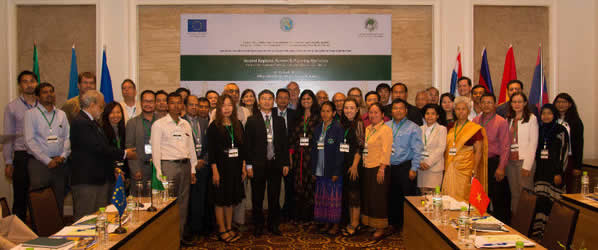
[November 5, 2018] A regional workshop in Bangkok, Thailand, was held November 1-2, 2018, to share the lessons learned and outcome of the 5-year regional SRI-LMB project. With the support of ministries and governmental agencies in all 4 project countries, Cambodia, Laos, Thailand and Vietnam, the project was successful in building capacity and confidence among farmers. More than 15,000 farmers participated directly in the farmer-led field trials located in 33 districts of 11 provinces of the four Lower Mekong Basin countries. The number of farmer-participatory experiments conducted under this EU-funded project was more than 1,500: 465 at >173 sites in 2015, and then 1,052 at >500sites in 2016. The results showed that in comparison with the pre-project baseline performance, SRI practices helped to improve livelihoods across the LMB region by increasing rice yield by 52%, farmers’ net economic return per hectare by 70%,labour use efficiency by 64%, water productivity by 59%, and fertilizer use efficiency by 75%. The total energy input required for farming operations decreased by 34%, along with significant reductions in per-hectare greenhouse gas emission, respectively by 14% with irrigated rice production and by 17% with rainfed cropping. Hand-to-hand research was conducted to ‘visualize’ the SRI adaptation response by farmers, and policy 3 SRI-LMB is funded by the European Union SRI-LMB is implemented by the AIT analysis was done within the context of economics and public-private environment for small-scale agriculture development in the Mekong region. [See workshop press release and final workshop report for details.]
2017
- SRI Lower Mekong Basin Project Interim Report for 2016 Shows SRI's Promise for Rainfed Areas
[December 31 2017] The SRI Lower Mekong Basin Project has provided an Interim report showing 171 Farmers’ Participatory Action Research (FPAR) sites in the wet season 2015 involving more than 7,000 farmers and at >400 FPARs in wet season 2016 involving more than 11,000 farmers in 33 districts of 11 provinces across the four countries (3 in Cambodia, 3 in Lao PDR, 3 in Thailand, and 2 in Vietnam). More than 500 field experiments and locally-suited SRI demonstration plots were set up by farmers for the development of low-cost technological options mostly in rainfed production systems using SRI principles. The results reported so far were clustered under three performance indicators:
- 1) improved farmer livelihoods -- productivity, profitability, and labour productivity;
- 2) resource use efficiency -- water productivity, inorganic fertilizer use efficiency, and total energy input; and
- 3) climate change mitigation -- greenhouse gas emission reduction -- where possible.
These indicators were compared with the baseline scenario.
The results showed that SRI practices helped to improve livelihoods across the LMB region by increasing rice yield (66% w.r.t. baseline) and net returns (70% w.r.t. baseline). Further it showed that the labor use efficiency increased (66% w.r.t. baseline) with SRI practice along with higher water productivity (59% w.r.t. baseline) and inorganic fertilizer use efficiency. At the regional level, 31 kg of paddy was produced per kg of inorganic fertilizer applied, whereas it was 11 kg in the baseline figure. The total energy input in farming decreased by 37%. With respect to greenhouse gas emission reduction, the results reported 16% and 13% reduction in total greenhouse gas emission from rainfed and irrigated areas respectively compared to the baseline figures. Therefore, it was clear that there is a potential to reduce greenhouse gas emissions by encouraging adoption of SRI practices. [For more information, see summary of Annex VI -- Interim Narrative report for SRI-Lower Mekong Basin Project.]
- SRI-LMB Project Findings Shared at Workshop
in Vietnam
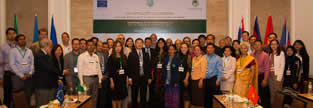 [May 19, 2017] Farmers from 11 provinces of Cambodia, Laos, Thailand and Vietnam have reported near doubling of profit for paddy grown with the System of Rice Intensification (SRI) management practices. This was a result of higher yield coupled with reduced cost of seed, seedlings, and pesticides; along with better quality of food-grains, thereby commanding a higher market price. These results and other project details were shared at Regional Review and Planning Workshop of the SRI-LMB Project organized in Hanoi, Vietnam on 24-25 April 2017 (see report). The results were reported from 172 action research sites spread over 33 districts in 11 provinces — three in Cambodia (Kampot, Kampong Speu and Takeo); three in Thailand (Uttaradit, Sisaket and Surin); two in Vietnam (Bac Giang and Ha Tinh); and three in Laos (Khammouan, Savannakhet and Vientiane); as a part of the regional collaborative project led by the Asian Center of Innovation for Sustainable Agriculture Intensification (ACISAI) of the Asian Institute of Technology (AIT), Thailand with funding support from the European Union. [See workshop report, ThaiPR article, SRI-LMB Newsletter 5(1), workshop powerpoints and the SRI-LMB website for details.]
 - SRI is Gaining Momentum in the Mekong Region Through SRI-LMB Project
[February 17, 2017] Utilizing the implementing consortia established at local, national and regional level, the SRI- Lower Mekong River Basin (SRI-LMB) Project now directly involves more than 7,000 farmers on more than 400 action research sites. The project, is also reaching out to another 30,000 farmers through field visits and local workshops in the region.
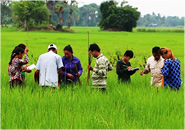 Farmers are engaged in developing, evaluating and adapting “Climate Smart” crop management practices using SRI agro-ecological principles through setting up of SRI demonstration and SRI learning plots. The government counterparts, who
are directly implementing the field activities in Cambodia, Laos, Thailand, and Vietnam, are reporting higher yield, higher net
income with reduced input use and greater resilience to extreme weather events. These findings have been
reconfirmed by research conducted by national universities in all four countries. The government believes
that better increase of crop production with good quality should enable farmers to successfully compete with global market. Some key challenges in the agriculture sector mainly are (a) the and lack of labor for agricultural
activist in the near future, (b) low and infertile natural resources and (c) the market instability need to be addressed to make the rainfed production system stable and efficient. [See December 2016 SRI-LMB Newsletter for further information, including information on the various workshops throughout the project countries of the Lower Mekong River Basin.] Insights gained from the project with regard to dealing with uncertainty and mobilizing farmers’ creativity have been compiled by Abha Mishra in her February 2017 article in the Agricultural Research & Technology journal.
Farmers are engaged in developing, evaluating and adapting “Climate Smart” crop management practices using SRI agro-ecological principles through setting up of SRI demonstration and SRI learning plots. The government counterparts, who
are directly implementing the field activities in Cambodia, Laos, Thailand, and Vietnam, are reporting higher yield, higher net
income with reduced input use and greater resilience to extreme weather events. These findings have been
reconfirmed by research conducted by national universities in all four countries. The government believes
that better increase of crop production with good quality should enable farmers to successfully compete with global market. Some key challenges in the agriculture sector mainly are (a) the and lack of labor for agricultural
activist in the near future, (b) low and infertile natural resources and (c) the market instability need to be addressed to make the rainfed production system stable and efficient. [See December 2016 SRI-LMB Newsletter for further information, including information on the various workshops throughout the project countries of the Lower Mekong River Basin.] Insights gained from the project with regard to dealing with uncertainty and mobilizing farmers’ creativity have been compiled by Abha Mishra in her February 2017 article in the Agricultural Research & Technology journal.
2016
- ECHO Asia SRI Workshop เอคโค่ เอเซียจะจัดอบรม SRI Held in Chiang Rai
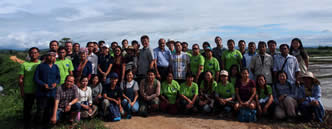 ECHO Asia in collaboration with Fah Mui Farm organized a two-day "The Northern Thailand SRI Experience: Sharing, Practicing and Niche Marketing" workshop at Fah Mui's farm in Chiang Rai Province, Thailand, on June 8-9, 2016. The workshop included 42 participants from five countries: Thailand, Laos, Singapore, India, and USA. Fifteen farmer representatives from northeastern provinces of Thailand were associated with the SRI Lower Mekong River Basin (SRI-LMB) project being implemented by the Asian Institute of Technology (AIT) in Bangkok.
Workshop speakers included Napaphan Jamnan (Fah Mui), a farmer from Chiang Rai who has been successfully practicing SRI for many years; Dr. K. N. Bhatt, a professor from India who shared his experience in India with System of Finger Millet Intensification (SFMI), which is similar to SRI and focuses on finger millet; Dr. Monamorn Preecharattana, a lecturer from Mahidol University who has conducted SRI research in Northeast Thailand and who works as a self-identified ‘Farmer Trainee’; and Dr. Suphathida Aumtong, a professor from Mae Jo University who shared what is being learned from reduced-water rice cultivation research. Several Thai farmers, including Fah Mui, also shared their experiences with adopting SRI. Fah Mui is a northern Thailand farmer who, in addition to her environmentally-friendly rice culture, has created a niche market through her farm and ships the value-added rice all over Thailand.
ECHO Asia in collaboration with Fah Mui Farm organized a two-day "The Northern Thailand SRI Experience: Sharing, Practicing and Niche Marketing" workshop at Fah Mui's farm in Chiang Rai Province, Thailand, on June 8-9, 2016. The workshop included 42 participants from five countries: Thailand, Laos, Singapore, India, and USA. Fifteen farmer representatives from northeastern provinces of Thailand were associated with the SRI Lower Mekong River Basin (SRI-LMB) project being implemented by the Asian Institute of Technology (AIT) in Bangkok.
Workshop speakers included Napaphan Jamnan (Fah Mui), a farmer from Chiang Rai who has been successfully practicing SRI for many years; Dr. K. N. Bhatt, a professor from India who shared his experience in India with System of Finger Millet Intensification (SFMI), which is similar to SRI and focuses on finger millet; Dr. Monamorn Preecharattana, a lecturer from Mahidol University who has conducted SRI research in Northeast Thailand and who works as a self-identified ‘Farmer Trainee’; and Dr. Suphathida Aumtong, a professor from Mae Jo University who shared what is being learned from reduced-water rice cultivation research. Several Thai farmers, including Fah Mui, also shared their experiences with adopting SRI. Fah Mui is a northern Thailand farmer who, in addition to her environmentally-friendly rice culture, has created a niche market through her farm and ships the value-added rice all over Thailand.  Lower Mekong River Basin (LMB) Article Documents Successes in Thailand and Cambodia
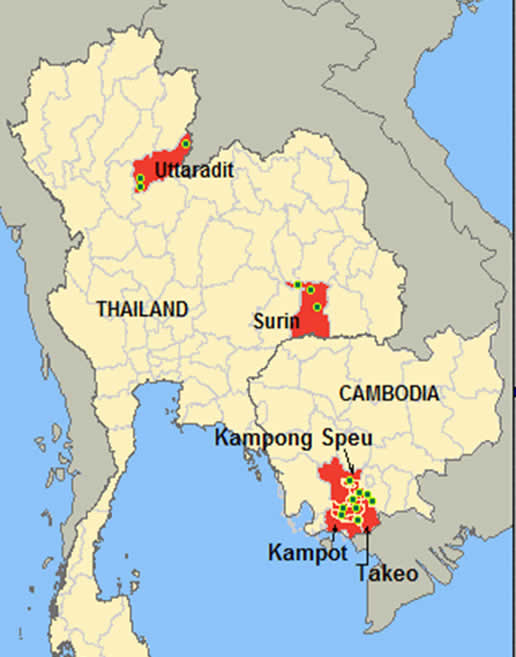
[April 5, 2016] A recent article in AIMS Agriculture and Food records some of the findings from the regional Lower Mekong River Basin (LMB) project, which involves smallholder rice farmers, researchers, extension personnel, and development professionals, together with staff of relevant government ministries. The project objective is to produce healthier and profitable rice crops under rainfed conditions using SRI methods, which are evaluated and refined through farmers’ participatory action research (FPAR). As part of the action-research, more than 120 sets of field experiments have been carried out at 60 FPAR sites in Cambodia and Thailand (see map at right), directly involving 3,600 farmers. The experiments have ranged from the integration of many SRI principles with farmers’ current local practices or improved practices which was termed as "SRI-transition" to full demonstrations and assessments of SRI methodology, i.e., SRI-demonstration.
The initial calculation of yields has showed an average paddy yield of 5.03 t/ha with SRI-transition, whereas with SRI-demonstration the average yield was 6.41 t/ha. These yields were 60 and 100% higher than the average baseline yield in the region, 3.14 t/ha, for the same farmers and same locales. Productivity gains (dollars gained/dollars spent per ha) were calculated for both rainfed and irrigated production areas. In comparative terms, the economic gains for farmers were found to be higher in rainfed areas when using the new methods. The paper also addresses the potential of new strategies to promote food security in rainfed areas in the LMB region by managing household and natural resources more productively.
2015
 SRI-LMB Newsletter Highlights Project's Progress in the Lower Mekong River Basin Region
[December 1, 2015] Through the SRI-LMB Project spearheaded by the ACISAI Center at the Asian Institute of Technology, more than 5,000 primarily rainfed rice farmers in Cambodia, Thailand, Laos and Vietnam have been learning and adapting SRI methods at 172 sites in 32 districts of 11 provinces this year. According to the December 2015 project newsletter, despite this year's delayed monsoon that was experienced throughout the Lower Mekong River Basin region, the SRI fields were able to cope up with harsh weather vagaries. Small rainfed farmers continued to adopt SRI methods due to better crop production as well as increased tolerance to droughts, pests and diseases.
The newsletter (page 5) notes how SRI-grown rice is responding to the epidemic of neck blast (Magnaporthe oryzae) in Kampong Speu Province, Cambodia. Late rains resulted in the delayed transplanting of rice until mid-September. Rainfall continued until the final week creating a very favorable micro-climate in densely planted conventional rice in the farmer's field, with 50 - 70% ear heads showing symptoms (drying off) in farmers' fields. However, in the fields where Farmer's Participatory Action Research (FPAR) and farmers have set up SRI demonstrations with wider-spaced (25 x 25 cm), single seedlings transplanted at 15 days, the disease incidence was only in the range of 20 - 25%. This provided an important learning to rice farmers in the changing dynamics of weather patterns, especially late rainfall and transplanted rice in Kampong Speu province.
 Abha Mishra Presents SRI Lower Mekong Basin (SRI-LMB) Experience at Cornell University
[October 12, 2015] Abha Mishra, team leader for the EU-funded project on Sustaining and Enhancing the Momentum for Innovation and Learning around the SRI in the Lower Mekong River Basin (SRI-LMB) gave a talk on Farmer Adaptation of System of Rice Intensification (SRI) Methods in the Lower Mekong Basin Region on October 12. (See PowerPoint). She will also present experiences of the first two years of the SRI-LMB project at the 2nd International Conference on Global Food Security, that is taking place in Ithaca, New York, October 11-14, 2015. Some of the findings of the SRI-LMB project so far include are as follows:
1) Efforts to make SRI knowledge and practices available on a wider scale can raise productivity and incomes and in turn can address food insecurity of the broad population of smallholders without further deteriorating the environment.
2) Economic productivity was higher in rainfed compared to the irrigated systems; therefore only a small investment is needed to make the rainfed system more productive and resilient, and
3) Bringing poor smallholding farmers more directly into the process of economic growth can offer more hope at both micro and macro levels.- Supisra Arayaphong Joins Panel on Women's Economic Opportunities at Clinton Global Initiative Event in NYC
[September 29, 2015] Supisra Arayaphong (shown at right with the SRI rice she produces), discussed her experiences as an SRI rice farmer in Thailand during a panel on Unleashing Women's Economic Opportunities at Clinton Global
 Initiative in New York City on September 29. The founder of FarmerDo began farming after writing a thesis on SRI at Uppsala University in Sweden and working with the Thai Weekend Farmers Network. The panel, which was chaired by Chelsea Clinton, also included the president of the Walmart Foundation, executive chairman of the Estée Lauder Companies, the Ethiopian Minister of Foreign Affairs, and the CEO of the Xerox Corporation. [To see Arayaphong's discussions, choose the follow times in the video: 42:56-46:16 and 1:02:51-1:06.00]
 - SRI-Lower Mekong River Basin Project Holds First Regional Review in Cambodia
[June 6, 2015] The first Regional Review and Planning workshop of the SRI - LMB was held in Siem Reap Cambodia from June 2-3, 2015. The workshop was organized by the Asian Institute of Technology (AIT ) and hosted by the General Directorate of Agriculture (GDA), Ministry of Agriculture, Forestry and Fisheries (MAFF), Cambodia. The objectives of the workshop were to share the initial learning derived from 60 action research sites (with 120 field experiments), jointly review project activities undertaken since 2013, and collect feedback from various stakeholders and feed into the next cycle of action research to strengthen the project actions. (See page 2 of the 2015 SRI-LMB Newsletter for details.)
- Thai Delegation
Attends SE Asia Regional SRI Conference in Malaysia
[May 31, 2015] The Southeast Asia Conference on the System of Rice Intensification (SRI), held May 26-28 in Alor Setar, Malaysia, was attended by four participants from the Thailand: Supisra Arayaphong and Thongdam Phongphichith, who represented the Thai Weekend Farmers Network; Boonsong Thansrithong from ECHO; and Michael Common from Earth Net Foundation. The Thai participants made presentations, participated in various panels and discussion groups, and were present at the side events for SRI equipment development, the SRI Global Research Network, and a meeting on the final day of the conference to begin creating a SE Asia regional SRI network.
For 2001-2014 SRI Activities, see Thailand Archives
Workshops and Meetings
- For the numerous workshops related to the Mekong River Basin (LMB) project, see the project website.
- Farmer's Congress and National Review and Planning Workshop - Thailand / Sustaining and Enhancing the Momentum for Innovation and Learning around the The System of Rice Intensification in the Lower Mekong River Basin (SRI-LMB), sponsored by the System of Rice Intensification in the Lower Mekong River Basin (SRI-LMB) Project, June 23-25, 2016, at the Suanpa Resort, Surin province, Thailand.]
- The Northern Thailand SRI Experience: Sharing, Practicing and Niche Marketing workshop, sponsored by ECHO Asia, was held at Fah Mui's farm in Chiang Rai Province, Thailand, on June 8-9, 2016. [See workshop report.]
- The Workshop on Small-scale Crop Production Equipment for System of Rice Intensification, held at AIT in Pathumthani on November 1-3, 2014, was organized at AIT in Pathumthani, Thailand. This event, which had 60 participants from 12 countries, was organized by ACISAI and SRI-Rice.
- The Workshop on Building Alliances around SRI and Agro-Ecology, held October 27-28, 2014, in Bangna, Bangkok, was sponsored by SRI-Rice and Oxfam. It provided a forum for discussing how respective and collaborative efforts can contribute to the more rapid and effective scaling-up of SRI use around the world.
- A National Inception and Planning Workshop about the Asian Institute of Technology's 60-month project entitled "Sustaining and Enhancing the Momentum for Innovation and Learning around the System of Rice Intensification (SRI) in the Lower Mekong River Basin" took place on January 29-30, 2014, at the AIT's Conference Center .
- A Northern Thailand SRI Network was formed during a meeting organized by the ECHO Regional Office and facilitated by Green Net at ISAC (FARM) February, 2010. Thirty participants from 13 organizations from Phrae, Nan, Phayao, and Chiang Mai attended.
- A Southeast Asia Regional Knowledge Exchange on SRI Producing More with Less Water involving MRB countries (Cambodia, Laos, Vietnam and Thailand) was organized at Asian Institute of Technology, Bangkok, Thailand, June 22-23, 2009, in collaboration with World Bank Institute, Washington DC, followed by a field-visit on 24 June in NE Thailand.
- A workshop on practices and experiences with the System of Rice Intensification (SRI) was held during June 2005 near the provincial capital of Surin. The Thailand Alternative Agriculture Network (AAN) organized the workshop which was co-hosted by the Surin Farmers’ Support Project (SFS)
- A meeting of the SRI Network, organized by MCC/CMU (Multiple Cropping Center), was held at Chiang Mai University, February 15, 2005.
- A national SRI workshop, held at Chiang Mai University, June 5-6, 2003, was organized by MCC/CMU (Multiple Cropping Center) in cooperation with ISAC, RRAFA and MRC.
Reports and Articles
Research and Evaluations
- Panomjan, Nantiya. 2023. Cost reduction of rice production with the System of Rice Intensification (SRI). Songklanakarin Journal of Plant Science 10(1): (Online First, February 2023)
- Ginigaddara, G. A. S., and S.L. Ranamukhaarachchi. 2021. Varied responses of System of Rice Intensification to medium and short-aged rice and types of Planting material in Central Plains of Thailand. Asian Journal of Emerging Research 3(1): 12-18.
- Mishra, Abha, Jan Willem Ketelaar, Norman Uphoff and Max Whitten. 2021. Food security and climate-smart agriculture in the lower Mekong basin of Southeast Asia: evaluating impacts of system of rice intensification with special reference to rainfed agriculture. International Journal of Agricultural Sustainability doi:10.1080/14735903.2020.1866852
- Deejing, Somkid, and Anuttree Buntor. 2019. Screening and identification of endophytic bacteria from organic red jasmine rice soil. Journal of Agriculture 35(1): 49-60.
- Precharattana, Monamorn, and Tanaporn Kajonphol. 2018. A stochastic cellular automata model for rice tillering in the system of rice intensification. Journal of Physics: Conf. Series 1053: 1-10. doi: 10.1088/1742-6596/1053/1/012104
- Mishra, Abha. 2017. Dealing with uncertainty with certain principles, and mobilizing farmers’ creativity for sustainable agriculture intensification that contributes to food security. Agricultural Research and Technology: Open Access Journal 4(1): 1-3. doi: 10.19080/ARTOAJ.2017.04.555629.
- Mishra, Abha, Prabhat Kumar, and Jan Willem Ketelaar. 2016. Improving rice-based rainfed production systems in Southeast Asia for contributing towards food security and rural development through sustainable crop production intensification. AIMS Agriculture and Food 1(2): 102-123. doi:10.3934/agrfood.2016.2.102
- Doi, Ryoichi, and Masaru Mizoguchi. 2013. Feasibility of system of rice intensification practices in natural and socioeconomic contexts in Thailand. International Journal of Sustainable Development & World Ecology (published online first June 17, 2013). doi:10.1080/13504509.2013.801002
- Watanarojanaporn, N., et. al. 2013. Effect of rice cultivation systems on indigenous arbuscular mycorrhiza fungal community structure. Microbes and Environments. (published online first, May 29, 2013)
- Mishra, Abha. 2013. Intermittent irrigation enhances morphological and physiological efficiency of rice plants. Agriculture(Pol'nohospodárstvo) 58(4): 121–130. doi:10.2478/v10207-012-0013-8
- Arayaphong, Supisra. 2012. Cost - benefit analysis of different rice cropping systems in Thailand. Master's thesis, Uppsala University, Sweden. (60p., 2MB pdf).
- Mishra, Abha, Prabhat Kumar and Andrew Noble. 2012. Assessing the potential of SRI management principles and the FFS approach in Northeast Thailand for sustainable rice intensification in the context of climate change. International Journal of Agricultural Sustainability (published online early by iFirst). doi:10.1080/14735903.2012.658648
- Mishra, Abha, and Vilas M. Salokhe. 2011. Rice root growth and physiological responses to SRI water management and implications for crop productivity. Paddy and Water Environment 9:41-52. DOI: 10.1007/s10333-010-0240-4
- Sooksa-Nguan, Thanwalee, Phrek Gypmantasiri, Nantakorn Boonkerd, Janice E. Thies, and Neung Teaumroong. Changes in Bacterial Community Composition in the System of Rice Intensification (SRI) in Chiang Mai, Thailand. Microbes and Environments 23(3):224-227. DOI:10.1264/jsme2.ME09184
- Mishra, A. and V. M. Salokhe. 2010.The Effects of Planting Pattern and Water Regime on Root Morphology, Physiology and Grain Yield of Rice. Journal of Agronomy and Crop Science 196(5):368-378. DOI: 10.1111/j.1439-037X.2010.00421.x
- Mishra, Abha. 2009. System of rice intensification (SRI): A quest for interactive science to mitigate the climate change vulnerability. IOP Conf. Ser.: Earth Environ. Sci. 6: 242028. DOI: 10.1088/1755-1307/6/24/242028
- Mishra, Abha and V.M. Salokhe. 2008. Seedling characteristics and the early growth of transplanted rice under different water regimes. Experimental Agriculture 44:365-383. doi:10.1017/S0014479708006388
- Mishra, Abha. 2006. Increasing water use efficiency by using mulch under SRI management practices in Northeast Thailand. Paper presented at the the CGIAR Challenge Program on Water and Food Forum, November 12-16, in Vientiane, Laos. (68p., 866KB pdf)
- Gypmantasiri, Phrek. 2002. Experience with the System of Rice Intensification in Northern Thailand. Presentation at the international conference on Assessments of the System of Rice Intensification (SRI), April 1-4, in Sanya, China. [Presentation from the Multiple Cropping Foundation, Chiang Mai University]
General Reports and Articles [in order of acquistion]
- Gray, Denis D. 2017. Can Thailand’s latest ‘superfood’ fortify its struggling farmers? NIKKEI Asian Review. July 29. (Also reposted in Chiangrai Times) [Includes story of Fa Mui, who grows and sells SRI rice in Chiang Rai.]
- ACISAI. 2017. Developing sustainable practices among rice farmers, using the System of Rice Intensification principles. International Cooperation and Development (EU) website. July 13. [Story about the SRI-LBM regional SRI project in the Lower Mekong Basin.]
- ACISAI. 2017. Second Regional Review and Planning Workshop - Hanoi, Vietnam. SRI-LMB website. [Report on the workshop of the SRI-LMB Project -- Sustaining and Enhancing the Momentum for Innovation and Learning around the System of Rice Intensification (SRI) in the Lower Mekong River Basin (SRI - LMB)] [accessed July 2017]
- SRI-LMB. 2017. SRI-LMB Newsletter 5(1): 1-6. [Biannual newsletter published by the SRI-LMB Project, Asian Center of Innovation for Sustainable Agriculture Intensification (ACISAI), Asian Institute of Technology (AIT). National and Regional workshops are highlighted in this edition.]
- SRI-LMB. 2017. System of Rice Intensification: Path to Sustainable Rice Production. SRI-LMB website. June. [Poster for World Environment Day developed by the Asian Institute of Technology's SRI-LMB (Lower Mekong Basin) Project.]
- 2014. ปฏิวัติการปลูกข้าวด้วย ข้าวต้นเดียว SRI SYSTEM OF RICE INTENSIFICATION (Revolutionary rice cultivation with SRI (System of Rice Intensification). เกษตรกรรมธรรมชาติฉบับที่ Natural Agriculture magazine. 2/2557, 84 p. (price: 60 THB)
- Mysore, Ashwin. 2017. Workshop Report: Second Regional Review and Planning Workshop, 23-25 April 2017, Hanoi, Vietnam. SRI-LMB website. June. (72p. pdf) [Workshop report about the project on Sustaining and Enhancing the Momentum for Innovation and Learning around the System of Rice Intensification (SRI) in the Lower Mekong River Basin.]
- AIT. 2017. System of Rice Intensification (SRI) findings shared at Hanoi workshop. ThaiPR.net, May 19.
- 2016. SRI-LMB Newsletter 4(1): 1-8. (December 2016) [accessed January 19, 2017]
- ECHOAsia. 2016. ECHO Asia organized a Northern Thailand SRI experience workshop, June 2016. SRI-Rice website.
- Mishra, Abha. 2016. Seeding the way with Systems of Rice Intensification in Cambodia, FAO, Family Farming Platform section, May.
- Manpati, Tipakson. 2016. Organic rice in Northeastern Thailand: Improving farmers’ livelihoods and the environment. Mekong Commons website. March 18. [Long story about organic rice production in Thailand; has section on an SRI farmer experience (Nattanan Katisart).]
- 2016. SRI: A better way to grow rice? Progress TH website. March 4. [Thought of a Thai group who are going to try out SRI]
- 2015. SRI-LMB Newsletter 3(2): 1-7. December 2015 edition [A publication by the System of Rice Intensification - Lower Mekong River Basin Project operating in Cambodia, Laos, Thailand and Vietnam.] Note: See http://www.sri-lmb.ait.asia/media/newsletter.php for all project newsletters]
- 2015. SRI-LMB Network Newsletter. 3:(1) 1-6. June 2015 issue.
- Thansrithong, Boonsong. 2015. Community member spotlight - Fah Mui: Biological S.R.I. rice farmer. ECHO Community website. June 2.
- 2014. Thai 'smart' farmers lead drive to boost production. The Nation. September 14.
- Bicksler, Abram, and Rebecca Garofano (eds.). 2014. SRI Innovations. ECHO Asia Notes. Issue 21, June 2014. [Includes five articles from Asia about SRI, mostly about tools used for planting SRI in Thailand.]
- Asian Centre of Innovation for Sustainable Agriculture Intensification (ACISAI). 2013. System of Rice Intensification - Lower Mekong River Basin website. [Project website of AIT's "Sustaining and Enhancing the Momentum for Innovation and Learning around the System of Rice Intensification (SRI) in the Lower Mekong River Basin"]
- 2013. SRI-LMB Newsletter. Vol. 1, Issue 1 (4p. pdf; a biannual newsletter of the SRI Lower Mekong River Basin Project. This issue covers the launch of the project together with the ACISAI Center at the Asian Institute of Technology in Bangkok during April 2013.) [acquired October 2013]
- Asian Institute of Technology. 2013. AIT awarded € 3.4 million grant by the European Union to intensify sustainable agriculture development in Thailand, Laos, Cambodia and Vietnam. AIT website. April 9. [Asian Centre of Innovation for Sustainable Agriculture Intensification (ACISAI) launched with Lower Mekong River Basin grant from EU.]
- Asian Institute of Technology. 2012. AIT signs agreement with EU for 3.4 million Euro project. AIT website. December 14. [Regarding AIT-led project "Sustaining and Enhancing the Momentum for Innovation and Learning around the System of Rice Intensification (SRI) in the Lower Mekong River Basin"]
December 14, 2012, Asian Institute of Technology (Thailand) - Li, Zhong. 2012. The system of rice intensification (SRI) is gaining ground in Asia. Thailand Business News, May 15.
- Mishra, Abha. 2011. Sustaining and enhancing the momentum for innovation and learning around the SRI in the Lower Mekong River Basin. System of Rice Intensification website. September 9.
- Mishra, Abha and Prabhat Kumar. 2011. Community preparedness for climate change and increased water use efficiency for rice cultivation using principles of System of Rice Intensification (SRI) in Central Thailand: Summary report. System of Rice Intensification website. May 1. (16p. 595KB pdf) [This Asia-Pacific Forum for Environment and Development (APFED) Showcase 2008 project was undertaken 2009-2011 by the Asian Institute of Technology in collaboration with Department of Agriculture Extension, Royal Government of Thailand and the rice farmers of Ratchaburi province. It was intended to bring the latest agricultural innovation to the rice farming communities of central Thailand to prepare them to cope with the negative externalities of the climate change.]
- 2010. Innovative climate friendly rice production in Central Thailand. Greater Mekong Subregion Energy and Environment Network section of the Asian Institute of Technology website. 30 March.
- Mishra, Abha and Prabhat Kumar. 2009. Southeast Asia Regional Knowledge Exchange on SRI Producing More with Less Water. Asian Institute of Technology, Bangkok, Thailand. (109p., 13.22 MB pdf)
- 2008-2009. Various entries related to SRI on the Surin Farmers Support blog. (http://www.surinfarmersupport.org/search/label/SRI)
- Uphoff, Norman. 2007. Report on visit to Thailand to review SRI Progress. System of Rice Intensification website. July 18-20. (3p. pdf) [Trip report for the Cornell International Institute for Food, Agriculture and Development]
- Salokhe, V.M., P. Kumar and A. Mishra. 2007. Increasing Water Use Efficiency by Using Mulch under SRI Management Practices in Northeast Thailand, Participatory Action Phase (July.- Dec. 2006). CPFW, AIT and TEF, Bangkok. System of Rice Intensification website. (40 p., 2.13MB pdf) [Challenge Programme for Water and Food (CPWF)-funded Small Grant Project No. 504]
- 2006. AIT, NGO team up to make rice growing greener. Asian Institute of Technology website. [Article about competitive research grant from the Consultative Group on International Agricultural Research Challenge Program for Water and Food awarded to AIT in February 2006]
- U-saengsri, Rachakorn. 2005. Minutes of Meeting on System of Rice Intensification. Multiple Cropping Center (MCC) Chiang Mai University. System of Rice Intensification website. 15 February. (5p., 119KB pdf)
Practical Information
- The Agricultural Extension Unit at the McKean Rehabilitation Center in Chiang Mai, Thailand, authored a Thai language SRI manual. (A separate English language introduction to the Thai version as well as the Thai version with an English title and author page are also available).
Videos
- 2021 (December 14). SRI (System of Rice Intensification) at ECHO Asia Farm. 4:34 min. ECHO Asia channel, YouTube. [Thai version also available] [This video from ECHO Asia, which is located in northern Thailand explains SRI and emphasizes its importance for producing pure seed.]
- 2018 (July 2). เสวนาประชาคมเกษตรกรไทย สัมมนาเชิงปฏิบัติการระดับประเทศ. สถาบัน กศน. ภาคเหนือ channel, YouTube. [Video of the SRI-LMB National Workshop & Farmers Congress, held May 29-20, 2018, in Uttaradit province, Thailand.]
- 2017 (May 3). SRI LMB developing a more intelligent pathway for sustainable rice intensification. 7:59 min. SRI LMB channel, YouTube. [The AIT is implementing an EU-financed project entitled: “Sustaining and Enhancing the Momentum for Innovation and Learning around the System of Rice Intensification (SRI in the Lower Mekong River Basin”. The objective is to enhance resilience of rainfed small-scale farmers of Lower Mekong region confronting climate change.]
- 2016 (December 16). Thai farmers experience on SRI. 4:01 min. SRI LMB channel, YouTube. [Farmer experiences for the SRI-Lower Mekong Basin - project. In Thai with English subtitles.]
- 2015 (November 25). System of Rice Intensification - Wanpen Channard & Picharineeraksri Channard. 28 min. Nate Flood channel. [Wanpen Channard and her daughter, Picharineeraksri, who are farmers from Baan Tha Mai Village, Nakorn- sawan Province of Thailand, talk about how they carry out SRI. ECHO Asia Conference, Chiang Mai, Thailand, Oct. 6-9, 2015]
- 2015 (September 26). นักประดิษฐ์พันล้าน หญ้าหายเกลี้ยง กับ Rotary Weeder และห่านดิน. Supachai Pitiwut channel, YouTube. [Supachai Pitiwut demonstrates weeders on the Thai TV show Billionaire Inventor.]
- 2015 (September 29). Unleashing Women's Economic Opportunities. Clinton Global Initiative, livestream.com. [Choose the video on women's economic opportunities; Supisra Arayaphong talks about using SRI as a Thai farmer at the following times: 42:56-46:16 and 1:02:51-1:06.00]
- Supachai Pitiwut's channel on YouTube has dozens of SRI videos covering (among many topics) rice production equipment, duck weeding, soil fertility, and the "dart method" of transplanting
- 2006. Living Labs Mekong
River Basin. Video (on YouTube) about SRI and rice production in Thailand
produced by TVE Asia for CGIAR Challenge Program for Water and Food. 5.02
minutes
Slide Presentations
- Mishra, Abha. 2012. IPM-SRI Practices in Thailand. PowerPoint presented at the National Workshop on Sustainable Rice Production: Revisiting IPM, Universiti Kebangsaan Malaysia, Bangi, Selangor, Malaysia, September 12-13. 38 slides.
- Mishra, Abha. 2010. Climate Change and SRI @ AIT. PowerPoint presented at the Pre-Congress 'SRI Day" at the 3rd International Rice Congress, Hanoi Hotel, Ha Noi, Vietnam, November 8 . 16 slides. [also available as pdf version]
- 15 PowerPoint presentations are available from regional workshop "Southeast Asia Regional Knowledge Exchange on SRI Producing More with Less Water", an event organized at Asian Institute of Technology, Bangkok, Thailand, June 22-24, 2009, in collaboration with World Bank Institute, Washington DC.
Photo Collection
- The Thailand Photo Collection contains pictures obtained from Norman Uphoff and others. The slideshow can be viewed in the summary section at the top of the page. Clicking on the photo showing will enlarge it. If you do not have Flash installed, click here to see individual photos which are made available on Picasa.