

BURKINA FASO
Summary of SRI in Burkina Faso
The earliest SRI trials in Burkina Faso were set up in 2006 by a graduate student from the University of California, Santa Cruz, together with 6 farmers from the Valée du Kou; one of the farmers recorded 7 tons/ha during the 2007 season. A Japanese-funded FAO project undertook additional trials in the Valée du Kou during 2009 and 2010 that recorded substantially higher tillering and average yields over 7 tons/ha. During 2012, the French NGO CODEGAZ located some of the farmers from Krupnik's 2006 trials and continued on with SRI and began a three year project that will involve 200 farmers in Bama in evaluating and expanding SRI there. June 13-15, 2012, more than 30 representatives of rice producers' organizations, research institutions, development agencies and other value chain actors across Burkina Faso participated in a USAID E-ATP training on SRI in Bobo Diolasso.
Due to growing interest in SRI in some West African countries, a Regional Workshop on System of Rice Intensification of (SRI) was held in Ouagadougou, Burkina Faso, on July 26 and 27, 2012. The workshop was organized by the West and Central African Council for Agricultural Research and Development (CORAF/WECARD), the National Center of Specialization for Rice (NCOS, WAAPP Mali) and SRI-Rice (Cornell University) within the framework of the West Africa Agricultural Productivity Program (WAAPP). (See item below for more workshop information). The project Improving and Scaling up the System of Rice Intensification in West Africa (SRI-WAAPP), which resulted from the workshop, was formally launched during January 2014. This was a three-year regional World Bank-financed project to increase rice productivity throughout a 13-country Economic Community of West African States (ECOWAS) area.
During 2020, a French language extension video on SRI cultivation in Burkina Faso, which was produced by the Ministry of Agriculture and Water Works, has been translated into four additional local languages: Diaoula, Gourmatché, Mooré, and Fulfuldé. In 2021, research was carried out by Centre National de Recherche Scientifique et Technologique (CNRS) to determine the why adoption rates for SRI are low in Burkina Faso. Obstacles to adoption of SRI (in the Karfiguela Valley in Banfora) were found to be the unavailability of labor, the difficult management of irrigation water supply and drainage, lack of awareness of SRI, the complexity of the technology, and lack of financial resources. During 2022, a Plantvillage supported project with women of the Gouantina de Douna Cooperative reported increased yields and profits with SRI methods. In January 2023, a five-year project entitled “Scaling up Climate Resilient Rice Production in West Africa” (RICOWAS) project began. In Burkina Faso, the project Ministry of Agriculture and Hydro-agricultural Development/General Directorate of Sector Studies and Statistics will be in charge of implementing the project; regionally the Sahara and Sahel Observatory (OSS) will oversee overall implementation of the project.
Progress and Activities
2023 Updates
 Farmer Field School with SRI Undertaken by Gouantina de Douna Cooperative
[January 12, 2023 ] At the request of the Gouantina cooperative at the start of the campaign, the "DreamTeam Douna" of the NGO PlantVillage led by Albert Compaore set up an SRI field school to encourage better rice production practices. The Gouantina cooperative, which is composed of 65 women rice producers, has previously had training in the production of compost and biopesticides. The field school field had two plots of 200m2 set up to compare SRI with traditional rice production methods. For the SRI plot, 12-day-old seedlings were transplanted singly at 25cmx25cm into a field that included organic inputs. Weeding was carried out as needed. The control plot (the usual farmer practice) was direct sowing with 5 to 10 seeds per hill, no addition of organic manure nor mineral fertilizer and only a few weedings.
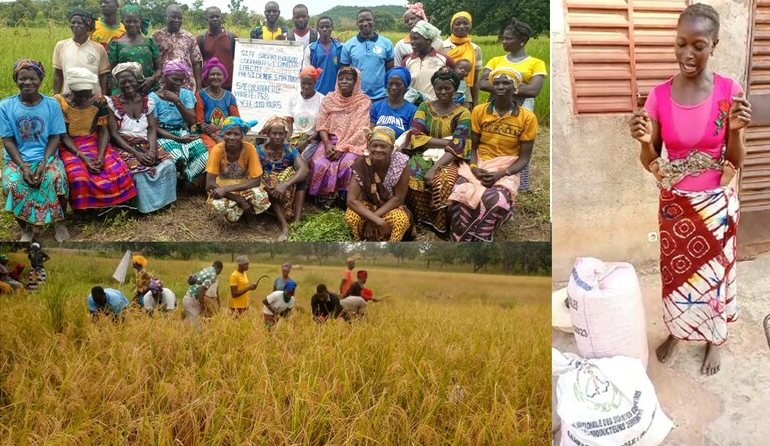 Before and after harvest, the women of the Gouantina cooperative clearly saw the difference between the plots. On a plot of 200m2 after threshing and winnowing the traditional practice yielded 20kg (exptrapolated to 2t/ha) while the SRI plot yielded 35kg (extrapolated to 3.5t/ha).
In view of the results obtained from this farmer field school, the women understood the profitability with rice production using SRI methods; each of them intends to adopt it. Many of them are already active in the production of compost.
The cooperative president, SOURA Makoura, said "We thank PlantVillage and the field agent Albert Compaore for the ongoing support and advice. With this school field we have seen an increase in yield; also the transplanting by row in line facilitates the maintenance of the plot. This technique saves seeds."
[See full PlantVillage article.]
Before and after harvest, the women of the Gouantina cooperative clearly saw the difference between the plots. On a plot of 200m2 after threshing and winnowing the traditional practice yielded 20kg (exptrapolated to 2t/ha) while the SRI plot yielded 35kg (extrapolated to 3.5t/ha).
In view of the results obtained from this farmer field school, the women understood the profitability with rice production using SRI methods; each of them intends to adopt it. Many of them are already active in the production of compost.
The cooperative president, SOURA Makoura, said "We thank PlantVillage and the field agent Albert Compaore for the ongoing support and advice. With this school field we have seen an increase in yield; also the transplanting by row in line facilitates the maintenance of the plot. This technique saves seeds."
[See full PlantVillage article.]
2022
- PReCA PRoject Trains Farmers in the regions of the Boucle du Mouhoun, Cascades, Hauts Basins and the North
[December 5, 2022] By 2025, the Agricultural Resilience and Competitiveness Project (PReCA) intends to increase rice yields by at least 40% in the regions of the Boucle du Mouhoun, Cascades, Hauts Basins and the North. To this end, in addition to the planned agricultural perimeter arrangements, PReCA trains rice producers on the System of Rice Intensification (SRI). This activity is done in collaboration with the Regional Directorates in charge of agriculture and through the Farmer Field Schools. Follow the RTB video report to appreciate this support of the Project in Karfiguéla, in the Cascades region.
2021
- Burkina Faso Included in Four-Year SRI-Based RICOWAS Project
[October 21, 2021] The Adaptation Fund (AF) approved the “Scaling up Climate Resilient Rice Production in West Africa” (RICOWAS) project during late October, 2021. The four-year effort, which emphasizes the System of Rice Intensification (SRI), is the largest regional project funded by the AF in Africa, with a total amount of $14 million and covering thirteen ECOWAS countries. In Burkina Faso, the project Ministry of Agriculture and Hydro-agricultural Development/General Directorate of Sector Studies and Statistics will be in charge of implementing the project. The overall purpose of the initiative is to improve climate resilience and increase the productivity of the rice system of smallholder rice farmers in West Africa. Regionally, the Sahara and Sahel Observatory (OSS), will oversee the project overall implementation. The Rice Regional Center of Specialization, hosted by the Institute of Rural Economy (IRE) of Mali, will be in charge of the regional level execution and will work in partnership with the Climate Resilient Farming Systems program at Cornell University. [See OSS article for more information.]
- Determinants of Adoption Studied in the Karfiguela Valley in Banfora
[September 14, 2021] As reported in an article in the Revue des Etudes Multidisciplinaires en Sciences Economiques et Sociales, Tionyélé Fayama decided to study the System of Rice Intensification (SRI) because, despite the innovation's ability to increase rice productivity, improve living conditions of the producer, and provide other advantages and opportunities, SRI methods are struggling to be adopted at different sites where it has been disseminated in Burkina Faso. The research was conducted in the irrigated perimeter of Karfiguéla among 90 rice farmers; the results showed that SRI was adopted at a rate of 47.8%. The determinants of SRI adoption include the level of education, availability of organic manure, participation in training, access to information, and area sown. Obstacles to adoption of SRI include the unavailability of labor, the difficult management of irrigation water supply and drainage, lack of awareness of SRI, the complexity of the technology, and lack of financial resources. [See full Fayama article (in French).]
2020
- Ministry of Agriculture and Water Works Produces SRI Video in Five Languages
[March 16, 2020] A French language extension video on SRI cultivation in Burkina Faso, which was produced by the Ministry of Agriculture and Water Works, has been translated into four additional local languages: Diaoula, Gourmatché, Mooré, and Fulfuldé. Extension agent Dramane Yiogo narrates the video, describing the principles and practices associated with the System of RIce Intensification.
2016
- BRICOP Project Begins Work with SRI in Houet and Kénédougou
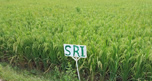 [November 28, 2016] A Radio France Internationale (RFI) program by Sayouba Traoré describes the principles of SRI and an SRI project currently being implemented in Burkina Faso. Traoré explains the production gap of rice in meeting consumer need in Burkina Faso, and how producers are turning to SRI to increase productivity.
The broadcast focuses on the BRICOP project, which is in a pilot phase of an SRI intervention working with 20,000 small farmers in the regions of Houet and Kénédougou in Burkina Faso.
[November 28, 2016] A Radio France Internationale (RFI) program by Sayouba Traoré describes the principles of SRI and an SRI project currently being implemented in Burkina Faso. Traoré explains the production gap of rice in meeting consumer need in Burkina Faso, and how producers are turning to SRI to increase productivity.
The broadcast focuses on the BRICOP project, which is in a pilot phase of an SRI intervention working with 20,000 small farmers in the regions of Houet and Kénédougou in Burkina Faso. The goals of the BRICOP project are to increase production, improve commercialization, and increase access to credit. SRI is one of the approaches being used to increase agricultural production: the goal is to reach 6 tons/ha, in contrast with current yields at 3.5 tons/ha. Guests on the radio show include BRICOP extension agents and representatives from rice farmer cooperatives. Extension agents describe SRI methods, the yields they hope to attain, evaluation methods, and best practices for post-harvest. Farmers explain learning methods for water control, as well as how SRI differs from their conventional practices of planting 15-day-old seedlings with 3 seedlings per hill. They also expressed appreciation for the higher yields and commercalization opportunities, and note that neighboring farmers are curious to learn about this new method of rice production. [Listen to the French language RFI radio show.]
- SRI Farmer Field School in Namassa Concludes with Positive Results
[November 8, 2016] Regional and local authorities, along with agricultural technicians and farmers gathered in the rice-growing area of the village of Namassa in the rural commune of Arbollé to conclude a Farmer Field School in rice production at end of the 2016 agricultural season. The 30-hectare Namassa rice site is expected to provide 5 tons/ha according to the Provincial Director of Agriculture. Three hundred farmers, including 117 women, participated in this government training in rainfed SRI that was carried out in order to increase smallholder capacity to achieve rice self-sufficiency and to reduce rural poverty. [See Lefaso.net article for details.]
- SRI-WAAPP Site Map Updated
[June 2016] The project on Improving and Scaling up the System of Rice Intensification (SRI) in West Africa (SRI-WAAPP) has had continued success promoting the introduction, adaptation and scaling up of SRI in Burkina Faso since January 2014. The map to the right shows both rainfed and irrigated rice field sites that have adopted SRI as of May 2016.
2014-2015 Updates
- IRC-B / INERA Partnership to Promote SRI as Part of Plan to Increase Yields and Diversify Rice Varities
[December 2015] In a November 4 article about rice imports published in African Business, the desire to improve the quality of rice produced in Burkina Faso has resulted in a partnership between the Interprofessional Rice Committee - Burkina (IRC-B) and the National Institute of Environment and Agricultural Research (INERA) which will enable producers to increase their yields and diversify the rice varieties. INERA has been adapting and promoting SRI to increase productivity of rice while reducing the use of environmentally harmful chemical fertilizers. According to INERA's Ibrahima Ouedraogo, SRI reduces production costs particularly through lower inputs,with the amount of seed per hectare required decreasing from 50 kg per hectare to less than 15 kg. In addition, SRI uses less mineral fertilizers (conventional fertilizers) in favor of organic manure. Ministry of Agriculture officials believe that the the introduction of SRI could in the long term lead to reduced rice imports and an increase in the per hectare yield of 20%.
- Update on on CODEGAZ / AMPAD SRI Efforts in Bama
[July 2015] Faced with declining agricultural yields, small plots, and the inadequacy of traditional methods to deal with soil depletion and scarcity of water resources in the context of climate change, farmers from Bama in the region of the "Hauts-bassins" began working several years ago with CODEGAZ, an international NGO and AMAPAD, their partner in Burkina Faso, to implemented a multi-year training program on SRI and ecological gardening. With the technical assistance and training by Pierre Belem and the AMAPAD team, by the close of 2014, 524 farmers cultivated 576 hectares of rice with SRI methods, reaching an average yield of 8 t/ha-- double the traditional method yield of 4 t/ha. In addition, 72 relay farmers have received extensive training and now advise their neighbors and others. CODEGAZ and AMAPAD plan to launch during 2015 a new SRI and gardening training program for the farmers of Bama, Sangouléma, Samandéni and Badara. In addition, the program plans to build biodigesters to produce biogas as well as bio-slurry that will be used as fertilizer to promote soil restoration to improve SRI yields in the future. [See pages 20-21 of CODEGAZ' 2014 Agro-Nutrition and Energy Report]
- Regional Project to Scale Up SRI Formally launched
[January 1, 2014] The project Improving and Scaling up the System of Rice Intensification in West Africa was formally launched during January 2014. This is the first phase of a regional World Bank-financed project to increase rice productivity throughout a 13-country Economic Community of West African States (ECOWAS) area. The three year project, which includes Burkina Faso, is part of the larger West Africa Agricultural Productivity Program (WAAPP), which is funded by the World Bank. SRI-Rice is the technical lead partner on the project, working in close collaboration with the coordinating institution, CNS-Riz, in Mali. Check the project's Burkina Faso page in the coming months for updates.
2012
- First Campaign for CODEGAZ and AMAPAD in Bama Results in 70% Increase in Yield
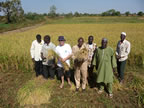 In 2012, CODEGAZ and its partner AMAPAD from Burkina carried a program out in Bama (20 km north of Bobo Dioulasso) in order to increase rice production and improve production for gardening markets.
During this first 2012 campaign:
In 2012, CODEGAZ and its partner AMAPAD from Burkina carried a program out in Bama (20 km north of Bobo Dioulasso) in order to increase rice production and improve production for gardening markets.
During this first 2012 campaign: - 111 farmers (among them 18 women) were trained in SRI methods
- 25 farmers leaders were given in-depth SRI training in order to train other farmers
- 83 farmers practiced SRI methods on their fields
- 32 farmers used organic compost
- 6,500 m2 of seedbeds were planted, and,
- 65 hectares were cultivated with SRI methods.
As a result of using SRI methods, farmers registered an average yield of 7.64 tons/hectare, an increase of 70% in the yield in comparison with traditional rice culture. The increase in production should allow farmers to have food until the next harvest and to generate surpluses that can be sold on the wholesale merchants of Bobo Dioulasso. In the future, AMAPAD intends to open rice-shops in Bama and Bobo-Dioulasso in order to increase sales revenues of farmers.
- West Africa Regional SRI Workshop Held in Burkina Faso
In order to consider the role of SRI in the West African context, the First Regional Workshop on the System of Rice Intensification of (SRI) was held in Ouagadougou, Burkina Faso, on July 26 and 27, 2012. The workshop was organized by the West and Central African Council for Agricultural Research and Development (CORAF/WECARD), the National Center of Specialization for Rice (NCOS-Mali) and SRI-Rice (Cornell University) within the framework of the West Africa Agricultural Productivity Program (WAAPP). Oxfam America, in collaboration with SRI Global, Inc., sponsored participation for civil society representatives. The objective of the workshop, which attracted 60 participants from 13 West African countries was to define an approach for the integration of SRI in research and extension programs in the 15 Economic Community Of West African States (ECOWAS) countries by 2015.
Atamana Dabire was interviewed at the workshop. A presentation was also made on the FAO Project in the Vallee de Kou. Photos from the workshop are shown in the slideshow at right (If you do not have flash, click here to see the workshop photo album). For more information see ChronicleOnline article, PowerPoint presentations, workshop agenda, and video interviews with participants.
- USAID's E-ATP Project Sponsors SRI Training in Bobo Diolasso
On June 13-15, 2012, more than 30 representatives of rice producers' organizations, research institutions, development agencies and other value chain actors across Burkina Faso participated in a training on SRI in Bobo Diolasso. The training, which was organized by USAID's Extended Agribusiness Trade Promotion (E-ATP), is part of the project's efforts to expand SRI in West Africa. (See p.4 of Trade Catalyst communication - no longer online)
- Oxfam-Québec Part of Plan to Scale Up SRI in Burkina Faso
Oxfam-Québec has been evaluating SRI in Toussiana since 2011, partnering with ECLA in the Eau de la Haute Comoé project area. The project, supported by the One Drop Foundation and Hilton Foundation, is expected to consolidate the SRI experiences and move forward during 2012-2013. The 2011-2012 experience was considered very positive as yields averaged 3.5 t / ha in the Toussiana site vs the normal yields of 1.5-2 t / ha for lowland rice in this area. A scaling up initiative that includes SRI is being developed by four Oxfam affiliates from Burkina Faso and elsewhere (Intermon Oxfam, Oxfam America, Novib and Oxfam Great Britain).
- CODEGAZ Begins Supporting SRI in Burkina Faso
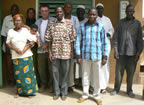 During 2012, CODEGAZ, a French humanitarian association, began supporting SRI efforts in Burkina Faso.
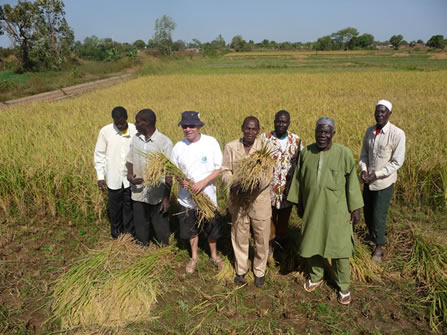
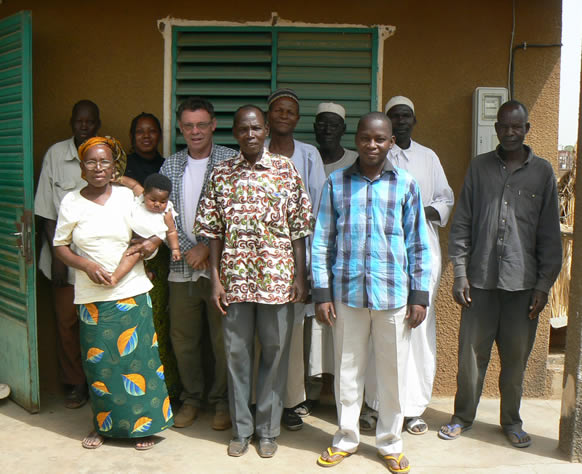
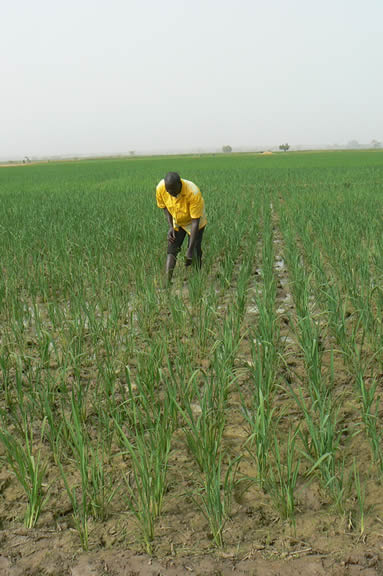
  This NGO has been working with SRI programs in Cambodia and in Madagascar since 2008. CODEGAZ is working in Bama (20 km from Bobo Dioulasso) with Pierre Belem (in the center of the photo a left), who was trained in SRI methods along with 50 rice farmers in 2006 by Tim Krupnik (see items below).The initial project is planned for a duration of three years and will take place in Bama, an area specialized in rice growing. At right is one of the Bama farmers in his SRI field who had adapted SRI methods based on the 2007 trainings provided by Krupnik. (Click on the photos to enlarge them.)
 SRI trainings will include 200 farmers over the three-year period (80 the first year and 60 more for each other year). Vegetable production training will also be provided. The first SRI training has already begun, with the first harvest expected in October/November, 2012. For details of this project, contact Alain Oscar at CODEGAZ.
2009-2010
- FAO Project in the Vallee de Kou Shows Yield Increases with SRI Methods
In 2009 and 2010, under an FAO project in the Valée de Kou, trials were conducted under the auspices of the Direction Provinciale de l'Agriculture et de l'Hydrologie (DPAH-Houet) and the Union des Cooperatives Rizicole Burkina (UCRB). SRI methods yielded 7.6 tons/ha compared with 6.25 tons/ha using presently recommended methods (GIPD) and 4.8 tons/ha with farmer practice.
The conclusion of DPAH and UCRB reported to a workshop on SRI held in Ouagadougou in July 2012, organized by the West African Agricultural Productivity Program supported by the World Bank, USAID's E-ATP Project, and SRI-Rice, with support also from Oxfam America, was that their trials confirm the results reported in the literature, and they consider SRI methods to be an effective methodology for raising rice production in Burkina Faso. (For additional details, see DPAH-Houet presentation).
2006-2007
-
Indication of SRI Potential in Burkina Faso
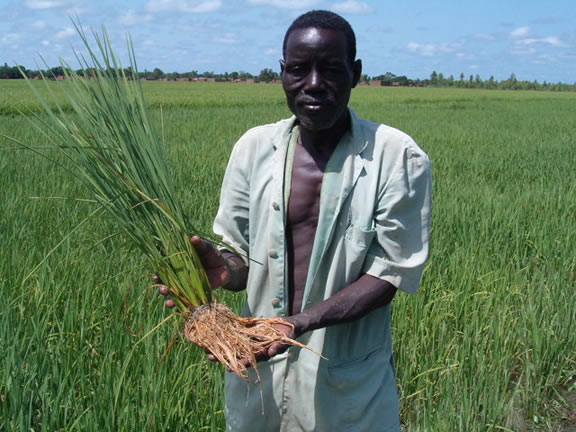
Tim Krupnik has reported that Bourema, the one farmer out of six whom he trained in SRI methods in 2006, has
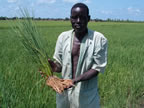 had a
yield of 7 tons/hectare in his second season (2007) using the new SRI techniques.
With more experience and confidence, Bourema was able to grow very
vigorous and large rice plants with extensive root systems (see picture at
right).There were no subsequent reports of uptake of the alternative practices by other
farmers (until 2012), however, and Krupnik moved his thesis research site to Senegal (see
Senegal page) given the little interest in
SRI expressed by local agricultural technicians.
had a
yield of 7 tons/hectare in his second season (2007) using the new SRI techniques.
With more experience and confidence, Bourema was able to grow very
vigorous and large rice plants with extensive root systems (see picture at
right).There were no subsequent reports of uptake of the alternative practices by other
farmers (until 2012), however, and Krupnik moved his thesis research site to Senegal (see
Senegal page) given the little interest in
SRI expressed by local agricultural technicians. -
Preliminary SRI Trials Begin in Burkina Faso
Tim Krupnik (currently working with CIMMYT), at that time a PhD student at the University of California, Santa Cruz, reported on preliminary SRI trials that were carried out during the 2006 rainy season in Burkina Faso. The six volunteer
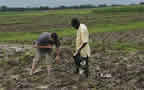 SRI farmers had previously participated in the FAO Farmer Field School Integrated Pest and
Production Management program in the Valée du Kou irrigation scheme and
were accustomed to experimenting with new production methods. Their results were later compared with 6 matched farmers using standard recommended farmers practices
(FP) which are relatively input-intensive. Tim Krupnik and Brema, a Burkinabe
farmer, are shown at left taking soil samples at the evaluation site in Valle du
Kou.
SRI farmers had previously participated in the FAO Farmer Field School Integrated Pest and
Production Management program in the Valée du Kou irrigation scheme and
were accustomed to experimenting with new production methods. Their results were later compared with 6 matched farmers using standard recommended farmers practices
(FP) which are relatively input-intensive. Tim Krupnik and Brema, a Burkinabe
farmer, are shown at left taking soil samples at the evaluation site in Valle du
Kou.SRI results were compared with those from conventional FPs in the study area, which at the time of the study reported average yields of 3.5 t/ha, quite good for West Africa. Despite the reported yields by farmers in this irrigation scheme, national rice production figures in Burkina Faso were much less encouraging: per hectare yields are 2.6 tons, below the global average, and up to 15% of the harvest is regularly lost to pests. In the Valée du Kou, recommended FPs at the time of the trials included applying up to 300 kg of mineral fertilizers per ha; transplanting at 2-3 weeks after nursery seeding, with up to 5 seedlings/hill and around 15 cm spacing. Conventional methods also include ample use of herbicides and pesticides and maintaining at least 5 cm of water throughout the cropping season, when available.
The SRI trials included application of about 360 kg of composted cattle manure/ha, transplanting single seedlings at 10-12 days, with 25 cm spacing in a grid pattern, and limited irrigation. Push weeders were employed to manage weeds at least twice during the cropping season. To learn more about the results of the prelim trials, please contact Tim Krupnik.

Reports and Articles
- 2023. Technique de production agroécologique du riz au profit de la coopérative Gouantina de Douna. Plant Village blog. January 12. [PlantVillage project in Burkina Faso tests SRI with women's cooperative in farmer field school.]
- 2022. Rochefort-en-Terre. L’association locale Ingalañ lance une collecte de fonds pour le Burkina Faso. Ouest-France website. August 11. [French NGO has promoted SRI in Burkina Faso since 2012.]
- Fayama, Tionyélé. 2021. Determinants l'adoption ou non du Systeme de Riziculture Intensive (SRI) dan la Vallee de Karfiguela a Banfora - Burkina Faso. Revue des Etudes Multidisciplinaires en Sciences Economiques et Sociales 6(2): 44-65. doi: 10.48375/IMIST.PRSM/REMSES-V6I2.2465
- 2017. Le système de riziculture intensive, ou SRI, à Bama au Burkina Faso. Ouaga.com website. August 21.
- 2017. SRI: Système de Riziculture Intensive. Tinga Neere website. [Website of the NGO Tinga Neere, which recount four years of work on SRI in Burkina Faso.]
- Nikièma, Par Yann. 2016. Suivi des activités agricoles 2016-2017 au Nord: La campagne de récolte du riz pluvial lancée à Namassa. Lefaso.net, November 8. [300 farmers (117 women) practiced rainfed SRI in northern Burkina Faso.]
- 2015. La bataille du riz. African Business, November 4.
- CODEGAZ. 2015. 2014 agro-nutrition and energy report. SRI Afrique Ouest website. [See pages 20-21 for information on SRI in Burkina Faso.]
- 2014. Fonds Compétitif National PPAAO / Burkina Faso: 240 millions de F CFA aux six premiers projets sélectionnés. WAAPP/CORAF website. March 13.
- Oscar, Alain. 2013. Pierre Belem. Burkina Faso: La formation aux méthodes SRI améliore le quotidien des paysans de Bama. Agridape 29(1): 6-9. April.
- Oscar, Alain. 2013. Report on CODEGAZ 2012 SRI activities. System of Rice Intensification website. January. (3p., 292 KB pdf) [Report from CODEGAZ, on the SRI activities by their NGO in Burkina Faso, Cambodia and Madagascar].
- 2012. Des innovations pour accroitre la production: Filière riz en Afrique de l'Ouest. Mediaterre website.
- 2012. West Africa Regional Workshop on the System of Rice Intensification (SRI). System of Rice Intensification website. August.
- Styger, Erika. 2012. Cornell helps scale up 'green' rice production in West Africa, ChronicleOnline, August 13. [Also available on R&D website]
- 2012. Rice farmers in Burkina Faso learn new methods of increasing rice production. In Trade Catalyst newsletter, p4., USAID West Africa's agribizafrica website. June. (article is no longer online)
Extension (Practical) Material
- Ouedraogo, Ibrahima, et al. 2016. Système de Riziculture Intensive (SRI). PAPSA website. [French language manual from the Institut de L'environnement et de la Recherceh Agricole (IN.E.R.A.) in Burkina Faso]
Videos
- 2024 (February 2, 2024). PReCA _ Le Systeme de Riziculture Intensive . 12:56 min. PReCA channel, YouTube. [French language SRI video from PReCA in Burkina Faso.]
- 2023 (December 14). Publireportage : Projet ECDD - Soutenir l’agriculture familiale face au changement climatique. 5:52 min. Agribusiness TV channel, YouTube. [French language TV clip about the Eau, CLÉ du Développement Durable (ECDD) project which has SRI elements. Implemented by SNV and World Waternet in Karfiguéla, Burkina Faso]
- 2020 (March 4). Système de riziculture intensive (SRI). 10:52 min. Agriculture Burkina Faso channel, YouTube.[French language video about SRI in Burkina Faso.]
- 2012 (August 23). First West Africa SRI Workshop, Ouagadougou, 8/26-27/12: Atamana Dabire (Burkina Faso). 2:55 min. Produced by SRI-Rice. sricornell channel, YouTube.
[Comments by Atamana Dabire while attending the First West Africa System of Rice Intensification (SRI) Workshop, Ouagadougou, Burkina Faso, July 26-27, 2012.]
PowerPoint Presentations
- Experience de la Vallée du Kou en SRI
Powerpoint presented by La Direction Provinciale de l'Agriculture et de l'Hydraulique du Houet (DPAH Houet) at the West Africa Regional SRI Workshop, Ouagadougou, Burkina Faso, July 26-27, 2012. 7 slides.
Photo Collection
- SRI-Rice Burkina Faso photo collection (Picasa) (see Summary section for slideshow)
- Photo album from the West Africa SRI Conference (see West Africa SRI Conference item above for slideshow)