

MADAGASCAR
Summary of SRI in Madagascar
SRI work began in Madagascar (and the world), with the efforts of Association Tefy Saina (ATS) to disseminate and further develop the methods that Fr. Henri de Laulanié originally assembled in the 1980's. In 1994, CIIFAD began working with ATS in introducing SRI in the peripheral zone around Ranomafana National Park under a USAID-funded conservation and development project there. By 1997, after the farmers guided by ATS field staff on SRI use had averaged 8 t/ha yields where before they had averaged 2 t/ha, CIIFAD and ATS began working more earnestly to advance the knowledge and practice of SRI, first in Madagascar and then in other countries.
Prof. Robert Randriamiharisoa, while director of research for the Faculty of Agriculture (ESSA) at the University of Antananarivo, joined with CIIFAD and ATS in 1997 to begin validating and explaining SRI through student thesis research assisted by Tefy Saina and CIIFAD (see more on his group's research). In 1998, Bruno Andrianaivo, senior rice specialist with FOFIFA, the government's agency for agricultural and rural development, began working with ATS, the University of Antananarivo and CIIFAD on SRI evaluation, including an adaptation of SRI concepts and practices to upland rice production. He subsequently did PhD thesis research on SRI and became a supporter within the Madagascar government, which had been otherwise disinterested in SRI. In November 1999, the Rockefeller Foundation made a small grant to a consortium of Tefy Saina, the University, FOFIFA and CIIFAD to do research on SRI and its dissemination. This collaborative research continued until 2003. (see FOFIFA final report and Consortium final report).
In 2000, Catholic Relief Services began to disseminate SRI in 8 dioceses of Madagascar and found yield increased according the number of SRI practices used. ADRA and other NGOs also began to disseminate SRI in the early part of the decade. CIIFAD continued to investigate and promote SRI in the Landscape Development Interventions (LDI) project funded by USAID and implemented by the consulting firm Chemonics. Master’s and PhD research on SRI by Cornell and Malagasy students was supported under this project, while SRI was extended in the central-eastern part of Madagascar through a network of farmer associations known as "Kolo Harena" assisted by the project. In 2003, Dr. Willem Stoop of WARDA visited Madagascar to review SRI progress.
Master's theses and associated articles completed by Cornell University students include 1) an evaluation of SRI adoption and disadoption done by Christine Moser that found SRI dissemination and maintenance depended heavily on extension support, and 2) joint 2000-2001 theses and 2003 articles by Joeli Barison and Oloro McHugh, who concluded that SRI is an 'unambiguously superior technology.' (Barison and McHugh estimated that half of the 88% increase in yield with SRI practices for these 107 farmers was attributable to the adoption of SRI techniques on a ceteris paribus basis. The other half was attributable to differences in 'farmer quality,' which could also be interpreted as meaning 'best use' of SRI practices).
During 2006, the U.S. Embassy in Madagascar cooperated with Association Tefy Saina in setting up and maintaining a 0.36 ha SRI demonstration plot at the Presidential Palace at Ioavolaha. The U.S. Ambassador and the Madagascar President, Marc Ravalomanana, both participated in the planting of young seedlings, and in the harvest ceremony. During 2008, then President of Madagascar, Marc Ravalomanana, in his address to the U.N. General Assembly as part of its debate on the global food crisis, said: “We are promoting the widespread use of the System of Rice Intensification (SRI), an eco-friendly and pro-people method developed in Madagascar in the 1980s. SRI promotion is an important part of Madagascar’s recently launched ‘natural revolution’." During a subsequent Madagascar Action Plan national workshop in 2008, two days were devoted to getting SRI knowledge and practice disseminated to all 22 regions through government and NGO partnerships.
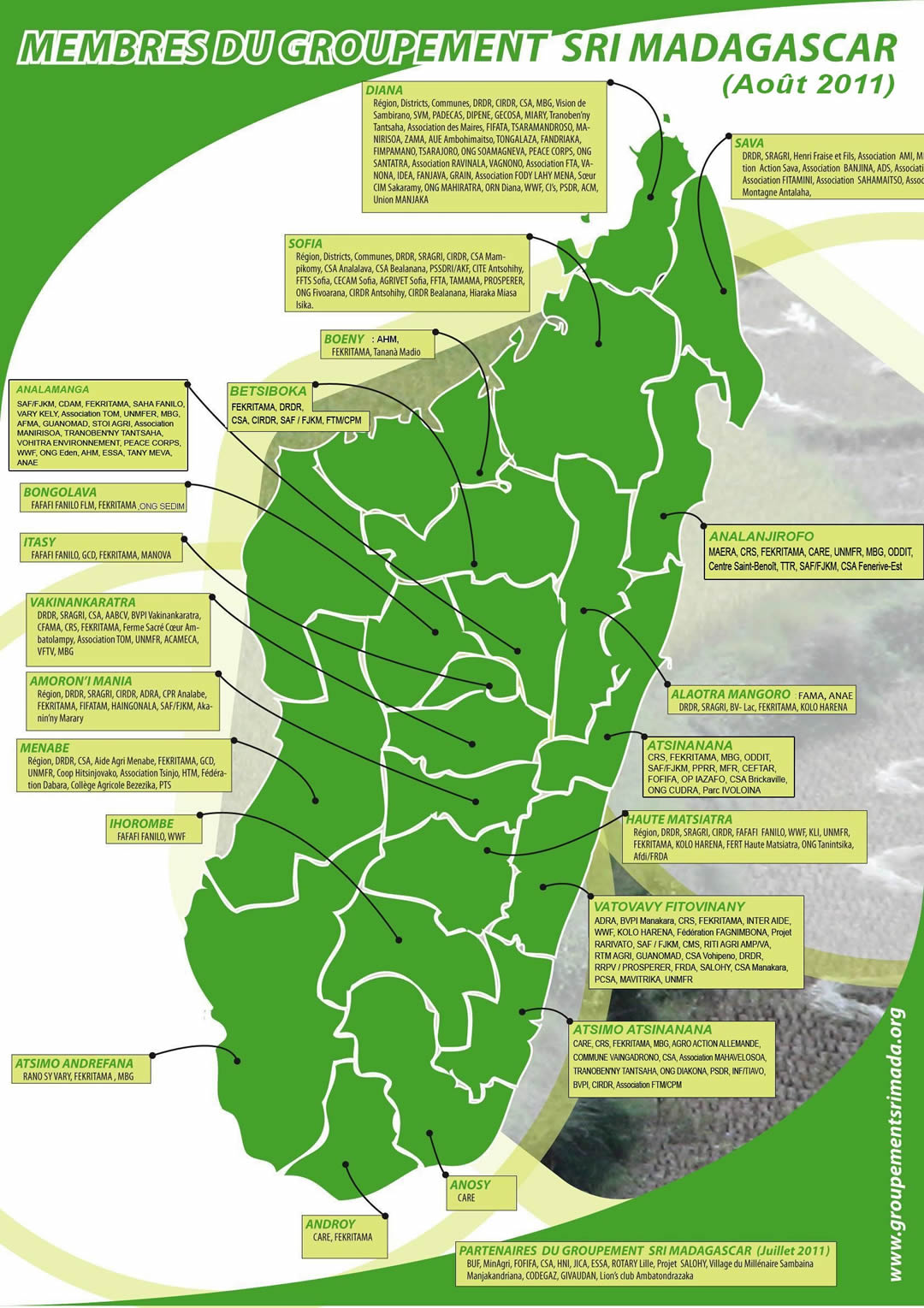 With support from the Better U Foundation of Los Angeles, California, the SRI
Group of Madagascar (GSRI) was established in November/December 2008, providing
technical and logistical support for an SRI Secretariat based in Antananarivo. This has created a hub for SRI activities in Madagascar, also making small
grants to NGOs and local government bodies to experiment with and evaluate
innovative ways to improve and apply SRI and to get it more widely adopted. In
2009, a SRI Blog and website were set up by the Secretariat of the
SRI Platform in collaboration with the Ministry of Agriculture and various SRI
entities in Madagascar and the Better U
Foundation provided technical advisors as well as financial assistance for
this venture. Membership of the SRI Group of Madagascar, which began with ten
organizations collaborating in the BUF initiative in 2008, and has grown to 267
members and partners distributed in 22 regions of Madagascar and organizations in
2012 (see map at right).
With support from the Better U Foundation of Los Angeles, California, the SRI
Group of Madagascar (GSRI) was established in November/December 2008, providing
technical and logistical support for an SRI Secretariat based in Antananarivo. This has created a hub for SRI activities in Madagascar, also making small
grants to NGOs and local government bodies to experiment with and evaluate
innovative ways to improve and apply SRI and to get it more widely adopted. In
2009, a SRI Blog and website were set up by the Secretariat of the
SRI Platform in collaboration with the Ministry of Agriculture and various SRI
entities in Madagascar and the Better U
Foundation provided technical advisors as well as financial assistance for
this venture. Membership of the SRI Group of Madagascar, which began with ten
organizations collaborating in the BUF initiative in 2008, and has grown to 267
members and partners distributed in 22 regions of Madagascar and organizations in
2012 (see map at right).
After several years of involvement from several projects (Business and Market Expansion, Landscape Development Initiative, and BVLac Alaotra) and from volunteer groups (US Peace Corps and Agronomes et Vétérinaires Sans Frontières), Lotus Foods imported to the US the first container (about 18 tons) of milled pink rice or “Varini Dista” grown with SRI methods in the Lac Alaotra region. With BUF funding, the farmers in the Koloharena (KH) village association that grew the rice acquired weeders, other simple implements, and organic inputs, resulting in a 50% increase in production. Lotus Foods imported a second container in early 2010 and is working with the KH and Ecocert on organic and fair trade certifications.
Progress on SRI in Madagascar over the past decade is recorded in the section below. For research, visit the Madagascar section of the SRI Research Library on Zotero, which contains 40+ research items related to SRI in Madagascar.
Progress and Activities (chronological order)
2025 Updates
-
 Ecological Crisis and the Jesuit Way of Proceeding in the Mission of Henri de Laulanié
[December 1, 2025] A recent article by Adam Parr about Henri de Laulanié, S.J. (1920–95), a French agronomist whose mission to Madagascar shows how the Jesuit way of proceeding, may be applied in the ecological crisis we face today. For thirty-four years, Laulanié worked with Malagasy peasant farmers to help them become self-sufficient while restoring degraded land and protecting more land from slash-and-burn farming. Laulanié can be placed in a four hundred-year arc of Jesuits who have confronted ecological crisis and called for regeneration. Laulanié took his mission into the fields, where he was guided by necessity and the resources available to him. His greatest achievement was the empirical development of a new, agroecological approach to rice cultivation known as the System of Rice Intensification (SRI).
Laulanié combined transplantation of young seedlings with wider spacing of plants and sparing use of water to double yields or more. Subsequent research has validated Laulanié’s observations and shown that SRI also reduces greenhouse gas emissions. SRI has spread to most rice-producing countries, become a Project Drawdown solution, and been included in the Nationally Determined Contributions of a dozen countries. Nonetheless, scaling has proven difficult, as is the case with agroecology in general. Laulanié’s mission may encourage a new generation of agricultural entrepreneurs to make agroecology the foundation of food sovereignty and a regenerative food system. This transformation is urgently needed if we are to meet the needs of people and planet. It can only be achieved if we follow Laulanié in doing what is necessary and working with what is available now. [See full article published in the Journal of Jesuit studies. A French translation is available on the SRI website.]
2018
- 30% of Farmers in Alaotra Mangoro Region Have Adopted SRI
[August 16, 2018] According to an article on the MA-TV website, 510,000 tons of paddy in the Alaotra Mangoro Rice production has improved significantly this year, said Lucien Ranarivelo, Director General of Agriculture at the Ministry of Agriculture and Livestock (MPAE). Overall, an increase of 15% over normal years is estimated. For the Alaotra Mangoro Region, production increased by 50% compared to last year. According to his explanations, the production of this region, rice granary of Madagascar, will be 510,000 tons for this year 2018. This marked improvement in the harvest is due to several factors. The Director General cited, among other things, the rehabilitation of three large dams in the Alaotra Mangoro region and the renovation of 75 km of irrigation canals. He also noted that hese efforts of the MPAE would be in vain without the commitment of the producers, noting that, "At least 30% of the farmers have changed their practice by undertaking the SRI technique adapted to the region and the climate."
-
Government Promotes SRI in the District de Marovoay
[August 6, 2018] Rice self-sufficiency in 2020 is one of the objectives of the Fisandratana Plan of the President of the Republic of Madagascar HE Mr. Hery Rajaonarimampianina. Conditions for improving rice yield and achieving this goal is the adoption and practice of modern rice crop cultivation techniques and the use of improved seeds. The Regional Directorate of Agriculture and Livestock (DRAE) Boeny has undertaken for this campaign 2017/2018 promotion of SRI in the District of Marovoay. A SRI demonstration site, with an area of 15 ares, has been set up in the rural district of Ankazomborona District Marovoay. Transplanting on April 19 and harvesting followed on August 6. The yield is estimated at 5 tons/ha.
Increase of Rice Production Linked to SRI, Government Support and the Abundance of Rain
[May 31, 2018] According to an article on the MA-TV website, a good harvest this year is the cause of a significant drop in the price of rice. Since 2015, the government has strengthened extension of rice cultivation using SRI methods, which were developed in Madagascar in the 1980s, and have enjoyed considerable success in several areas of the country. In Marovoay, Antalaha and Ambatondrazaka, producers who have adopted SRI methods have doubled their production which has been linked to the abundance in the country's rice production. The strengthening of support to producers through the provision of improved and certified seeds and the rehabilitation of irrigation systems in areas with high rice potential have also reprotedly led to a clear improvement in productivity. The country has additionally benefited from the abundance of rain which was not the case in 2017 when water shortages hit the country. The government has set a goal of doubling agricultural production, with Madagascar's main island becoming the food granary of the Indian Ocean.
2015
- Use of SRI in Ambohidratrimo District Double Crop Yields
[May 6, 2015] The Malagasy Ministry of Agriculture says that about 4 million tons of rice are expected to be harvested this year in Madagascar compared with 3.6 million tons in 2014. According to the article in in the Indian Ocean Times, the use of System of Rice Intensification in the district of Ambohidratrimo in the northeast province of Tananarive, in particular allowed double crops. This is important as the required rice imports in Madagascar in 2015 could approach to about 235,000 tons against 363,423 tons imported in 2014 to about 410,373 tons in 2013.
2014
- SRI Among Methods Promoted in REDD+ Project Funded by Microsoft through Pioneering Carbon Credit Scheme
[February 18, 2014] According to an article in Green Business, Microsoft is helping to protect one of Madagascar's most pristine rainforests, after buying a block of carbon credits from the government to use in the Makira REDD+ (Reducing Emissions from Deforestation and Forest Degradation 'plus') conservation project. Overall, the project aims to curb deforestation on 320,000 hectares of land, preventing the release of 32.5 million metric tonnes of carbon into the atmosphere. The project plans to reduce deforestation while teaching local communities about the benefits of sustainable farming. The project is enabling households to adopt alternative techniques that replace destructive and unsustainable methods. These activities include SRI as well as other sustainable improved farming techniques. The investment makes Microsoft the first organization to purchase carbon credits from the new scheme, which is being run by the Madagascan government and the Wildlife Conservation Society. The move is the latest investment made by Microsoft as part of its commitment to operate as a "carbon neutral" company by curbing emissions where possible and offsetting its remaining emissions.
- Videos about SRI in Madagascar Available on the CODEGAZ YouTube Channel.
[January 28, 2014] Corrine Lalo produced two French language videos on SRI practices and successes in Madagascar in collaboration with the NGO Association Tefy Saina and the French NGO CODEGAZ. Both videos are available on the CODEGAZ channel on YouTube. They are 1) CODEGAZ et la genèse du SRI (système de riziculture intensive) à Madagascar and 2) Système de Riziculture Intensive SRI préconisé par CODEGAZ à Madagascar.
2013
- SRI Among Successes in Madagascar's Millennium Village Project
[August 22 and March 23, 2013] An article on the IRIN website featured a Millennium Village Project site in Madagascar after five years of support from the UN Development Programme (UNDP) ended during March 2013. Launched in 2004 by the UN in conjunction with the Earth Institute at Columbia University and the international nonprofit Millennium Promise, Sambaina Commune in Madagascar was one of 14 sites in rural Africa selected to become "Millennium Villages." Madagascar's Millennium Village appears to have had some success in demonstrating that sufficient, targeted investment can speed up development despite four years of political crisis and low economic growth.
The IRIN article mentioned the Rabodozafy family, who learned about SRI methods through the project, is now growing enough food to eat for 11 months of the year, while previously they had rice for only three months. Mayor Arsene Randriamiarana of Sambaina reported that about 73 percent of local farmers now use the SRI method, greatly improving their production. (See also Aug. 22 allAfrica article.)
- Article in Farming Matters Documents CODEGAZ Success with SRI in Madagascar
[April 2, 2013] An article by Alain Oscar published in the March edition of Farming Matters magazine recounts successes in two SRI projects in Madagascar. CODEGAZ, a French NGO working on SRI in Madagascar since 2009, has been developing organic SRI-based projects. The first was implemented in the Ménabé region, where 150 families were invited to follow a training programme aimed at increasing their food security and helping them overcome poverty. Since 2010, CODEGAZ has been developing a larger-scale SRI project to train 3,000 families in Morarano. [see more in the CODEGAZ item below.]
2012 Updates
- CODEGAZ Reports on SRI Success in Morarano
 In 2012, CODEGAZ continued cooperating with its Malagasy partner TAOEZAKA on a SRI project in the rural town of Morarano. The project results showed that rice yields could be significantly increased with SRI method, and, with a yield of 8 to 9 tons per hectare, rice yields could triple. This program also included a specific SRI awareness and initiation campaign for school children through presentations in the town schools; 441 pupils were introduced to SRI methods. The 2011-2012 campaign, the second for CODEGAZ, brought very good results:
- 1,549 farmers trained on the SRI methods
- 434 rice farmers practiced SRI in their fields
- 8.193 m2 of seedbeds were planted, and,
- 85 hectares of rice fields were planted with SRI methods.
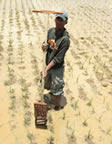
A study with a sample population of 20 people determined that practicing SRI had been very beneficial for the farmers with respect to living conditions, health conditions, sending children to school, and even their general well being. All rice farmers interviewed were unanimous about the effectiveness of SRI, particularly rice farmers with small plots, who were able to double or triple their yield through SRI. Farmers also benefited from the use of weeders as shown in the photo at right. (See page 3 of project report.)
- GSRI Meeting Showcases SRI Accomplishments and Opportunities
During a February 10, 2012, meeting held at CRS Tsiadana, the Groupement SRI Madagascar (GSRI) presented its 2011 accomplishments, current activities and prospects for this year 2012 to a group of individuals representing NGOs, several government ministries/agencies, agribusiness interests and other civil society stakeholders. The GSRI, with its secretariat, is a work-group started in association with the Ministry of Agriculture of Madagascar and with the financial support of the Jim Carrey's Better U Foundation. It currently has 267 members and partners distributed in 22 regions of Madagascar (covering 63,714 ha of SRI with 218,155 practitioners as of mid-2011 compared 56,000 ha and 159,000 practitioners in mid-2010). An external consultant's study presented at the meeting indicated that, given the socioeconomic constraints, climate variability, and other parameters related directly or indirectly in the rice sector in Madagascar (world market, cost of fuel, etc.), the use of SRI methods should help rice to regain its previous rank in terms of quantity and quality.
The Ministry of Agriculture shared information at the meeting about CARD (Coalition for African Rice Development), an advisory group of bilateral donors and multilateral and international institutions which aims to double rice production in sub-Saharan Africa by 2018. A delegation the CARD members, led by the Ministry of Agriculture, adopted a "National Strategy for Rice Development" with various projects to be implemented in order to achieve CARD goals. With regard to Madagascar, SRI has been enlisted to help achieve these results through "Priority Project No. 07: Support for the dissemination of SRI," which is part of the PTA of the Ministry of Agriculture and is present in various projects / programs presented to the General Assembly of the CARD in Uganda during November 2011.

2011
- Better U Foundation's SRI Program in Madagascar Broadens it
Outreach
The Better U Foundation's SRI program in Madagascar, which was initiated in 2007, has made significant strides in during the past year which are outlined in an August 2011 report. The program supports direct field activities of partners through competitive grants as well as supporting the Secretariat for the SRI Group of Madagascar (GSRI) which serves as a hub for SRI activities in the country. GSRI membership has now grown to over 200 groups and organizations (see map at right).The BUF-supported SRI work is now taking place in twelve regions of the country with eight field grants being disbursed during 2010-2011. Among its numerous projects, the GSRI is continuing its successful pilot 'SRI school' initiative in which teachers and students in primary schools are introduced to basic concepts and principles of SRI. (See the report for details of other efforts).
- Reports of National and Regional SRI Workshops Disseminated
A report by the Secrétariat Permanent Groupement SRI (GSRI) about a National SRI Conference held November 22-24, 2010, at Siège FFPM Vohipiraisana Ambohijatovo Atsimo, Antananarivo, is now available. (see full report or executive summary - both are in French).
The Ministry of Agriculture, which now has a permanent link to the Groupement SRI on its website, reported recently on a February 17 consultation workshop with a variety of stakeholders that was held in the Ambositra capital of the Amoron'i Mania region in collaboration with GSRI and the Regional Fund for Agricultural Development (FRDA). According to Jean Roger Rakotorahalahy, a rice farmer and member of the Coordination Platform, many farmers are practicing SRI in the region, but they are constrained by a lack of inputs and production equipment. The workshop included strategies for moving forward with SRI in the region.
1990-2010
- For 1990-2010 SRI Activities, see Madagascar archives
Reports and General Articles
- Pitchboule, Lalatiana. 2025. SRI and the Malagasy paradox of short-termism, or "When Madagascar imports rice of its own invention", Madagascar Tribune, September 1. [See original French version] [accessed March 14, 2026]
- MeriZRAPP. 2023. Amelioration de l'environment en amount de la filiere riz:
SRI semis germoir biodégradable
Rapport-Gratuit.com. June 23. - 2021. Reduced carbon footprint and increased economic results: when science proves the positive impact of agroecology! Agrisud International website. January 13. [See also French version] [Summary of a research paper that shows SRI can play a part in reducing carbon footprint in Madagascar.]
- 2019. Groupe de la BAD : Le Président Akinwumi ADESINA est dans nos murs. La Gazette, July 1. [Strengthening the dissesmination and adoption of SRI through training and investment will increase productivity and help fight climate change: ADB president]
- R., Riana. 2018. Riziculture: sensibilisation sur le SRI a Marovoay. MADANews, August 16.
- A., Marc. 2018. Mercuriale: Le riz Makalioka 1.800 Ar. chez les détaillant. MA-TV website. May 31. [French article from Madagascar about SRI]
- 2018. Note sur le système de rizipermaculture ZANATANY. Journal de L'Agro-Ecologie 4:20 (January-March) [accessed May 31, 2018]
- A., Marc. 2018. Santabary 2018 : 510.000 tonnes de production dans l’Alaotra Mangoro. MA-TV website, May 24.
- Manou. 2018. Amoron'i mania: Miarinavaratra inaugure la PNEFP. News Mada, January 4. [200 women trained in SRI in Miarinavaratra in Madagascar's Fandriana district]
- Gerety, Rowan Moore. 2017 Carbon dreams: Can REDD+ save a Yosemite-size forest in Madagascar? Mongabay website. November 29. [SRI part of effort linked to carbon credits/REDD+ in Makira Natural Park village near Madagascar's Makira Natural Park. However, the project is not entirely successful.]
- 2017. How rice is made in Madagascar. Chic African Culture website. July 20.
- Riana. 2016. Itasy : introduction réussie du SRI. News Mada, August 2.
- Antsa R. 2016. Récolte rizicole 2016 : Un rendement moyen de 11 tonnes à l’hectare à Morarano Antongona. Midi-Madagaskara, August 2.
- 2015. Madagascar: 4 million tons of rice expected be harvested in 2015. Indian Ocean Times, May 6. [Doubling of rice yield with SRI in the district of Ambohidratrimo contributes to substantial increase in national rice production.]
- 2015. Five questions for IFAD. An original technique for growing rice, that is spreading by word of mouth across Madagascar. Expo Net. April 2.
- Loucks, J. 2014. Growing rice in Madagascar. Storehouse website. October. [Pictorial story of Jeannot growing his rice crop.]
- Shankleman, Jessica. 2014. Microsoft snaps up Madagascan rainforest protection credits. Business Green website. February 18. (Rainforest protection credits purchased by Microsoft include promotion of SRI in Madagascar.)
- JICA. 2014. Revolution in Madagascar, a rice-growing country. JICA website. December 13.
- 2013. Madagascar town tries Millennium Model. allAfrica, August 2. [70% of Millennium Village in Madagascar using SRI.]
- Oscar, Alain. 2013. New Initiatives in Madagascar and Mali. Farming Matters 29(1): 38-40.
- ar/ks/rz. 2013. Madagascar's Millennium Village goes it alone. IRIN website. March 22. [73% of farmers now use SRI which was introduced through Millennium Village project. Rabodozafy’s family now grow enough rice with SRI to eat for 11 months/year as opposed to 3 before.]
- Saint-Ange, Perin. 2013. System of Rice Intensification. International Fund for Development website. February. [See also the resources section on adoption of SRI that describes and links to videos on farmers spreading SRI in Burundi, Madagascar and Rwanda.]
- Oscar, Alain. 2013. Report on CODEGAZ 2012 SRI activities. System of Rice Intensification website. January. (3p., 292 KB pdf) [Report from Alain Oscar, CODEGAZ, on the SRI activities by their NGO in in Burkina Faso, Cambodia and Madagascar].
- Rappocciolo, Francesca. 2012. Spreading the system of rice intensification across East and Southern Africa: Case Study. International Fund for Agricultural Development (IFAD) website. November. (16p. pdf) [Case study on the International Fund for Agricultural Development's progress with promoting SRI in Madagascar, Rwanda and Burundi.]
- 2012. Smallholders fulfil their households' needs with a new way of farming rice. International Fund for Agricultural Development (IFAD) website. [article links to Seeds of Innovation - East and Southern Africa Project bulletin (December 2012)]
- 2012. SRI: Successful campaign and encouraging in Morarano. CODEGAZ website. [no longer online].
- Massonnet, Adrien. 2012. SRI, Defis alimentaires et sous-developpement a Madagascar. Groupement SRI Madagascar website. September 10. (French, 91p.) [Report (mémoire master 2) on constraints to SRI adoption by a Sorbonne University student.] [acquired Dec. 14, 2012] [no longer online].
- R., Navalona. 2012. Filière rizicole: Un rendement de plus de 9 t/ha avec des engrais bio,Agri avec Madagascar, October 19. [Nine percent of Madagascar's 2 million farmers are using SRI methods on 11% Madagascar's rice lands. Using organic fertilizers can improve yields to 9+ t/ha. Article also reported on AllAfrica website.]
- Ramambazafy, Jeannot. 2012. Madagascar: Une histoire (vraie et réaliste) de riz par Erick Rajaonary. Madagate website. March 23.
- Banning, Jenna. 2012. Africa: Five great grains with promise for the future. AllAfrica website, press release. March 6. [Dista rice, grown with SRI in Madagascar, on of 5 highlighted grains]
- 2012. MADAGASCAR: The "less is more" philosophy of rice production, IRIN Humanitarian News Service, January 31, Africa section.
- Fajardo, Sara A. [2012]. Cultivating prosperity: Madagascar's rice revolution. CRS website, Madagascar section. May 17.
- Fajardo, Sara A. [date?]. Madagascar Rice: Same Fields, Bigger Yields. CRS website, Madagascar section.[ no longer online].
- Fitzgerald, Winifred M. and Rames Abhukara. Progress Report to the Better U Foundation Madagascar Program, Aug 2011, V4. System of Rice Intensification website. August 2011. (27p. 414KB pdf)
- Fanjanarivo. 2011. Filière riz: Bientôt la mise à jour de la stratégie nationale, La Gazette, May 30.
- Fanjanarivo. 2011. Filière riz: Un livret SRI pour les paysans des pays ACP, La Gazette, May 26. [no longer online].
- Nierenberg, Danielle. 2011. Madagascar’s “Magic Rice” – Dista Rice. Nourishing the Planet blog. March 28.
- Rasoanaivo, Anjara. 2011. Riziculture : Le SRI augmente le rendement, Jacaranda Madagascar, January 15.
- 2011. One original way to preserve the plot during drought season: sharing experience on SRI, project in Menabe supported by the NGO CODEGAZ. SRI Group of Madagascar website. March. [no longer online].
- 2011. Région de l' Amoron' i Mania: Promouvoir la production rizicole par le SRI. Ministere de Agriculture Madagasikara website. March. (French) [no longer online].
- Alaotra Lake Dista Rice. Slow Food for Biodiversity website. [Presidium received for the Dista pink rice grown with SRI in Alaotra, Madagascar] [no longer online].
- 2011. Rapport Atelier SRI National - Le SRI à Madagascar, un levier de la sécurité alimentaire, de la croissance économique et du développement durable. System of Rice Intensification website. (41p., 1.4MB pdf). (French language). [Report by the Secrétariat Permanent Groupement SRI of a National SRI Conference held November 22-24, 2010, at Siège FFPM Vohipiraisana Ambohijatovo Atsimo, Antananarivo]. (See also executive summary in French).
- 2011. MADAGASCAR: Rice is 'becoming a luxury'. IRIN website. February 15. [see also French version]
- 2011. La riziculture intensive bio : pour l’autosuffisance alimentative de Madagascar et de notre region. Empennages (Reunion), January 20.
- 2010. Blackly: Hens laid a trophy. The Times of Madagascar, November 27. [no longer online].
- Shrives, Pravash. 2010. Enough food to protect lemurs. WWF for a Living Planet website. October 8.
- Viler, Tudor. 2010. How to boost rice yields.Softpedia.com website. October 10.
- Fitzgerald, Winifred and Rames Abhukar. 2010. Progress Report of the Better U Foundation - April 2010. System of Rice Intensification website. (10p., 84.5KB pdf)
- 2009. Sharing on the pink rice variety/Partage de la variété riz rose: Mr Jules Randrianarivelo, President of the National Confederation Koloharena. Groupement SRI blog. May 11.
- Uphoff, Norman. 2008. Madagascar: Report on a visit to review progress with the System of Rice Intensification (SRI), September 25-October 3, 2008. System of Rice Intensification website. [Trip report for Cornell International Institute for Food Agriculture and Development.] (6p. pdf)
- Ravalomanana, Marc H.E. 2008. Madagascar. Presentation at the 63rd of the General Assembly of the United Nations, September 23, in New York. (7p., 4MB pdf). [Address by the President of the Republic of Madagascar to the United Nations. Mention of SRI is on page 4. See also video of address in French].
- Deluxe, Al wa. 2005. Riziculture intensive, June solution pour s' en sort ir? Rotary International, site Internet Francophone. [Article is also published in the April 2005 edition of Le Rotarian].[no longer online].
- 2002. Madagascar papers presented at the international conference.
Assessments of the System of Rice Intensification (SRI), April 1-4, in Sanya,
China.
- SRI Experience of Association Tefy Saina in Madagascar
Justin Rabenandrasana, Association Tefy Saina
- CRS Experiences with SRI in Madagascar
Niacin Andriankaja and Patrick Transmission, Catholic Relief Services
- An NGO Perspective on SRI and its Origins in Madagascar
Sebastian Agartala, Association Tefy Saina
- Uphoff, Norman. 2001. Report from field visit to farmers practicing SRI around Lac Alaotra, Madagascar. System of Rice Intensification website. June 6. [Trip report for Cornell International Institute for Food Agriculture and Development.]
Research / Evaluations
[in order accessed]
- Parr, Adam. 2025. Ecological crisis and the Jesuit way of proceeding in the mission of Henri de Laulanié. Journal of Jesuit Studies 12: 521-547. [See also French version.]
- 2024. Etude de l’adaptation du systeme de riziculture intensive (SRI). Rapport-Gratuit.com [Madagascar SRI adaptation study]
- Moore, Maya, Kimmerling Razafindrina, V. Ernesto Méndez and Meredith T. Niles. 2024. An analysis of the adoption of the “system of rice intensification” (SRI): Why a homegrown technique has yet to take seed among rice farmers in Madagascar. Cogent Food and Agriculture 10(1):2319932. doi:10.1080/23311932.2024.2319932
- Andriambahoaka, Lydie C., et al. 2021. Mecanisation artisanale du repiquage et valorisation des dechets plastiques en riziculture. Recherches pour Developpement Série Sciences Technologiques N° 6: 121 2021
- Ravalisoa, Rojo. 2017. Trajectoire et facteurs d'innovations en riziculture paysanne des hautes terres de Madagascar. Masters Thesis. Faculté des sciences économiques, sociales, politiques et de communication, Université Catholique de Louvain. Prom.: Stassart, Pierre. 121 2021
- Ralaivoavy, Christian. 2021. Capitalisation des pratiques agroecologiques dan la Region Analanjirofo. Ingénieur Agronome (Master 2) thesis. Antananarivo University (Madagascar). 45p. [accessed August 13, 2022]
- Rakotovao, Narindra Harisoa, et al. 2020. Production Impacts on greenhouse gas balance and rural economy after agroecology development in Itasy Madagascar. Journal of Cleaner Production (In press) 125220. doi:10.1016/j.jclepro.2020.125220
- Rasolonjatovo, Fulgence. 2008. Diffusion du système de riziculture intensive par les écoles vertes en Isandra (Hautes Terres à Madagascar). Kabaro, revue internationale des Sciences de l’Homme et des Sociétés, Interethnicité et Interculturalité à l’île Maurice, IV (4-5): 143-152.
- Jenn-Treyer, Olivier,Marie-Hélène Dabat, and Philippie Grandjean. 2007. Une deuxième chance pour le système de riziculture intensive à Madagascar ? La recherche d’un compromis entre gain de productivité et investissement en facteur de production. Paper presented at the conference Dynamiques rurales à Madagascar: Perspectives sociales, économiques et démographiques, held April 23-23, 2007, in Antananarivo, Madagascar. 28p.
- Whitman, K.L., J.H. Ratsimbazafy, and N.J. Stevens. 2020. The use of System of Rice Intensification (SRI) near Maromizaha Protected Area, Madagascar. Madagascar Conservation & Development 15(10): 1-7. doi: 10.4314/mcd.v15i1.1
- Serpantié, Georges. 2017. Le système de riziculture intensive ou « SRI » à Madagascar. Entre légende urbaine et innovation rurale. Anthropologie & développement 46-47: 67-99. doi: 10.4000/anthropodev.588
- Rijaharilala, Razafimanantsoa. 2009. Analyse de l'échec et de la diffusion du Système de Riziculture Intensive à Madagascar. MSc thesis, Universite d' Antananarivo. (Antananarivo, Madagascar) [accessed Sept. 25, 2017]
- Rakotovao, Narindra H., Tantely M. Razafimbelo, et al. 2017. Carbon footprint of smallholder farms in Central Madagascar: The integration of agroecological practices. Journal of Cleaner Production 140(3): 1165–1175. doi:10.1016/j.jclepro.2016.10.045
- Barison, Joeli and Norman Uphoff. 2011. Rice yield and its relation to root growth and nutrient-use efficiency under SRI and conventional cultivation: an evaluation in Madagascar. Paddy and Water Environment 9:65-78. DOI: 10.1007/s10333-010-0229-z
- Tsujimoto, Yashiro, Takeshi Horie, Hamon Randriamihary, Tatsuhiko Shiraiwa, and Koki Homma. 2009. Soil management: The key factors for higher productivity in the fields utilizing the system of rice intensification (SRI) in the central highland of Madagascar. Agricultural Systems 100(1-3): 61-71. doi:10.1016/j.agsy.2009.01.001
- Barrett, Christopher B., Christine M. Moser, Oloro V. McHugh, and Joeli Barison. 2004. Better technology, better plots, or better farmers? Identifying changes in productivity and risk among Malagasy rice farmers. American Journal of Agricultural Economics 86(4): 869-888. doi: 10.1017/S0014479709990548
- Moser, Christine M., and C. B. Barrett. 2003. The disappointing adoption dynamics of a yield-increasing, low external-input technology: The case of SRI in Madagascar. Agricultural Systems 76: 1085-1100. doi: 10.1016/S0308-521X(02)00041-0
- Barison, Joeli. 2003. Nutrient-use efficiency
and nutrient uptake in conventional and intensive (SRI) rice cultivation systems
in Madagascar. Master's thesis, Cornell University. (88p., 2.01MB pdf)
(This thesis was based on both on-station experimental trials at Before research station in Madagascar and on-farm studies of rice plants and practices associated with SRI and conventional rice cultivation. The latter sample was based on interviews with 109 farmers and measurements taken on their 109 farms sampled in four different parts of Madagascar during 2001-2002.) - Andriankaja, Andry H. 2003. Evidence on the opportunities for development of rice production with the adoption of the System of Rice Intensification, and evaluation of biological nitrogen fixation (in French). Memoire de Fin d'Etudes (thesis), University of Antananarivo, Madagascar. [English language summary]
- 2003. Research/Extension in the System of Rice Intensification in Madagascar. System of Rice Intensification website. (18p., 242KB pdf) [A report to the Rockefeller Foundation by the SRI Consortium in Madagascar- Association Tefy Saina, ESSA, FOFIFA, and CIIFAD, Nov. 1999 - Dec. 2003].
- McHugh, Oloro V. 2002. Growing more rice with less water: Adaptive water management schemes utilized in the System of Rice Intensification (SRI). Master's thesis. Cornell University. (102p., 567KB pdf)
- 2002. Madagascar papers presented at the international conference Assessments
of the System of Rice Intensification (SRI), April 1-4, in Sanya, China.
- Evaluations of the System of Rice Intensification in Inamorato Province of Madagascar
Bruno Andrianaivo, FOFIFA
- Evaluation of Nutrient Uptake and Nutrient-Use Efficiency of SRI and Conventional Rice Cultivation Methods in Madagascar
Joeli Barison, Cornell University/Landscape Development Interventions Project
- Research Results on Biological Nitrogen Fixation with the System of Rice Intensification
Robert Andrianaivo, University of Antananarivo
- Factorial Trials Evaluating the Separate and Combined Effects of SRI Practices
Robert Andrianaivo and Norman Uphoff - Moser thesis (2001) - not yet on-line
- Fanjanarivo, Jean de Adieu. 2000. Contribution a glamorization des revetments de 2ème Alison de la double riziculture par SRI sours experimentations multifaceted, Memoire de Fin d'Etudes (thesis), University of Antananarivo, Madagascar. [French] (83p. 725KB pdf)
- Bonlieu, Frederic. 1999. Summary of findings from thesis research on SRI in Madagascar. University of Angers, France. System of Rice Intensification website.
- Joelibarison. 1998. Ecole superior des sciences agronomic departemen agriculture perspective des developpement de la region de Ranomafana: Les mechanisms physiologic du riz sur sols de bas-fond's, ca's du Systeme de Riziculture Intensive. Memoire de Fin d'Etudes (thesis). Université D'Antananarivo, Madagascar. (French) (103p., 403KB pdf)
Practical Information
- 2011. Système de Riziculture Intensive (SRI). Collection Guides Practices du CTA No. 17. Groupement SRI Madagascar website. 8p. [French language SRI manual published by CTA in collaboration with GDC and the Groupement SRI Madagascar] [no longer online].
- 2011. Intensive Rice Cultivation. CTA Practical Guide Seri No. 17. anancy.net website. 6p. [This English language manual is a collaborative effort of the Technical Centre for Agricultural and Rural Cooperation (ACP-EU) - CTA, Groupement SRI Madagascar and Group Counsel Developpment (GCD)]
- Association Tefy Saina. 2006. Voly Vary Maro Anaka: Systeme de Riziculture Intensive. Association Tefy Saina website. (36p., 3.1MB pdf) [Malagasy language SRI manual, also online on CIIFAD's System of Rice Intensification website. Contact Operation SRI Madagascar for Spanish and French translations]
- Uphoff, Norman, and Association Tefy Saina. Comment Faire pour Avoir des Plants de Riz Qui Croissant Ibex et Qui Rowdiest plus Informez et Informez les Autres. System of Rice Intensification website. (20p., 230KB pdf) [Manual written Association Tefy Saina, an NGO in Madagascar.]
SRI Websites and Blogs in Madagascar
|
(no longer active) |
| French & Malagasy | |
| French |
Video and Audio
- 2022 (June 4). Le Système de Riziculture Intensive à la rizière Sainte-Anne, Imady. Esperanza Joie des enfants channel, YouTube. [Interview with rice farmer about SRI in Saint-Marie, Imady, Madagascar (in French).]
- 2014 (January 28). CODEGAZ et la genèse du SRI (système de riziculture intensive) à Madagascar. 21:39 min. Produced by Corinne Lao. CODEGAZVIDEO channel, YouTube.
- 2014 (January 28). Système de Riziculture Intensive SRI préconisé par CODEGAZ à Madagascar. 7:57 min. Produced by Corinne Lao in collaboration with Association Tefy Saina. CODEGAZVIDEO channel, YouTube.
- 2013 (October 1). Madagascar's alternative rice farming. 2:53 min. Produced by Deutsche Welle. Vid-life.org. [This video uses footage from videos made by FloodedCellar videos in conjunction with IFAD and SRI-Rice.]
- 2012 (August 17). A Madagascar success story for the International Fund for Agricultural Development. 3:16 min. TV2Africa channel, Youtube. [Broadcast from TV2 Africa that includes a shortened version of a Floodedcellar video about SRI farmers in IFAD projects southern and eastern Africa. The clip focuses on a farmer from Madagascar.]
- 2012 (January 19). SRI in East and Southern Africa. 8:09 min. FloodedCellar channel, YouTube. [Video on SRI knowledge spreading from Madagascar into Rwanda and Burundi.]
- 2011. The Natural Revolution: From the Roots Up. Produced by Better U Foundation, Better U Foundation website. [Jim Carrey travels to Madagascar to support System of Rice Intensification efforts.] [no longer online].
- 2011. Self Reliance. Produced by Better U Foundation, Better U Foundation website. [Jim Carrey's work supporting SRI in Madagascar through the efforts of the Better U Foundation that he founded.] [no longer online].
- Sorensen, Meredith, et al. 2011 (February 6). Madagascar on My Mind - Megatransect Part 2 (of 3). 5:31 min. iknowtrash channel, YouTube. [Video about four former Peace Corps Volunteers who walked the length of Madagascar in 2004, teaching SRI along the way.]
- Duriez, Nicholas. 2008 (December 16). SRI, Systéme de Riziculture Intensive. 19:30 min. Radio France Internationale. [French language broadcast about SRI in Madagascar]
- Lalo, Corinne. 2008. Systéme de Riziculture Intensive (SRI). Produced by Corinne Lalo. 7:58 min. Nicolas Duriez Channel, YouTube. [French language video about Tefy Saina and SRI in Madagascar]
- 2008. SRI: Le pépinière du frère Hubert. 21:39 min. Produced by Corinne Lalo, Jean Yves Clavreul, and Nicolas Duriez. The Water Channel.
- 2008 (Sept. 23). Address of President H.E. Marc Ravalomanana to the 63rd General Assembly of the United Nations. 16 min. Produced by the United Nations. French and English (RealPlayer).
Presentations
- 2012. Le SRI: Une technique agro écologique en faveur du développement durable. Groupement Madagascar SRI (GSRI) website. 16 slides. [GSRI presentation at a national workshop to prepare for the United Nations Conference on Sustainable Development] [no longer online].
- 2011. Groupement
SRI Madagascar
- PowerPoint by Winifred Fitzgerald, advisors to the Antananarivo SRI Secretariat in Madagascar. 30 slides. [French language 2011 updates on the activities of the Groupement SRI Madagascar] - 2007. SRI au Madagascar: Rendement, Méthodes Riziculture, et des Facteurs de
Meilleur Rendement dans les Rizières de SRI
- PowerPoint by Yasuhiro Tsujimoto, Graduate School of Agriculture Kyoto University. 23 slides - Jenn-Treyer, Olivier,Marie-Hélène Dabat, and Philippie Grandjean. 2007. Une deuxième chance pour le système de riziculture intensive à Madagascar ? La recherche d’un compromis entre gain de productivité et investissement en facteur de production. Paper presented at the conference Dynamiques rurales à Madagascar: Perspectives sociales, économiques et démographiques, held April 23-23, 2007, in Antananarivo, Madagascar. 28p.
Photo Collection
- CIIFAD Madagascar Photo Collection The Madagascar Photo Collection contains photographs provided by Norman Uphoff and various colleagues in Madagascar. (Click on the photo showing to enlarge it or to see captions). If you do not have Flash installed, click here to see individual photos which are made available on Picasaweb
- Groupement SRI Madagascar photo gallery (blog) (SRI-Antsahabe)